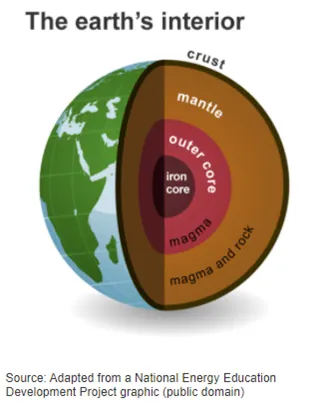
Deep within the Earth is a hot, molten iron core. As you get closer to the surface, the temperatures moderate until you reach the surface air temperature. If there are cracks, hot springs or volcanoes bringing fluids to the surface, you can use that to heat or run a turbine and create power. Otherwise, you can drill down 10 feet or more and get to a zone with a constant 54 degree temperature. You can use that constancy to heat and cool your home, office or other buildings.
How do we get from underground temps to cozy buildings?
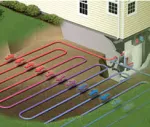
You have to drill underground, set some water pipes in place, then bring the loops of water up through a heat pump. The heat pump can cool your building in the summer months and warm it in the winter.
Horizontal or vertical? A feasibility study would tell us which arrangements would be best for which locations.
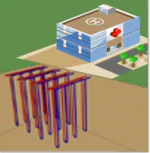
Geoexchange – moving energy back and forth from ground heat to a comfy home or business …
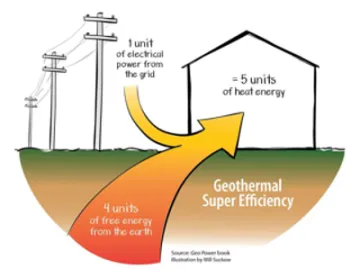
Compared to other technologies, geoexchange is much more efficient, with minimal carbon footprint
Conventional HVAC systems move 70-98 units of energy for every 100 taken in, wasting 2-30 units of energy in the process.
A geoexchange system moves 300-600 units of energy for every 100 units of power used – no waste, in fact you get a net gain of 3-6 times the energy used! And if those 100 units of power are solar- or wind-generated, the carbon footprint is nominal.
And if you network the buildings, it gets even better …
- Achieve economies of scale in drilling, digging, installation So – it costs less!
- Energy not needed in one home or building is available to others So – it costs less!
- Energy not needed by any building is stored in the ground for later So – it costs less!
- Unused heat in summer is stored in the ground for use in winter So – it costs less!
- A large project could be done cooperatively with the City, PGW and others So – it costs less!
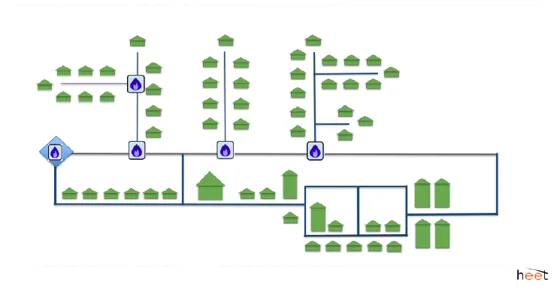
So that’s our vision
- ground-source heat-pumps for geoexchange wherever feasible,
networking them together where possible, - the project done with PGW as the managing partner if we can achieve agreement
- All in order to become more sustainable, bring about more climate justice and help Philadelphia achieve its climate goals.
Do you want to know more about geothermal? We offer more detail here.
Additional Resources
More about geothermal
Want to know how a heat pump can convert 50 degree ground temperatures into comfortable heat and comfortable air conditioning for your home or building?
In less than four minutes, watch This Old House describe exactly that.
Did you know that geothermal can help regulate humidity as another free benefit?
Geothermal heat pumps remove excess humidity from the air, allowing it to condense and drain away. The result – lower humidity, which can mean a more comfortable space. It also means less bacteria and mold, so your home or building feels cleaner, fresher, and has fewer allergens in it. People with asthma will stay healthier. And there is some evidence that COVID transmission may be inhibited by keeping the humidity in a moderate range – see these two articles from the Washington Post and from Yale News.
Do you know who else is going geothermal?
The Queen of England! She put geothermal heating and cooling into her favorite art gallery in 2002, and it worked so well that she had it installed in Buckingham Palace also.
President George and Laura Bush rely on geothermal for their 1600 acre ranch in McLennan County, Texas. This helps them use 75% less energy than the average American home, even though located in one of the hottest parts of the country.
George Lucas recently installed geothermal at Skywalker Ranch, where much of the work for the Star Wars movies is carried out.
Microsoft is beginning to install geothermal on their campuses. Google’s new headquarters campus has geothermal, as well as Delta American’s headquarters and a major IKEA center in Colorado.
New housing developments in Austin, Texas and Sydney, Australian rely on geothermal, while several high-rise apartment and condo complexes in Brighton, Colorado and Toronto, Canada have built or retrofitted them in.
Colleges around the country have gone geo, including Allegheny College in Pennsylvania, Stockton University in New Jersey, Oregon Institute of Technology, Carlton College in Minnesota, Ball State University in Indiana and the University of Minnesota Bee and Pollinator Center.
And right here in Philadelphia we have years of successful geothermal installations at Bartram’s Garden, Kensington High School, the Police Tactical Training Facility and the German Society of Pennsylvania.
How many people use geothermal in their homes and buildings?
Only about 1% of the homes are currently heated or cooled by geothermal today – but we expect this to grow significantly over the next decade. Smart homeowners, school and hospital administrators and large commercial and industrial business people everywhere are beginning to bring geothermal into their plans for the future.