By Jill Stegman
Whenever I walk on the beach these days, I find myself filled with an ominous foreboding.
As much as I try to look away, my eyes are drawn to dead birds lying along the shoreline—Common Murres among them. Sometimes there is one. More often there are several, their black-and-white bodies lying in the sand among driftwood, seaweed, and the other things the ocean has left behind. I have walked past dead birds before, knowing that death is part of nature. But seeing so many of these birds is tragic.
I find myself wondering what happened to them. Were they simply birds that did not survive the hazards of a difficult life at sea? Or is something changing in the ocean that made it harder for them to find enough food?
The California Department of Fish and Wildlife (CDFW) has been investigating an increase in dead and debilitated seabirds, including Common Murres. Most of the murres examined have been young birds, severely emaciated. CDFW says starvation has been the primary cause found so far, but the investigation is continuing because other factors may be involved, including warmer water temperatures.
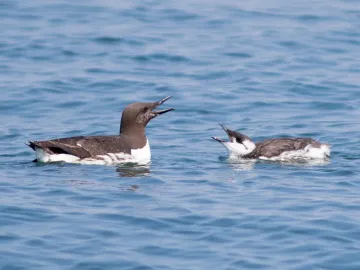
The small fish murres eat depend on even smaller organisms, including zooplankton. When the ocean warms substantially, the entire food chain can change. In the 2014–2016 North Pacific marine heatwave, researchers found that warming reduced phytoplankton and altered the zooplankton community, favoring less nutritious species. At the same time, warmer water increased the metabolic demands of forage fish, meaning they needed more energy. The result was less food of lower quality for the predators that depended on those fish.
There is another problem. When prey becomes harder to find, a murre may have to spend more time and energy searching and diving for it. For an adult, that is difficult enough. For a young bird, the margin may be much smaller.
Eventually, a bird can burn more energy looking for food than it takes in by eating it. That is how a change in ocean temperature can work its way through the food web and end with a starving seabird on the beach.
Scientists have not established that this is what is causing the current mortality in California. They are still investigating. The mechanism has been documented during previous marine heatwaves, but that doesn't mean the same chain of events is happening now.
That uncertainty makes it harder to dismiss the birds.
What saddens me most is knowing that many of the birds I see may have been young. Some may have had years of life ahead of them. Common Murres can live for decades; one documented bird lived more than 26 years. Their lives may have ended not because of some dramatic event we could see, but because they could not find enough food in an ocean they depend on completely.
The Common Murre is a bird of two very different worlds. It comes ashore to breed, often on crowded cliff ledges where thousands of birds may nest close together. But its life is really tied to the ocean. It feeds by diving underwater for small fish and other prey, sometimes disappearing beneath the surface for surprisingly long periods.
Murres raise their young in a remarkable way. The chick remains on the cliff for about a month, growing rapidly while its parents bring it food. Then comes the part that has stayed with me.
At about 35 days, the male parent leaves the cliff and goes down into the water. From there, he calls to the chick, encouraging it to make its first leap. The young bird leaves the only secure place it has known and drops hundreds of feet into the ocean.
The father and chick then remain together at sea for a short time. The father feeds the young bird and helps it learn how to find food and survive in an environment completely different from the nesting ledge. Then the young murre is on its own, traveling with other murres in search of food.
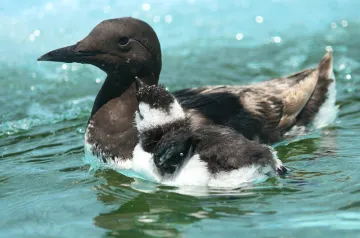
Wildlife organizations also report that male murres will adopt orphaned chicks and teach them the basics of survival. This is unusual in bird communities.
There is no long period of dependence. The transition is remarkably quick. A bird that only weeks earlier could not survive without its parents is suddenly living in the open ocean.
The real miracle of the murre is in the water. Its small size and narrow wings make it an awkward flier, but underwater, those wings become powerful oars. The murre can dive hundreds of feet into the cold Pacific in search of anchovies, sardines, and other small fish.
A sobering precedent for the mass starvation occurring in 2026 exists. During the extraordinary 2014–2016 marine heatwave in the North Pacific, enormous numbers of Common Murres died from starvation across the region. About 62,000 dead or dying murres washed ashore from California to Alaska, and researchers estimated that the actual mortality approached four million birds because most birds that die at sea never reach shore.
But California's current situation should not simply be called another Alaska.
The warmer water could be another temporary ocean event. Or it could be part of the longer-term changes occurring in the marine environment as the climate warms. Scientists know that marine heatwaves can disrupt seabird food webs in several ways, but the mechanisms vary from one event and ecosystem to another.
For now, I am left with the birds on the beach.
I know that death is part of nature. I know that young seabirds often face high mortality. Still, seeing so many dead murres evokes a profound sense of futility. The murre is amazingly well suited to life. But what makes its predicament heartbreaking is how well equipped it is to live.
Perhaps that is because the murre's story is so specific, yet representative of all wildlife. A chick makes that frightening leap from the cliff. Its father meets it below and gives it a brief education in the sea. Then it sets off into a vast ocean, dependent on finding enough food to keep going.
The current situation in California serves as a stark reminder of how closely resilience and vulnerability coexist in nature—and highlights the unsettling reality that we do not yet know which trajectory we are witnessing.