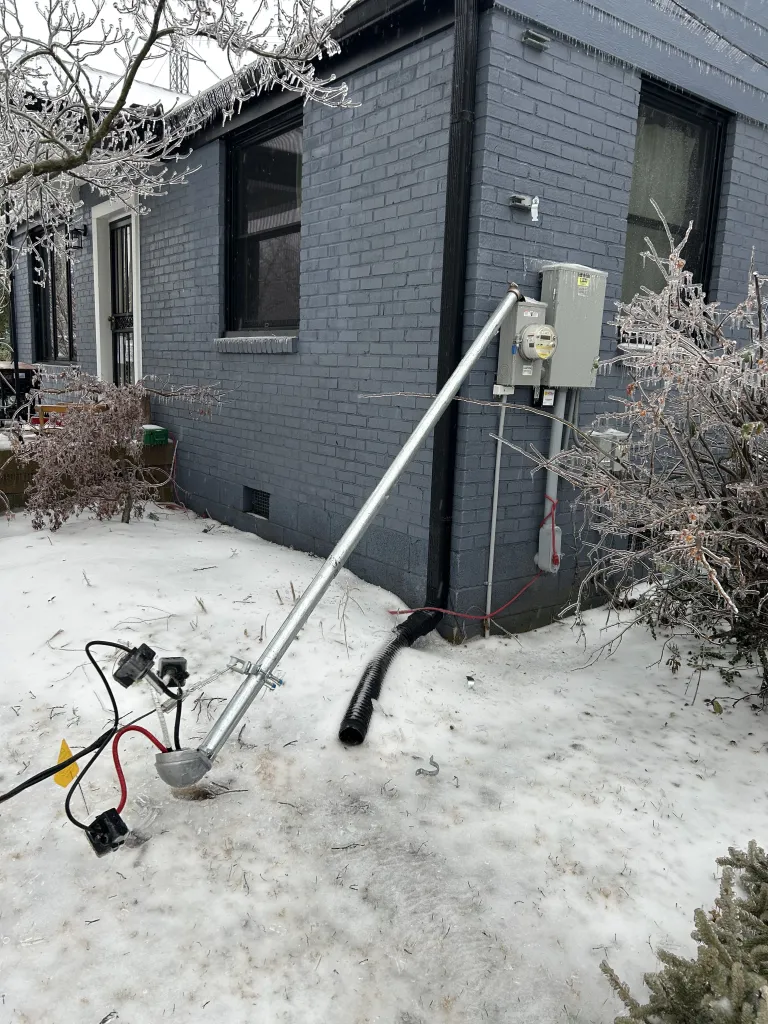
When the service mast was pulled off my house during Winter Storm Fern, it was a small-scale example of what happened across Middle Tennessee. My East Nashville neighborhood went dark Sunday morning, and as I share this almost two weeks later, some of my friends and neighbors still don't have power. But here's what didn't fail at my house: my Google Fiber Internet Line buried underground.
A friend in Brentwood never lost power and invited my family to stay with them. Their newer development has underground lines - no chaotic tangle of wires overhead, no aggressive tree trimming that leaves neighborhoods looking scarred. Just reliable power during the exact same storm that left tens of thousands of Middle Tennesseans in the dark. But we couldn't get there. We were trapped, surrounded on all sides by downed power lines blocking the roads.
The usual response from utilities and elected officials focuses on cost to taxpayers. But let's talk about the real costs. Schools closed for over a week. Businesses shuttered. Families burning through savings on hotel rooms or spoiled food. Emergency services delayed by impassable roads. Those are costs too - they just don't show up on a utility balance sheet.
And here's what frustrates me most: we're having serious conversations about spending billions on new methane gas infrastructure to power data centers while our existing grid can't keep Middle Tennessee families warm during an ice storm. We're prioritizing new generation for tech companies when the problem isn't generation at all - it's that the grid we count on is literally falling down around us.
I've heard from Sierra Club members across Middle Tennessee with solar panels and battery storage who didn't lose power during Fern. Their lights stayed on. Their heat kept running (some with geothermal to boot). They invested in resilience, and it paid off exactly when they needed it most.
We have two paths forward. We can keep patching an aging above-ground system, watching the same neighborhoods lose power every time weather gets rough, and hoping for the best. Or we can do what new developments already prove works: bury our lines, invest in distributed solar and storage, and build a grid that actually delivers the reliability Middle Tennessee families need to keep safe, sound and send their kids to school.
There is an environmental argument to be made about the frequency and severity of the storms causing destruction in Tennessee. We can’t keep our heads in the sand to our changing reality. But this is also about economics and competence. Other cities have figured this out. Some developers have figured this out. It's time for Nashville and Middle Tennessee to catch up.
The question isn't whether we can afford to invest in grid resilience. After watching Winter Storm Fern, the real question is whether we can afford not to.