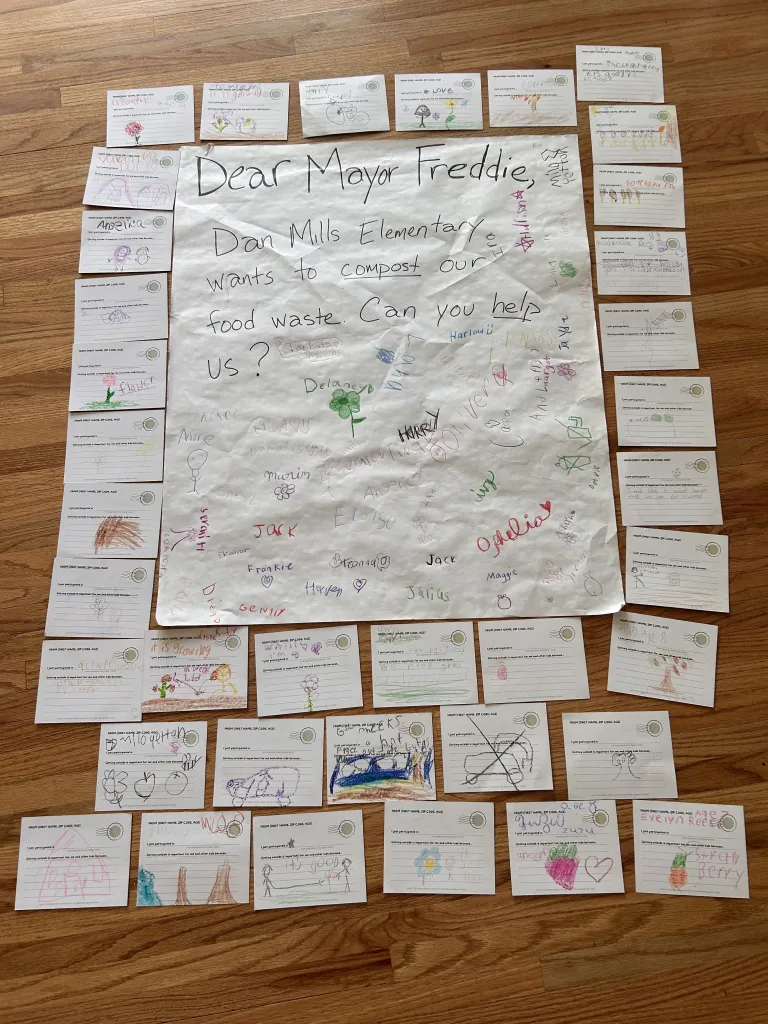
Letters, drawings and postcards from Nashville Public Schools 2nd Graders
Thank you to Karen McIntyre for her sustaining efforts to turn food waste into a resource in the Nashville Public Schools. Today I shared this letter along with drawings, postccards and a banner from over 100 2nd graders at a local elementary school in Nashville.
Below is our letter to Mayor O'Connell
Mayor Freddie O'Connell
Metropolitan Government of Nashville and Davidson County
1 Public Square, Suite 100
Nashville, TN 37201
mayor@nashville.gov
Dear Mayor O'Connell,
The Tennessee Chapter of Sierra Club writes you representing Nashville residents, educators and environmental advocates to urge you to include Dr. Adrienne Battle's $580,000 sustainability proposal — covering a district sustainability officer, composting on all MNPS campuses and LEED training for teachers — in your 2026-27 operating budget proposal. We ask you to make this commitment clear at your April 29 State of the City address.
Nashville faces a waste crisis — and schools are part of the solution.
Metro's contract with Republic Services expires in 2027. Middle Point Landfill, which currently receives roughly 1,800 tons of Nashville's trash every day, is projected to reach capacity around 2029. When Nashville must ship waste to facilities further away, disposal costs will rise sharply. Composting organic waste is one of the most cost-effective tools available to delay that day and reduce the city's long-term disposal burden. Starting that infrastructure in schools — where composting is already part of the 2nd grade science curriculum — is smart, scalable and fiscally responsible.
Five reasons this investment pays off:
- Student outcomes improve. Schools with sustainability programs see reduced absenteeism, stronger academic performance and better student mental health. Students who participate in solving real problems become more engaged citizens.
- Composting produces value, not just waste. Turning food scraps into healthy soil supports gardens, biodiversity and local food systems — while keeping organics out of landfills where they generate methane, a greenhouse gas 40 times more damaging than CO2.
- Redirecting untouched food saves money and feeds people. Food pantry partnerships for unconsumed cafeteria food reduce waste disposal costs, lower the district's landfill contribution and address food insecurity — a triple win for taxpayers.
- Sustainability lowers operating costs over time. Energy efficiency, waste reduction and LEED-trained staff reduce the district's long-term overhead. This is an investment with measurable returns.
- MNPS made this promise in 2020. Dr. Battle's proposal finally creates a path to fulfilling it. Funding it in the 2026-27 operating budget sends a clear message that Nashville keeps its commitments to students and community.
We urge you to champion this investment and stand ready to support this effort and look forward to seeing Nashville lead on school sustainability.
Respectfully,
Pat Cupples, Director
Sierra Club Tennessee Chapter