Earlier in April, Texas Water Development Board (TWDB) released the Draft 2027 State Water Plan for public comment. This is a Phase I version – sometimes referred to as the “skinny” version – which simply means that it’s an early draft. TWDB put it out sooner than usual to use it as a guide for water funding decisions that the Board will need to make this summer. In other words, think of this document as a working draft, which lays out main ideas and priorities, but it’s not the full picture yet. A more complete version (Phase II) – or the “fat” version – is expected later this year (before January 2027), with deeper analysis and additional context.
But for now, let’s take a look at what’s already in this draft and what it means for our water…
What’s In the Draft Plan
If you’re new to the State Water Plan and the regional water planning process, we break it down here.
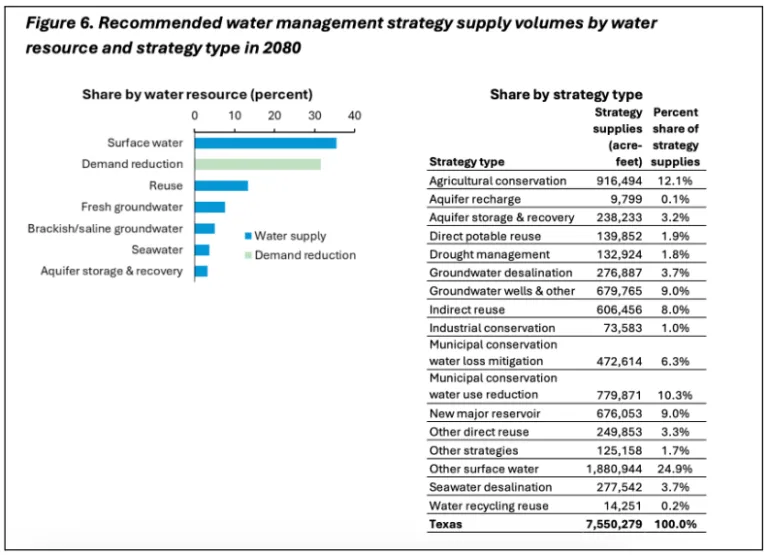
The newly released draft plan includes about 6,700 recommended strategies and 3,000 specific projects, from water conservation to new water supplies like reservoir construction and seawater desalination – all aimed at securing additional water for Texas.
Notably, about 30% of the projected water supply in 2080 will come from water conservation and reuse – the most affordable and reliable water strategies, especially in drought. Together, all recommended strategies and projects are expected to provide about 7.6 million acre-feet of additional water per year by 2080.
If you want to see specific water management strategies in your area, you can explore the interactive State Water Plan – just click on your region on the map.
What’s The Price Tag?
So what does it take to make all of this happen? The answer is $174 billion! More than double the cost of the previous state water plan. According to TWDB, this increase reflects rising construction costs, a longer planning horizon, major new projects, and the growing complexity related to finding new water supplies.
It's important to note that this cost doesn’t account for maintaining or repairing existing infrastructure, something that could also help make more water available.
This cost also assumes that all recommended water management projects and strategies are implemented. In reality, this is very unlikely, because some projects may not move forward (e.g., due to feasibility issues or public opposition), and some may become unnecessary depending on what gets built first.
At the same time, the stakes are high. If these strategies aren’t implemented, TWDB estimates that a drought could leave about 1 in 4 Texans without enough water, and the economic losses could reach up to $177 billion a year in the next 50 years.
The Elephant In the Room: Are We Planning for Data Centers?
It’s no secret that data centers are growing very fast in Texas, and so is their water use. According to the recent report by the Houston Advanced Research Center, data centers already use about 25 billion gallons of water each year in Texas, roughly the annual water use of about 270,000 Texas households. This number could reach 161 billion gallons annually in less than 5 years and would account for up to about 2.7% of the state’s total water use.
This is undoubtedly an important source of water demand that requires closer attention as we plan for our water supplies. However, looking at the 2026 regional water plans that have informed the development of the draft 2027 State Water Plan, it’s unclear how this growth is reflected in the current water projections or where it shows up (or will show up) across different water use categories.
Whether it’s already accounted for or not, this high-impact growth is happening fast in various regions of the state, and it’s something that deserves a clearer place in how we plan for water.
What Is the Draft Water Plan Asking the Texas Legislature to Do?
In addition to the recommended water management strategies and projects, the draft water plan includes a set of recommendations to the Legislature. These are areas where action is needed to move the identified water management strategies forward. Among the 10 legislative recommendations are issues such as:
- Protect certain rivers and streams of unique ecological value from future reservoir development: Alamito Creek in Presidio County, Black Cypress Bayou in Marion and Cass Counties, Black Cypress Creek in Cass and Morris Counties, Pecan Bayou in Red River County, and Terlingua Creek in Brewster County
- Designate four sites proposed for reservoir construction so they remain available for water supply development: Coryell County Off-Channel Reservoir, Millers Creek Off-Channel Reservoir (aka Lake Creek Reservoir, George Parkhouse Reservoir I (south), and George Parkhouse Reservoir II (north).
- Remove the requirement for interregional planning councils to simplify the planning process (the council’s role has been fulfilled or replaced by other efforts, making it duplicative)
- Improve groundwater planning by providing groundwater conservation districts (GCDs) with better modeling tools and guidance, and by removing confusing metrics that can distort the data about how much groundwater is actually available
- Require to explicitly account for drought conditions in groundwater management, so aquifers are managed more realistically
- Develop a single statewide groundwater well-identification system to connect groundwater data across agencies and improve planning
- Develop a standardized tool to assess socioeconomic impacts of groundwater management decisions with the goal to ensure that these impacts are sufficiently considered in decision making
- Redefine the role of TWDB in interregional conflict identification and resolution to focus only on overallocation of water
- Develop tools to better assess the long-term, cumulative socioeconomic impacts of water shortages, especially in fast-growing areas of the state
- Remove requirement of infeasible strategy assessment amendments, allowing regional water planning groups to address feasibility updates in the next planning cycle
What You Can Do Next
The draft state water plan is available for public comment until 5 p.m. on May 29. Anyone can submit comments and express concerns via this online form.
There will also be an opportunity to speak directly to the Board at a public hearing on May 27 at 1 p.m. You can join either in person (Room 170, Stephen F. Austin Building, 1700 North Congress Avenue in Austin) or virtually. Both options allow you to provide comments, however, you’ll need to register in advance. For more details, please visit TWDB’s website.