In the first part of this blog series, we addressed shorter and longer-term ERCOT load demand forecasts. But how are they related to transmission? It’s a factor but a bit more complicated. The LTDEF is used as part of the Regional Transmission Plan, which is produced each year.
What is ERCOT’s Regional Transmission Plan (RTP)?
Annually, ERCOT produces an RTP to comply with national and state planning rules, providing a six-year roadmap for grid improvements to address ERCOT System transmission needs. In short, this roadmap identifies where new transmission lines and upgrades are needed across the ERCOT Region. The RTP builds a comprehensive transmission “highway and road” plan for the future of the Texas grid. The RTP is the result of a coordinated planning process performed by ERCOT’s Grid Planning department with extensive review and input by Transmission Planners (TPs) and Transmission Owners (TOs) registered with North American Electric Reliability Corporation (NERC), and other stakeholders.
2024 RTP Transmission Demand
Two things happened in 2024 that fundamentally changed the scope of transmission projects. First, was the unbelievable rise in proposed large loads, first led by bitcoin and cryptocurrency projects, and then, data centers and AI facilities, the rise in future demand immediately made ERCOT and Transmission and Distribution Utilities call for the need for a more robust transmission system.
Second, the Legislature passed a new law in 2023 - HB 5066 - that required ERCOT to take direct information from Transmission and Distribution Utilities at face value - essentially including private information on proposed contracts in ERCOT’s demand projections - and to specifically create transmission projects to serve high-growth areas, beginning in the Permian Basin. Thus, rather than approving new transmission solely for reliability reasons, HB 5066 gave a boost to transmission projects meant to serve high growth areas. The bill was supported by major oil and gas companies and associations and utilities. The Sierra Club did not support or oppose the bill, but attempted to get some provisions to protect consumers from increasing costs.
The bill required ERCOT and the PUCT to develop a Permian Basin Reliability Plan, which they did, but ERCOT and the PUCT went beyond the more narrow confines of the plan to produce the TX 765-kV STEP plan to address the current and future transmission needs in the ERCOT Region.
ERCOT’s Strategic Transmission Expansion Plan (766 kV Plan)
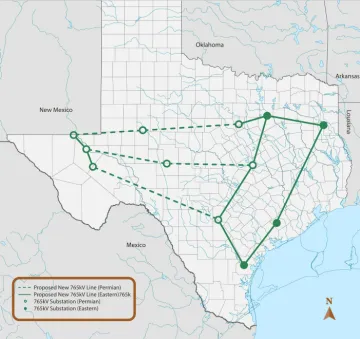
The following transmission projects were identified as part of the overall 765-kV STEP plan:
- Three 765-kV Extra-High Voltage (EHV) electric transmission lines into the Permian Basin area as identified by the Permian Basin Reliability Study. In April 2025, the PUCT approved these lines, known as Permian Basin Import Paths.
- Two 765-kV EHV transmission line projects to connect the western and eastern loop point-to-point electrical connections to the RPG for review.
- Western Loop: Oncor and American Electric Power (AEP) Drill Hole to Sand Lake to Solstice 765-kV Line Project
- Eastern Loop: AEP , CPS Energy, Oncor, and CenterPoint (CNP) Texas 765-kV STEP Eastern Backbone Project
On December 9, 2025, both the western and eastern loop projects passed through the RPG review process and were endorsed by ERCOT’s Board of Directors. The projects will now return to the PUCT to be evaluated for CCNs. The figure above shows the proposed western and eastern loop point-to-point connections.
However, just because a project has been identified does not mean it will get built. Virtually all projects must go through the Regional Planning Group process. Depending on the cost and type of transmission project different projects have a more robust approval process.
What is the Regional Planning Group (RPG)?
The RPG is a membership-based group led by ERCOT and is responsible for reviewing and providing comments on Transmission System Providers -proposed transmission projects out of the RTP or other proposed transmission projects. ERCOT works directly with RPG members to assess transmission needs and identify and implement solutions, address potential transmission constraints, and facilitate interconnecting new generation resources to meet the load demand needs. Participation in the RPG is required of all TSPs that operated within ERCOT but is open to all Market Participants (MPs), consumers, other stakeholders, and Public Utility Commission of Texas (PUCT) Staff.
Any member of the public can attend RPG meetings and provide comments. Unfortunately, most RPG meetings held in person and online are dominated by traditional stakeholders. Nevertheless, they are open to the public and any member of the public can participate in the discussion and even submit written comments on a proposed project.
Information about RPG meetings can be found here.
Regional Planning Group and Transmission Projects
From the RTP , utilities outline their proposed transmission project plans for RPG review and approval. They are required to address any reliability issues identified in the RTP to maintain the system reliability defined under planning criteria. Transmission projects are evaluated based on reliability needs and economic benefit. They must be shown to meet either or both, and they must be measured against other options. Once the RPG receives and reviews the proposed transmission project plans, projects are then designated one of the four tier levels shown below based on the scope and cost of the project.
ERCOT’s Tiered Transmission Projects
- Tier 1 ($100 Million+): Projects with an estimated capital cost of $100 million or more, or those requiring new right-of-way. These require an ERCOT Independent Review and endorsement by the ERCOT Board of Directors
- Tier 2 (Under $100) Million with CCN): Projects costing less than $100 million that require a Certificate of Convenience and Necessity (CCN) from the PUCT.
- Tier 3 (Under $100 Million, No CCN): Projects costing between $25 million and $100 million that do not require a CCN.
- Tier 4 (Neutral Projects): Minor, routine upgrades such as radial additions, rating changes, or equipment upgrades with minimal market impact. These projects do not normally require PUCT approval.
Long-Term Transmission Projects
While the RTP and RPG process are the main transmission planning processes which involve transmission projects in the near-term or medium-term (five to six years), ERCOT also engages in longer-term planning.
Long-Term System Assessment (LTSA)
Known as the Long-Term System Assessment (LTSA), this process evaluates the grid 10 to 15 years out using various stakeholder-driven scenarios (e.g., rapid electrification, various generation mixes) to identify transmission upgrades that will be necessary across multiple possible futures.
The LTSA uses scenario- analysis techniques to assess the potential needs of the ERCOT System up to 15 years into the future. The role of the LTSA is to guide near-term planning decisions by providing a longer-term view of system reliability and economic needs. The 2024 Long-Term System Assessment (LTSA) evaluated the capacity, reliability, and economic needs of the regional power grid over a 10- to 15-year horizon through 2039.
For the 2024 LTSA process which the Sierra Club participated in, ERCOT ended up looking at three major scenarios: current trends, high load growth and environmental regulations focused mainly on if major carbon regulations were imposed on the grid. ERCOT has already begun work on the 2026 LTSA and produced a current trends analysis. They have been holding meetings through a separate committee called SWAG, the Supply Analysis Working Group. The next meeting is.
Report on Existing and Potential Electric System Constraints and Needs
Finally, ERCOT also produces a kind of summary document - Report on Existing and Potential Electric System Constraints and Needs - that attempts to identify any issues in transmission or other issues that should be addressed. It helps identify both reliability and economic issues - like congested transmission lines - which impact the grid.
Strategic Transmission Expansion Plan and Permian Basin Reliability Plan
The decision to authorize three separate 765 kV lines as part of the Permian Basin Reliability Plan plus two separate eastern lines as part of the larger STEP was a major departure since it makes the first time that these larger transmission lines have been authorized in Texas. The decision was driven both by the specific need to create import paths to the Permian basin but was also influenced by the major increase in demand from data centers and other large loads.
The price tag is massive - totaling more than $33 billion to build all five lines plus associated equipment.
All five lines must not only be approved by ERCOT but also by the PUCT as the utilities are required to obtain a Certificate of Convenience and Necessity. All five lines are either already being contested by different stakeholders or expected to be, through a contested case hearing process and all five lines are in different stages.
Legislator Engagement
The lines are controversial because of the size and cost, the speed with which they have been approved and finally the routes. Several of the lines cut through sensitive lands, go right by parks, cross rivers and streams and impact farmland and other private property. While Sierra Club has not sought to intervene in the transmission line projects, we have filed comments making suggestions about avoiding certain areas such as our recent comments on the Big Hill to Bell East line which cuts through much of the Hill Country and in particular would impact the San Saba River which is subject to flooding.
Recently, a number of mainly conservative legislators submitted a letter calling for a pause in the development of all of the 765 kV lines arguing the legislature may want to opine on the process. Essentially the legislature had previously passed legislation that transmission projects should be decided within 180 days but these transmission projects are so massive and so long they are different from the “normal” processes. It is unclear whether the letter would actually have an impact since the three lines that most concern legislators are already in process but it is very likely that next session there will be legislation filed about creating a more robust and participatory process for larger transmission lines.
It should be noted in addition to voicing opposition to building all three import lines, the letter suggests instead prioritizing fossil fuel generation closer to the load in West Texas. While Sierra Club appreciates the need to take time to consider the build out of these massive lines, we do not believe the solution ultimately is doubling down on massive new gas plants!
Here’s the main part of the letter:
It is our understanding that the Permian Basin Reliability Plan can be successfully executed without the immediate construction of all proposed Import Paths. In fact, if the strategy were to prioritize dispatchable energy generation within the Permian Basin, closer to the fuel source, it could provide greater long-term grid reliability for Texas than relying primarily on large-scale import path transmission projects. It is our concern that increasing transmission capacity without increasing energy generation falls short of the solutions discussed in the aftermath of Winter Storm Uri. In fact, it was made abundantly clear that Texas needs more dispatchable energy generation and prioritizing transmission of energy produced by renewables does nothing to address a significant problem in the mix of electrical generation we currently have in our state.
In essence, the legislators are arguing that the lines are not really needed and that they are really being built to help move renewable energy, and that instead more gas plants should be built. Like all ERCOT issues, these issues are complex, interconnected and not easy to digest but Sierra Club agrees that taking more time on such a big decision is important, but renewable energy is not the problem but a needed solution to our grid crisis.
Cost Concerns
It’s important to note that Texas has a unique electricity market where generators participate in a market and assume the risk of either earning money or not - the risk is on them - but transmission is different - not only does everybody pay for transmission but the utilities that build it get a guaranteed rate of return that is ultimately approved by the PUCT.
Currently, transmission costs are charged as a percentage of the total load of a customer at the four highest ERCOT peaks over the four month summer period (June - September), often referred to as the 4 CP method. Analysis conducted by the PUCT has shown that this methodology tends to put more of the cost of transmission onto the back of residential customers, because they have less ability to lower their energy use during hot summer peak days. In fact, some large loads can completely avoid transmission costs by anticipating 4 CP events and coming off line, in essence putting that cost onto other consumers.
If the PUCT does not change this methodology, the $30 + billion dollar Strategic Transmission Expansion Plan projects could be borne mainly by residential consumers, even though many of these projects will largely serve the oil and gas industry and data centers, based on the demand growth.
Legislated Transmission Allocation Methodology
However, in some good news, as part of a bill passed last session - SB 6 - which deals with how large loads interconnect to the grid - the law not only requires the PUCT to establish new criteria for integrating large load but requires the PUCT to assess the transmission allocation methodology and consider a change. Recently, the PUCT invited comments on changing the methodology and many stakeholders - including the Sierra Club - suggested major changes. Specifically the Sierra Club advocated that the PUCT change from a 4 CP of 15 minutes to a 12 CP for one hour plus an energy use factor, as well as a required demand charge for any large loads. PUCT staff recently came forward with a proposal that is similar to the Sierra Club proposal, although not quite as beneficial to residential consumers.
Under the PUCT proposal the 15-minute 4 CP charge would be replaced with a 30-minute 12 CP allocation, plus for any large loads an additional demand charge. In essence, such a system would assure that large loads could not escape paying for transmission, and based on an analysis conducted by the PUCT it should lower the total amount charged to residential consumers by some 10 percent.
On June 18th, it is expected that the Commission will adopt a new methodology for further comments from the public. The Sierra Club will be submitting comments and inviting our members and allies to also weigh in over the coming month. The proposal will be submitted in a new project called Project 58000: Rulemaking to Update Wholesale and IOU Retail Transmission Cost Recovery in the ERCOT Region.
What’s Next At the PUCT
The PUCT probably won’t be ready to adopt the actual interconnection standards for large loads over 75 MWs, as required by SB 6, but it could be soon. Under Project 58481, PUCT has already proposed that large loads pay a large upfront fee of $50,000 per MW, which could be reimbursed depending on the ultimate costs of the project, and meet other criteria that are being closely watched by many stakeholders. While the PUCT will not be ready to adopt a final rule on June 18, a final rule is expected by September at the latest. All documents related to that project can be found here.
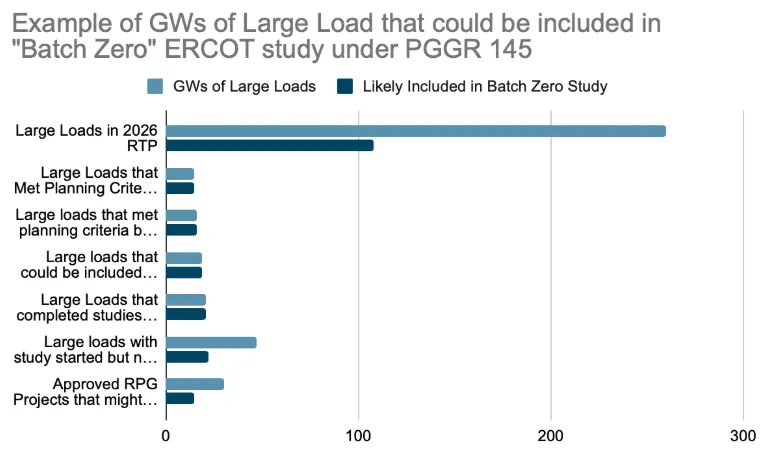
What the PUCT is expected to approve on June 18th is ERCOT’s Planning Guide Revision Request 145, which recently was approved by the ERCOT board. That is the new planning guide that establishes a batch study process (known as Batch Zero) which determines which of the over 280 GWs of proposed large loads wanting to come to Texas will actually be studied for potential incorporation into our grid over the next several years. Because PGGR 145 does include guardrails and timing issues on when large loads conducted studies or posted information and financial assurance, ERCOT estimates that rather than 260 GWs of potential new loads, the number will be somewhere around 100 GWs of new loads. This does not mean that all 100 GWs would qualify, it just means they would be studied for potential inclusion in ERCOT’s transmission plans.
Once approved, ERCOT would work with the utilities and large loads to conduct the study and come back with a final plan this fall. ERCOT will also begin working on Batch One which would be the next study conducted in 2027 or 2028 for any additional loads that meet new criteria.

Transmission and Offshore Wind
Currently, Texas has no plans to build lines for offshore wind, especially since the current administration has discontinued plans to lease ocean waters for offshore wind development. While an initial lease was held, and one project was approved, that project would have likely been integrated into the grid controlled by Entergy Texas, which is outside of ERCOT and has a different process.
If offshore wind is developed in the future, and assuming no obstacles were put in place, then an existing Transmission and Distribution Utility like Centerpoint Energy or AEP Texas could propose a transmission project to bring offshore wind into the larger ERCOT grid. However, there likely would need to be a conversation about what part of the transmission cost the wind facilities would have to pay since it would be a new transmission line to serve new generators in addition to coastal loads.
Sierra Club is working through the LATS process to see if ERCOT can model how offshore wind might help provide power and assure greater reliability as electric demand along the coast continues to rise.
Public Participation Opportunities
Once the PUCT approves the proposed rules on transmission cost allocation, we will let you know how to participate and some important points to make.
In terms of transmission, the RPG meetings are open to anyone, but once a transmission line goes to the PUCT it becomes a legal process. While anyone can make comments, having the real ability to influence the lines is most effective as an “intervenor” in a hearing. Comments on the Long Term System Assessment can also be made by the public and Sierra Club will be preparing some for the SWAG meeting.