Hyperscale data centers are exactly what they sound like: massive facilities built to handle enormous volumes of data. They support the growing demand for cloud computing, cryptocurrency, and, increasingly, artificial intelligence.
These large-scale operations can house thousands of servers and require complex systems to manage power, data processing, and cooling. Because they operate continuously, hyperscale data centers rely on extensive energy infrastructure and backup generators to prevent downtime and ensure constant access to data.
Some hyperscale data centers are owned and operated by major tech companies like Meta (Facebook), Amazon, Google, and Microsoft. Others are developed by third-party companies that either sell entire facilities to clients or lease space within them to businesses that need large-scale data storage and computing power.
Wisconsin elected officials have actively encouraged data centers to set up shop in the state. In 2023, lawmakers approved a major sales-tax exemption that lets large data center developers avoid paying state sales tax on much of the expensive equipment they install—meaning millions in lost revenue that could have supported public schools, parks, and other essential services.
At the same time, electric utilities like We Energies and Alliant have been recruiting data centers because these facilities use huge amounts of electricity, allowing utilities to justify building new power plants and infrastructure—projects that boost utility profits. This dynamic creates a powerful push to bring in more data centers, even when the public may end up bearing the financial and environmental costs.
Currently, there are no guardrails for data centers, including clean energy requirements, protections for customers of the utilities that will be powering these massive energy users, or limits on water use.
Here are some of the concerns around data centers:
- Data centers use a staggering amount of energy. Just two data center proposals (Vantage data center in Port Washington and the Microsoft data center in Mt. Pleasant) would use as much energy as the entire state of Wisconsin. The Vantage data center would use more electricity than the City of Los Angeles. Using that much energy means Wisconsin utilities will have to dramatically expand power generation. Unfortunately, we are seeing several coal plant closures being delayed and new methane gas plants being proposed and approved.
- Data centers consume an enormous amount of water. Data centers use an enormous amount of water to keep their servers cool—often millions of gallons per day for a single facility. As these centers multiply, their combined water demand can put real pressure on local rivers, lakes, and community water supplies.
- Wisconsinites could be left footing the bill. When a single, massive user like a data center comes online and consumes all the power a gas plant produces, or requires new transmission lines to serve it, all ratepayers share in the costs, even though only one customer reaps the benefit.
Data centers can and should be built in ways that minimize these impacts. Instead of increasing our dependence on fossil fuels, data centers should be powered by new, clean energy sources so that their growth doesn’t exacerbate the climate crisis. Other states have processes in place to ensure that utility customers' bills do not increase once data centers arrive in an area and create a high energy demand.
With the uptick in proposals to build new data centers, everyone is beginning to learn what the benefits and downsides of these facilities are, helping build awareness and the need for protections.
Banding together for protections from data centers
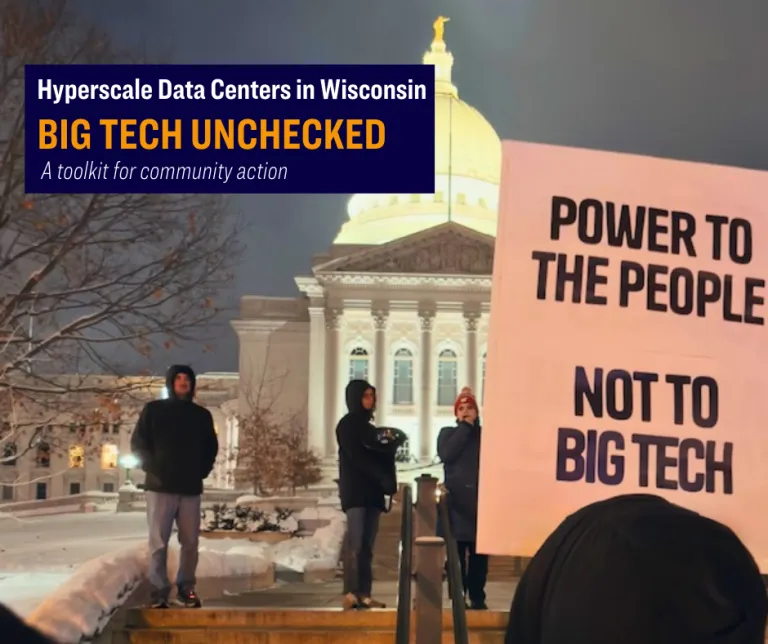
Community members are banding together, asking their leaders to pause proposals while they learn more and calling for protections. Grassroots community groups have formed around proposals for data centers in Caledonia, Port Washington, Janesville, Beaver Dam, Menomonie, and more. In December, the Sierra Club Wisconsin Chapter, Midwest Environmental Advocates, Healthy Climate Wisconsin, and GreenFire released a toolkit to help community groups understand the concerns surrounding data centers, navigate the regulatory process, and know what to ask for to protect themselves from the worst impacts of these proposals.
The Chapter is also working to help ensure customers of Wisconsin’s utilities are protected from seeing their electricity rates rise with the increasing demand on our energy infrastructure. We’re involved in a handful of proceedings at the Public Service Commission (PSC) that would determine how huge customers like data centers, are charged, what considerations should go into setting these rates, and how new infrastructure, like gas plants and transmission lines, should be paid for if they are mostly benefiting the data centers. The first quarter of this year will be critical to push the PSC to make data centers pay their fair share.
Legislation has been proposed by Senator Habush Sinykin and Representative Angela Stroud that would address some of the major concerns about data centers. The legislation would:
- Require quarterly electricity and water usage reports and proposals, as many of the data center owners will not state how much electricity or water they plan to use;
- Requires that the data centers provide good, family-supporting construction jobs if they are going to move forward;
- Require a data center to meet labor standards and use at least 70% renewable energy to be eligible for the tax credit;
- Require all data centers to be LEED certified or the equivalent;
- Require that data center owners pay an annual fee that funds renewable energy, energy efficiency, and low-income energy assistance programs;
Require the PSC ensure large customers like data centers pay their fair share of utility costs.
What you can do
As Wisconsin faces a wave of new data center proposals, communities, advocates, and lawmakers are working hard to ensure that growth doesn’t come at the expense of our climate, our resources, or our monthly bills. With stronger transparency requirements, fair rate structures, and clean-energy standards, we can make sure data centers contribute positively instead of shifting costs and risks onto the public. By staying informed, speaking up, and supporting commonsense protections like those proposed this session, we can guide this industry in a direction that benefits everyone—not just the biggest players.
Here’s what you can do:
- Download the toolkit and learn more about the concerns surrounding data centers and how you can engage in the permitting process.
- Contact your legislators and ask them to support the data center accountability legislation. It’s important that we quickly get guardrails put on these facilities.
- Participate in upcoming events to learn and contribute to the process.
- Join our team working to address the harms of data centers and protect rate-payers from footing the bill. Contact Cassie Steiner at cassandra.steiner@sierraclub.org