What is invasive reed canary grass?
Reed canary grass (Phalaris arundinacea, or “RCG”) is an aggressive, invasive plant that outcompetes and smothers native plants, thus creating monocultures that reduce biodiversity and wildlife habitat. Its dense root system also impacts floodplain services by limiting ground water recharge and reducing filtration of sediments, allowing pollutants to flow into waterways. Southeast Gateway Group (SEGG) is working with Racine Parks, Recreation and Cultural Services (PRCS) and Weed Out! Racine to reduce the RCG population in Colonial Park, a 75-acre gem on the Root River.
RCG is persistent and very difficult to control. It requires mowing and herbicide treatment closely tied to its life cycle, followed by reseeding of appropriate native forbs and grasses. This work requires more than volunteer groups are able to do, but thanks to a Mann Grant from the Wisconsin Chapter, we were able to start on a multi-year, adaptive management strategy.
How did this happen?
Colonial Park is the gem of the City's Parks system. Situated along the Root River in the western edge of the City, it spans 75 acres of woodlands and wetlands, and is home to many native critters, including endangered bats and bird species of special concern. It's a birding hotspot for migrating spring warblers, and offers some of the best trout and salmon fishing around.
After many years of logging and farming, the canopy in Lower Colonial Park (“LCP”) once consisted of native green ash and box elder, along with invasive buckthorn and honeysuckle. High school students began removing those invasives in 1999, and tackled others as they became established. In 2004, the Southeast Gateway Group organized a community project planting natives along the newly installed Root River Pathway. Over time, many community groups removed invasives and planted more natives. But then the emerald ash borer arrived, and we lost all the green ash, making up about 40% of the canopy in the Lower Colonial. The ecosystem dynamics changed, allowing more sunlight, which made invasives grow exponentially. Even several hundred volunteer hours were not enough to keep ahead of the problem. Reed canary grass was particularly difficult to control: we needed professional help.
What's Next?
With the advice of our consultant, we embarked on an adaptive management approach, where each year's plan depends on previous results. Starting in one section of the park, we mowed RCG in mid-summer, and treated regrowth in the fall, with the intent of reducing the RCG population by 95%. RCG is persistent, and retreatment may be necessary. We plan to seed this area with native forbs, grasses and a cover crop once the RCG is sufficiently reduced. Each year we begin a new area of mowing and spraying and seeding...until we reach all of LCP!
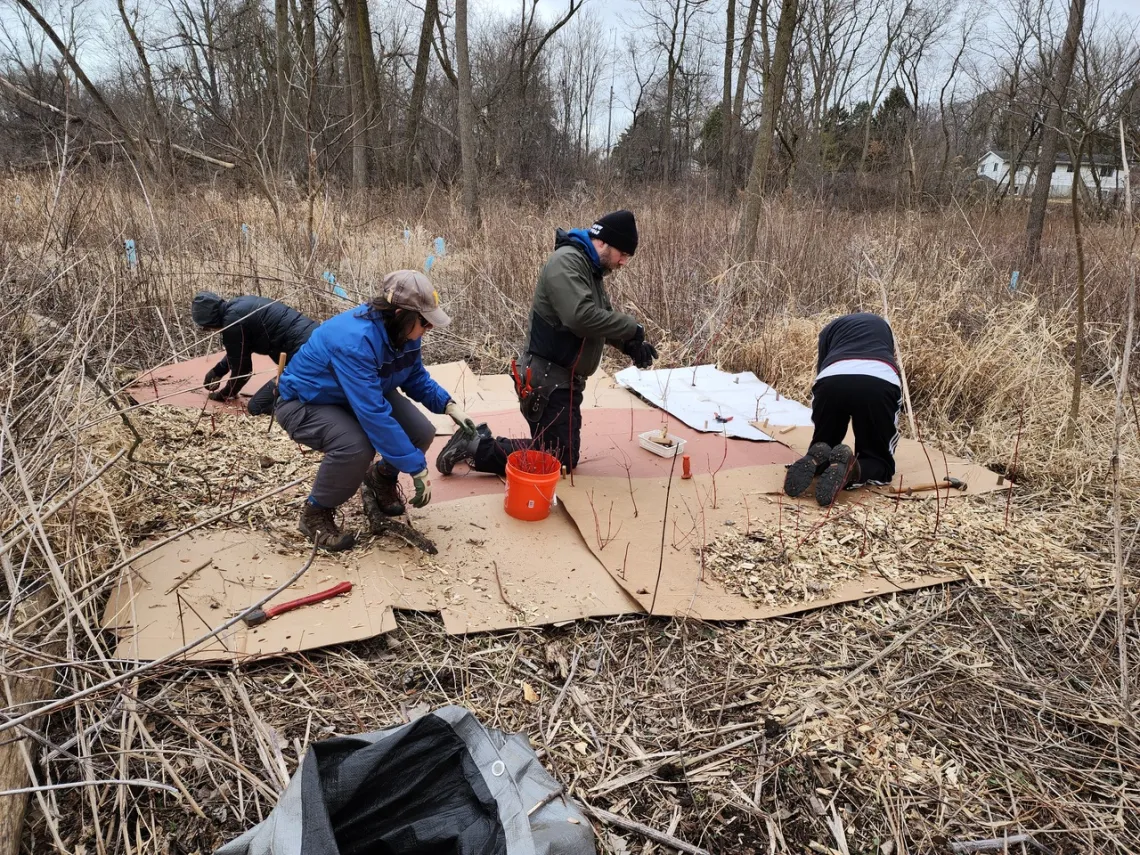
Meanwhile, we are creating shrub thickets in areas where the RCG population is smaller, and mechanical mowing would damage nearby natives. We cut the RCG to ground level, and hand-spray the regrowth about a month later. We then layer cardboard over the patch, and insert live shrub cuttings through the cardboard. When the live stakes take root, we expand our native shrub layer and provide competition for RCG resprouts.
What we are doing is as much an experiment as a recipe. If all goes well and we continue to have funding, we hope to have controlled RCG and reseeded throughout LCP by 2030!