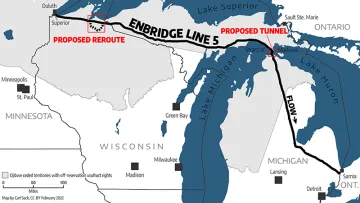
The Line 5 Pipeline transports oil across Wisconsin and Michigan into Canada. It has spilled over one million gallons of oil and is being operated well beyond its intended lifespan. Line 5 runs through the Bad River Reservation, and when easements to operate expired, members of the Bad River Band pushed back, passing a resolution to remove Line 5 from the reservation and Bad River watershed. However, Enbridge, the company that operates Line 5, responded by proposing a reroute of Line 5 that skirts the Reservation and crosses all major waterbodies that flow into the reservation, while cutting through Ashland, Bayfield and Iron Counties. The proposed reroute threatens critical watersheds and has been broadly opposed by the Bad River Band, environmental groups and many members of the public.
In February of this year, Enbridge began clearing the right of way for the Line 5 reroute as the legal case challenging their state permits for the projects continues. Despite the serious concerns raised by the Bad River Band and the environmental groups, Enbridge is proceeding with construction and preparing for the intensive, risky work they’ve proposed.
In May, a Wisconsin circuit court ordered Enbridge to halt pipeline construction at certain locations while it reviews the lawsuit challenging state regulatory approvals. The partial grant of a stay is based on the court’s finding that Enbridge’s eligibility for permits at those locations “may be on tenuous legal footing.” While this process plays out, monitoring Enbridge’s construction activities is critical. The permits they have do not mean that their work won’t leave a trail of lasting damage, as we saw with their construction of the Line 3 pipeline in Minnesota.
A warning from our Neighbors
In 2021, Enbridge completed construction on the Line 3 replacement project – effectively constructing a new pipeline in Minnesota, despite strong opposition. Waadookawaad Amikwag, a group of community members who documented the impacts of Line 3 construction, shared that “Enbridge and their contractors caused extensive and permanent ecological damage by disrupting groundwater and wetlands all along the route,” and that in addition to the threat of an oil spill after a pipeline is operating, “many don’t realize that the pipeline construction process itself can be disruptive to ground and surface water and can degrade key ecosystems.”
During Line 3 construction, Enbridge punctured aquifers along the route and caused frac-outs, which happen when drilling fluid is released, containing mud and chemicals. They altered wetlands, changed the water table, affected water temperatures and more. All of these damages have significant and lasting harm, with some impacts still being felt today.
Enbridge proposes to do the same type of work with the same contractors in Wisconsin – so all we have to do to see what could be possible in the future is look West and learn from our neighbors why it’s so important to prevent this construction from happening.
Enbridge’s Line 5 construction poses threats
Over the last few months, Enbridge’s behavior has raised concerns about the threats Line 5 opponents have warned of for years. Community members are documenting what’s going on at the Watch Line 5 website, where you can find all of the information they’re compiling and find out how you can contribute to construction monitoring efforts. You can see several examples below of the type of work Enbridge is doing – and what’s at stake if they’re allowed to continue.
The proposed Line 5 reroute is 41 miles long and would allow the pipeline to continue operating over the opposition of the Bad River Band, on whose land the pipeline is currently trespassing. Hundreds of thousands of people from those near the Line 5 pipeline to every state in the country have taken action to oppose Line 5 and highlighted the need to shut down the pipeline and protect the Great Lakes, tribal sovereignty and treaty rights, and our climate and environment.
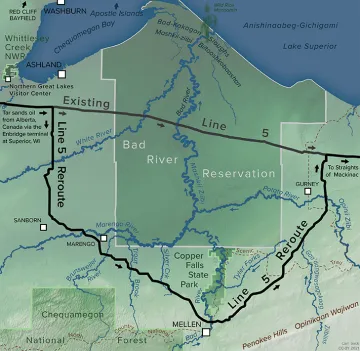
The examples below are loosely ordered by milepost, starting on the west side of the reroute and moving east. You can find a Google Map with the proposed Line 5 route and right of way here, and you can see Enbridge’s detailed site plans here. We encourage you to check out all of the monitoring work here. You can also view a storymap of the proposed reroute, with local history and information here.
Numerous signs mark the route
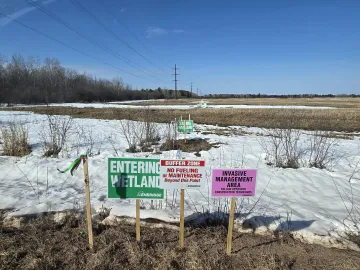
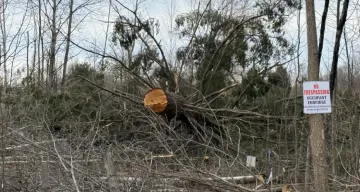
Enbridge has put in numerous signs marking Line 5 construction sites and posting warnings across the whole route. In the images above you can see signs that appeared earlier this year at Weister Road, near the start of the reroute, close to Ashland.
Further on in the route, near Highbridge, you can see another Enbridge sign, which reads in part, “NO TRESPASSING, OCCUPANT ENBRIDGE, VIOLATORS WILL BE PROSECUTED.” Passed and signed into law by Governor Evers in 2019, Wisconsin’s Felony Trespass Law makes protesting more dangerous, making it a felony to trespass or damage property on land “owned, operated, or leased” by energy companies, including pipelines. Industry groups like the American Petroleum Institute and Wisconsin Manufacturers and Commerce supported this bill, and we can see in this case why. In April, the Bad River Band raised concerns about the chilling effect of this law when arguing for a stay of construction in front of Judge Anderson. Ojibwe tribes in the region reserved the right to hunt, fish and gather – the usual rights of occupancy – on the land ceded in the 1842 Treaty with the U.S. Government, and the Felony Trespass Law acts as a deterrent for those rights, infringing on them.
Man Camp Concern
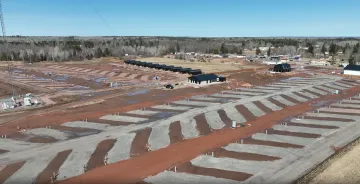
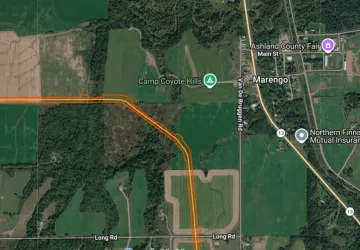
Near Marengo, around Mile Point 13, aerial footage shows construction of new housing units at Camp Coyote Hills, right next to a work site. This raises concerns about the impact of Man Camps and their connection to the MMIR (Missing and Murdered Indigenous Relatives) Epidemic. This year, the Bad River Band designated May 5th as a day of remembrance for Missing and Murdered Native Women and Girls, noting that “more than four in five American Indian and Alaska Native women have experienced violence in their lifetime…with the murder of these women being ten times the national average.” A clear connection has also been drawn between extractive industries and sexual violence. During construction of Line 3 Enbridge workers were arrested as part of a human trafficking sting in Minnesota – after advocates had warned Minnesota regulators that this could happen.
Flooding at the Bad River Crossing
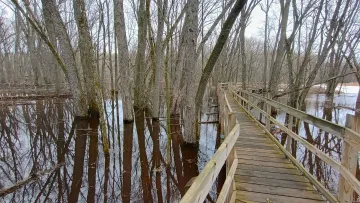
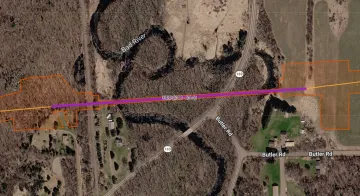
The Bad River, so central to the work to shut down Line 5 and protect the river, watershed, and region, was shown to have flooding at the site where Enbridge plans to use Horizontal Directional Drilling (HDD) to cross it. HDD is a method of installing a pipe without digging a trench – which may sound good until you hear about the negative consequences. As we saw with Line 3 in Minnesota, thanks to the work of dedicated community scientists, Enbridge’s use of HDD to cross water bodies resulted in “frac-outs”, which is the release of drilling fluids containing water, clay, salts and other chemical compounds, sometimes withheld as a “trade secret.” With Line 3, Enbridge reported frac-outs at a staggering 67% of their HDD crossings.
Flooding has also been a major concern in the area, especially in light of the devastating 2016 flood that washed out roads and left many without access to basic necessities like water, electricity and emergency services. Climate change has exacerbated flooding in the region and continued investment in fossil fuel companies like Enbridge will only continue worsen the issue.
This spring, community members also gathered to boil maple sap along the banks of the Bad River at this location.
Tree clearing across the route
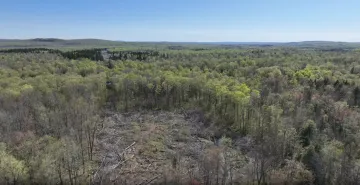
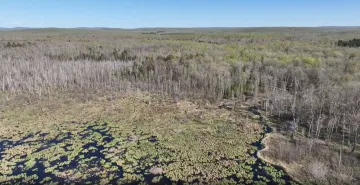
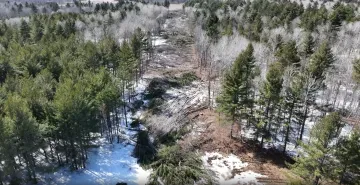
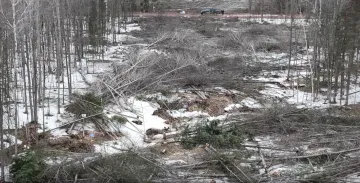
Throughout the span of the reroute Enbridge has cleared trees from the right of way, leaving them strewn across the ground as they moved to do this quickly and remove the trees later. These devastating images can be seen all along the route. As the Bad River Band noted in comments to the Department of Natural Resources, tree clearing, in addition to wetland conversion, blasting, and soil disturbance “all have long term, if not permanent, impacts,” and “old growth trees such as northern white cedar and black ash may not regrow in our lifetimes—if at all.”
Community monitoring also shows a beaver pond near the Tyler Forks river crossing, with lodges visible, raising concerns about impacts to local wildlife, which has regularly come up as an issue over the years.
Equipment yard in action
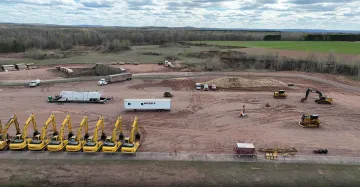
Monitors have noticed equipment yards being set up with materials and machines as Enbridge prepares for additional construction work. In the photo above, taken between Mellen and Gurney, you can see the Michels logo, the construction company that has been contracted to do the reroute work. Michels was a key contractor on the Line 3 project as well, notable for the damage left behind.
Going forward
As Enbridge and regulators continue to ignore the threats of climate change and refuse to acknowledge the economic and environmental benefits of renewable energy, there are many things to grieve. The old growth trees felled for construction equipment, the harm people suffer around man camps, the wildlife the next generation might not know because their habitats were destroyed. The recorded observations of Enbridge’s activity show how much has already been lost and how critical it is to continue the fight against Line 5. We encourage everyone to speak out in opposition to this dangerous project and in support of protecting the lands, waters and wildlife we love.
As we mentioned, this spring a Wisconsin circuit court ordered Enbridge to halt pipeline construction at certain locations while it reviews a lawsuit challenging state regulatory approvals for the Line 5 reroute.
Enbridge is still awaiting some permits, and the Judge will rule later this summer about whether the Department of Natural Resources should not have granted Enbridge permits to move forward.
Across the lake in Michigan, the future of Line 5 continues to be in question, following legal action by Governor Whitmer and Attorney General Nessel to protect the Great Lakes from the Line 5 pipeline. The State of Michigan is now taking public comments on a key permit for Enbridge’s proposed Line 5 oil tunnel through the Straits of Mackinac, a proposal created to skirt Governor Whitmer’s call to shut down the pipeline in the Straits.
Contributing authors: Sabine Peterka, Jadine Sonoda.
Join us on July 7 for an update about what's happening with Line 5.