
A new report from the Sierra Club, Thirsty Power: Coal and gas will leave us high and dry analyzes Wisconsin’s current power generation, the water needed for that power, and the potential impacts on Wisconsin’s water as Big Tech tries to build more data centers across the state. These data centers require enormous amounts of power– and in some cases are prompting entirely new gas plants that will compound water and energy use at peak times.
Summary
The report found, among other things, that:
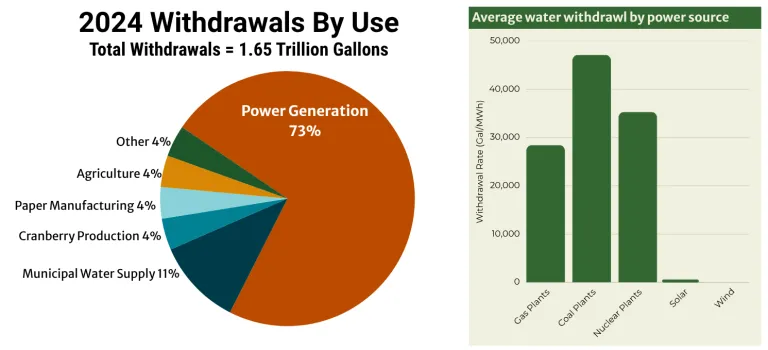
- Wisconsin’s current dirty energy power fleet– including coal, gas, and nuclear plants– withdraws 1.35 trillion gallons of water annually. Meanwhile, solar and wind use so little water that the EIA doesn’t even track their usage.
- This is more than 7 times all of the municipalities in Wisconsin combined, and 18 times more than agricultural irrigation.
- This is more than 7 times all of the municipalities in Wisconsin combined, and 18 times more than agricultural irrigation.
- Five new gas plants, known or assumed to be proposed for data centers, would use 142 million gallons of water a year on average– the equivalent of the annual drinking water for 778,082 people– and the majority of which would be needed during summer months when energy and water use has been strained by drought and heat.
- The proposed Red Oak Ridge gas plant in Kenosha would consume an estimated maximum of 266,400 gallons of water from the Great Lakes per day – the equivalent of daily consumption of nearly 3,248 average Americans.
- The proposed Foundry Ridge plant would use an estimated maximum of 55,152 gallons of groundwater from local wells per day.
- The five new proposed gas plants confirmed or suspected of being proposed solely to power data centers in Wisconsin equate to almost 4 gigawatts of power– or enough electricity to power approx. 3 million average homes. There are only 2.84 million homes in Wisconsin.
- The proposed Red Oak Ridge gas plant will become the second-largest gas plant in the state and use 266,400 gallons of water per day when it runs at full capacity. Plant owner Invenergy seeks to use Lake Michigan water, which will require special approval under the Great Lakes Compact.
Water in Wisconsin
Little is more essential to healthy, safe lives than clean water, and our region abounds with it. While Wisconsin isn’t as boastful as our neighbors, water is a key part of our identity. Surrounded by the Mississippi River, Lake Superior and Lake Michigan, home to 15,000 lakes, 84,000 river miles and millions of acres of wetlands, our waters spur a $27 billion tourism industry, support millions of jobs, provide drinking water, and are beloved places to swim, fish, boat, kayak and so much more.
One of the key threats to Wisconsin’s waters is our own water use. While Wisconsin’s water is plentiful, climate change has brought long periods of hot days and drought, bringing with them worries about water access for communities, agricultural irrigation, health impacts and more. And with the boom in hyperscale data center proposals, we’ve seen an accompanying boom in proposals for more gas plants – which will burn the fossil fuels creating the climate crisis in the first place. In our recently released report, Thirsty Power: Coal and gas will leave us high and dry, we look at the impact these gas plants could have on water use if approved.
In 2024, Wisconsin’s thermal power plants made up 73% of our state’s water withdrawal – that’s 1.3 TRILLION gallons. Meanwhile, solar and wind use so little water that the U.S. Energy Information Administration doesn’t even track their usage.
Hyperscale Data Centers & Water
Data centers themselves can use enormous amounts of water to keep cool. To keep their servers from overheating, many use evaporative cooling, which cools air by the same process as a human sweating on a hot day. Evaporative cooling consumes water as it evaporates into the ambient air. Under peak demand conditions, data centers employing evaporative cooling can directly use 1 - 5 million gallons of water per day alone, or as much as a town of 30,000 - 50,000 people. (The City of Wausau uses about 4.2 million gallons of water per day.) If these data centers are powered by fossil fuels, the combined water use can be massive.
In response to concerns about water usage, some data center companies have said they will use “closed-loop,” or air-cooled, systems that recycle water and use very little water. For example, the Vantage and Mt. Pleasant data center websites refer to their planned Wisconsin facilities as “near-zero” water use. Is this true?
The real secret is that these closed-loop cooling systems in data centers trade water consumption for higher electricity usage. By eliminating evaporative towers, these systems require more energy-intensive mechanical chillers and fans to continuously transfer heat to the outside air, making cooling more power-heavy, particularly in the peak summer months. (In addition, they add heat to the surrounding area.) If these data centers are powered by fossil fuel power plants, they will still indirectly result in huge amounts of water consumption. That’s why it’s critical that data center electricity growth is paired with clean energy generation to mitigate impacts. So the dirty, thirsty secret of closed-loop systems is that they use more electricity.
Hyperscale Data Centers Bring a Rush of New Gas Plants
Unfortunately, Wisconsin electric utilities are currently planning to build five new gas plants to help power data centers. Of the five new proposed gas plants, there’s a range of information available from publicly available documents– companies’ applications and agency environmental reviews– from which we’ve pulled out the relevant pieces. Where information was unavailable or unspecified in the environmental reviews, we assumed that the plants would operate similarly to one of the other planned plants of comparable size. These five proposals would produce almost 4 GW of power – that’s enough electricity to power about 3 million average homes. To put that in context, Wisconsin only has 2.84 million homes. In addition to these new plants, 4 coal plants in Wisconsin (two that were scheduled to be shut down) are converting to gas.
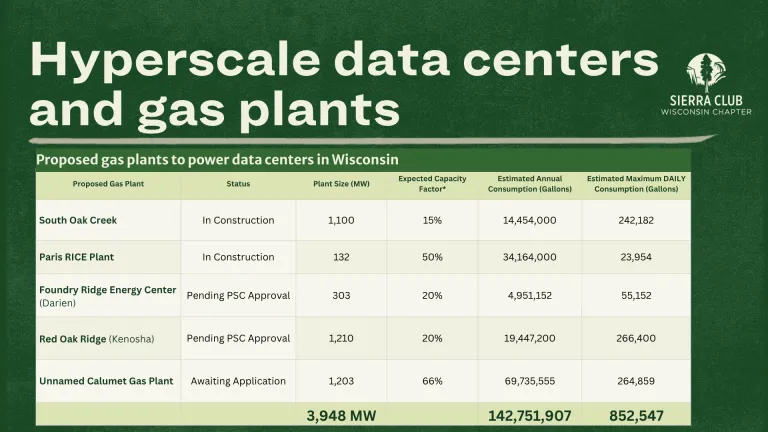
Taken together, at their peak, when operating at all time, these plants could collectively use 852,546 gallons of water in a single day. While these plants are not like traditional gas plants that use water-instensive steam power, they use water to cool the air for efficiency. This means that while they withdraw less than their counterparts, all of the water they withdraw is consumed and taken out of the local water system. Currently, We Energies and Invenergy anticipate using 142 million gallons a year, expressly for data centers.
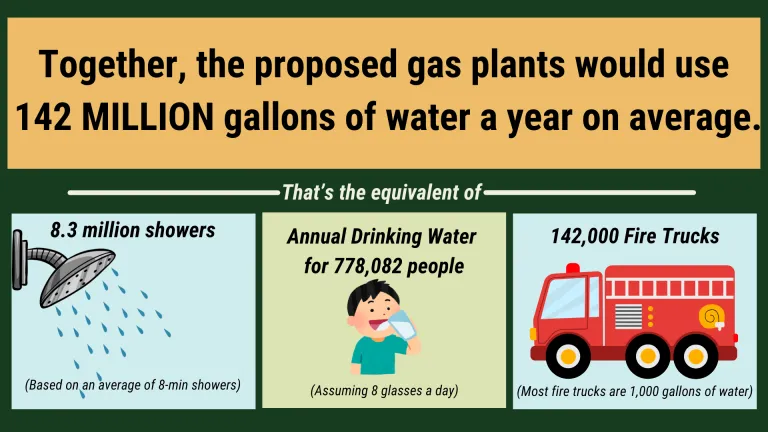
Were you ever told to turn off the water while you brush your teeth? This uses as much water as 40.6 million toothbrushings save.
Bad Timing
And one of the key questions here is when this water use will peak. Peak energy demand usually occurs in summer, when air conditioners are operating on hot days. And when you look at water use, peak energy demand and hot summers together, the impact is doubly concerning.
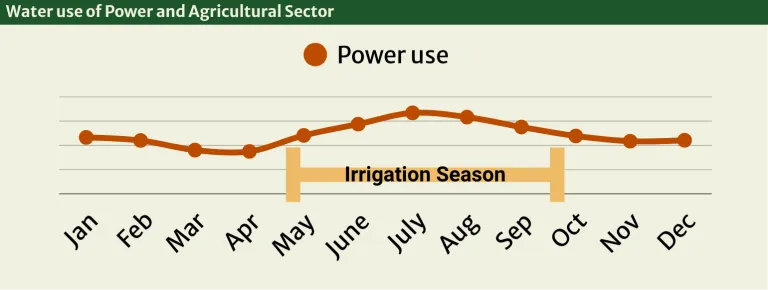
According to the Wisconsin Initiative on Climate Change Impacts (WICCI), Wisconsin is already experiencing more frequent and intense heat waves, hotter, wetter days, and droughts. WICCI predicts “an annual increase of 20-30 days with 90-plus degrees Fahrenheit over the next 50 years.” Summer heat impacts not only our communities, but also the agricultural sector.
The concerns raised here are critical for communities across Wisconsin, and they must be addressed by decision-makers across the state, who are being called on by Wisconsinites to do their duty and protect the state’s climate, water and air.
All of this and more, including a closer look at the closed-loop water cooling systems data centers are proposing and features on the proposed Red Oak Ridge and Foundry Ridge gas plants, are covered in Thirsty Power: Coal and gas will leave us high and dry. You can check out the report here.