Most recent update:
Thirsty Power: Coal and gas will leave us high and dry
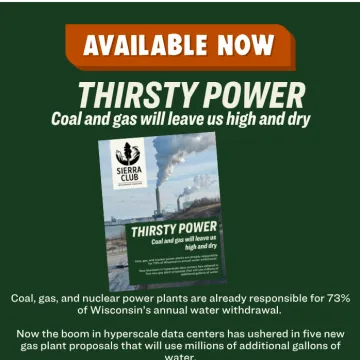
A new report from the Sierra Club, Thirsty Power: Coal and gas will leave us high and dry analyzes Wisconsin’s current power generation, the water needed for that power, and the potential impacts on Wisconsin’s water as Big Tech tries to build more data centers across the state. These data centers require enormous amounts of power– and in some cases are prompting entirely new gas plants that will compound water and energy use at peak times.
The report found, among other things, that:
- Wisconsin’s current dirty energy power fleet– including coal, gas, and nuclear plants– withdraws 1.35 trillion gallons of water annually. Meanwhile, solar and wind use so little water that the EIA doesn’t even track their usage. This is more than 7 times all of the municipalities in Wisconsin combined, and 18 times more than agricultural irrigation.
- Five new gas plants, known or assumed to be proposed for data centers, would use 142 million gallons of water a year on average – the equivalent of the annual drinking water for 778,082 people– and the majority of which would be needed during summer months when energy and water use has been strained by drought and heat. The proposed Red Oak Ridge gas plant in Kenosha would consume an estimated maximum of 266,400 gallons of water from the Great Lakes per day – the equivalent of daily consumption of nearly 3,248 average Americans. The proposed Foundry Ridge plant would use an estimated maximum of 55,152 gallons of groundwater from local wells per day.
- The five new proposed gas plants confirmed or suspected of being proposed solely to power data centers in Wisconsin equate to almost 4 gigawatts of power – or enough electricity to power approx. 3 million average homes. There are only 2.84 million homes in Wisconsin.
- The proposed Red Oak Ridge gas plant will become the second-largest gas plant in the state and use 266,400 gallons of water per day when it runs at full capacity. Plant owner Invenergy seeks to use Lake Michigan water, which will require special approval under the Great Lakes Compact.
In other news, Midwest Environmental Advocates (MEA) recently filed a lawsuit on behalf of the Sierra Club challenging a Wisconsin Department of Natural Resources (DNR) decision to issue permits for a massive data center campus in Port Washington without fully evaluating the project’s environmental consequences.
The lawsuit comes after emails obtained through a public records request revealed that DNR staff initially informed data center representatives that a detailed Environmental Impact Statement (EIS) would be required due to the scope and scale of the project. After data center representatives complained that an EIS would “kill the project,” the DNR reversed course and decided to conduct a more limited “environmental analysis summary.” The agency has never publicly explained that decision.
“This case is about transparency and accountability,” said MEA attorney Michael Greif. “Wisconsinites have a right to know why the state changed course and why one of the largest development projects in Wisconsin history is moving forward without the level of environmental review and public input the law requires.”
Vantage Data Centers, Oracle, and OpenAI are building the Port Washington data center as part of a broader effort to expand computing infrastructure for artificial intelligence. The $15 billion project is one of the first hyperscale data centers under construction in Wisconsin. The first phase alone will require an unprecedented 1.3 gigawatts of power—an amount that could power more than half a million households. The data center itself will cover 672 acres, and its energy demand will spur the construction of new gas plants, substations and high-voltage transmission lines that will spread over six counties.
"The Port Washington data center is unlike anything Wisconsin has seen before," said Elizabeth Ward, Sierra Club Wisconsin Chapter Director. "It will completely transform the local landscape, consume staggering amounts of electricity and water and significantly increase fossil fuel emissions. At a time when scientists warn that greenhouse gas emissions must be reduced to avoid the worst impacts of climate change, we cannot afford to be making long-term decisions that move us in exactly the opposite direction.”
Submit your Comment

Data Centers Need Proper Environmental Review
63% complete
Send My MessageBig Tech Unchecked: A Toolkit for Community Action

The Sierra Club, along with our partners at Healthy Climate Wisconsin, Midwest Environmental Advocates, and Wisconsin Green Fire, created this toolkit to help Wisconsinites understand what hyperscale data centers are, what impacts they have, and what local communities and concerned citizens can do to mitigate the worst impacts.
Download the toolkit, Big Tech Unchecked: A toolkit for community action here.
The toolkit is 34 pages. Download individual sections of the toolkit here.
The launch of the toolkit kicked off a series of webinars about the impacts of Data Centers and what you can do. Find the recordings here:
Big Tech Unchecked: Join Healthy Climate Wisconsin, the Midwest Environmental Advocates, the Sierra Club-Wisconsin Chapter, and Wisconsin's GreenFire as we walk through the new toolkit: Hyperscale Data Centers in Wisconsin: Big Tech Unchecked, A toolkit for Community Action.
No Discounts for Data Centers: Data Centers should cover their costs. There are major decisions being made about whether or not they will have to. Tune in to learn more about data centers' hungry electricity needs -- and how it could cost us all if the Public Service Commission doesn't make the right decisions.
Why it Matters
Hyperscale data centers are exactly what they sound like: massive facilities built to handle enormous volumes of data. They support the growing demand for cloud computing, cryptocurrency, and, increasingly, artificial intelligence. These large-scale operations can house thousands of servers and require complex systems to manage power, data processing, and cooling. Because they operate continuously, hyperscale data centers rely on extensive energy infrastructure and backup generators to prevent downtime and ensure constant access to data.
Some hyperscale data centers are owned and operated by major tech companies like Meta (Facebook), Amazon, Google, and Microsoft. Others are developed by third-party companies that either sell entire facilities to clients or lease space within them to businesses that need large-scale data storage and computing power.
Electric utilities like We Energies and Alliant have been recruiting data centers because these massive facilities use huge amounts of electricity, allowing utilities to justify building new power plants and infrastructure—projects that boost utility profits. This dynamic creates a powerful push to bring in more data centers, even when the public may end up bearing the financial and environmental costs.
Currently, there are no guardrails for data centers, including clean energy requirements, protections for customers of the utilities that will be powering these massive energy users, or limits on water use.
Here are some of the concerns around data centers:
- Data centers use a staggering amount of energy. Just two data center proposals (Vantage data center in Port Washington and the Microsoft data center in Mt. Pleasant) would use as much energy as the entire state of Wisconsin. The Vantage data center would use more electricity than the city of Los Angeles. In order to power these data centers, utilities are heavily investing in gas plants, which creates a number of different concerns.
- Data centers consume an enormous amount of water. Data centers use an enormous amount of water to keep their servers cool—often millions of gallons every single day for just one facility. As these centers multiply, their combined water demand can put real pressure on local rivers, lakes, and community water supplies.
- Wisconsinites could be left footing the bill. When a single, massive user like a data center comes online and consumes all the power a gas plant produces, or requires new transmission lines to serve it, all ratepayers share in the costs, even though only one customer reaps the benefit.
Data centers can and should be built in ways that minimize these impacts. Data centers should be powered by new, clean energy sources so that the growth of data centers doesn’t exacerbate the climate crisis. Finally, other states have processes in place to ensure that utility customers' bills do not increase once data centers arrive in an area and create a demand for a massive amount of energy.
Recent Updates

Legal Settlement Secured by MEA and Sierra Club Leads to Statewide Environmental Review of Data Center Development in Wisconsin

Sierra Club Wisconsin: PSC Greenlights Health Issues and Pollution with Construction Approval of New Gas Plants to Power Data Centers