By Carole and Alex Mintzer
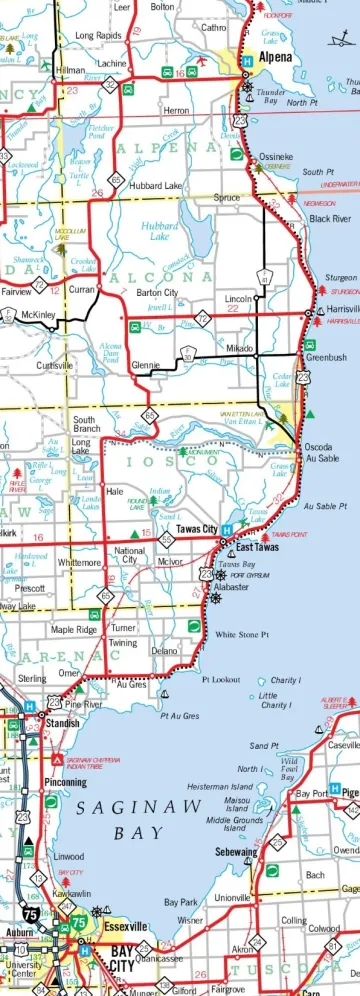
Every summer, we travel from SLO to Michigan to spend a week along a lake visiting family. It is a great tradition that we look forward to every year. The trip involves renting a car at the Detroit airport and driving about 200 miles from Ann Arbor to the little town of Hillman, in the northeast quadrant of the lower peninsula. On the return journey, we added three nights at a vacation rental on Saginaw Bay of Lake Huron, and a three-night visit with family near Lansing.
Every year, until this year, we have rented a traditional gas-powered car. We’ve toyed with the idea of renting an electric vehicle (EV) but were concerned about keeping it powered in rural Michigan. For sure, there’s no EV charging station in Hillman, nor at the nearby rustic resort where we stay.
As Tesla owners in Los Osos (hey, we bought it in 2022, before…), between home charging and Tesla charging stations, we’ve had no problems keeping the car juiced, even on road trips. However, when we looked into renting in Detroit, we quickly learned that the only EVs available were non-Teslas.
We’d read horror stories about the difficulties with finding functional charging stations for non-Tesla EVs and figured in rural Michigan it could be challenging. But feeling a commitment to stop renting gas guzzlers, we took the plunge and ordered an EV from Avis for our three-week trip. We had several options at the rental counter and chose a Hyundai Ioniq5, which has a range of about 300 miles when fully charged. The rental cost was about the same as the cost of renting a gas-powered car.
So far, so good, but we had little idea how to actually charge the car - what kind of port did it have? How would we find compatible charging stations? How would we pay for charging the car? We asked my niece, who drives a non-Tesla EV in the Midwest, and she advised us to download three apps - PlugShare, ChargePoint, and ElectrifyAmerica.
PlugShare provides locations of charging stations across most vendors. We told it what kind of car we were driving, what kind of charging port it had (turns out it was a CCS1), and it mapped out nearby charging stations. By moving the map around, we could see where the charging stations were all over Michigan. More than showing us the location, it told us how many chargers were available at each location, which company owned them, how many were in use, and how their reliability/utility was rated on a 1-10 scale. It also told us the power of the chargers (kWh), the cost per kWh, and about nearby amenities. By clicking on the directions button, it guided us to each station via Waze (Google Maps and others are also options).
We had heard that Tesla is opening up its charging stations to non-Tesla EVs, so for our first attempt at charging the Ioniq, we went to a Tesla site that was supposed to work for our car. However, we needed an adapter to plug the charger into our car and the rental didn’t come with one. (Ioniq5 2025 models come with a Tesla port and adapters for other types of chargers.) OK, on to an ElectrifyAmerica site 2 miles away. As we found typical of non-Tesla stations, this one had only a few charging units, but none were occupied, so we were in business. Except, we had to figure out how to pay for the charge. We had the ElectrifyAmerica app on the phone, but hadn’t added our credit card information, so that didn’t work. Fortunately the charger had an option to use a credit card directly, so we did that. It took about half an hour to get a sufficient charge, although we were reminded that charging slows way down after you get the battery up to around 90%. It’s best to stop around 80-90%.
On our way to Hillman, we stopped in Bay City at a site with four ElectrifyAmerica charging units. This time all the units were in use when we arrived, and there were two cars waiting ahead of us. We knew the route further north didn’t have many charging stations, so we waited about 20 minutes and then spent half an hour charging the car before we got back on the road. We used the time to eat our packed sandwiches and find a restroom.
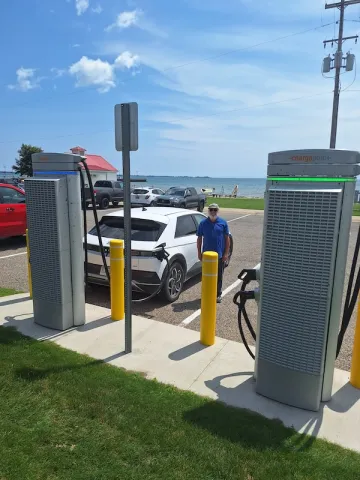
Because northern rural Michigan has few charging options, you really count on them working when you get there. Our return route took us south along the shore of Lake Huron, starting from Alpena, which has only two ChargePoint units. We charged the car there once during our weeklong resort stay 20 miles away, with no waiting. Halfway between Alpena and Bay City, there is just one station with two ChargePoint units at Shoreline Park in Tawas City. Those two chargers were occupied when we arrived, so we had early lunch at an excellent restaurant just across the street. One unit was open when we got back, and we enjoyed a 30-minute walk along the lakeshore while the car charged.
We felt fortunate that the charging sites in Alpena and Tawas City were both working when we needed them. And by this time, we had mastered using an app to start and pay for the charge. Hurray for technology! Point the phone at the charging unit, push a few buttons, plug in, and let it do its thing.
Enroute to the Lansing area, we used a ChargePoint at a gas station by the freeway exit we needed. A final top-up a week later at an Ann Arbor shopping center juiced the car past the 70% it needed to have when we returned it to the airport rental lot.
One more thing we learned: ChargePoint stations can charge fees if you leave your car sitting there after you're done charging. We got a warning about this on our phone and avoided the extra fees.
Overall, this experience was good and we definitely will try it again, especially now that we know how to find and pay for charging a non-Tesla EV. We learned a new skill. And as always, it felt good to bypass gas stations.
Carole leads the Santa Lucia Chapter Communications Team
Alex is Chair of the Santa Lucia Chapter Political Committee