By Judith Bernstein
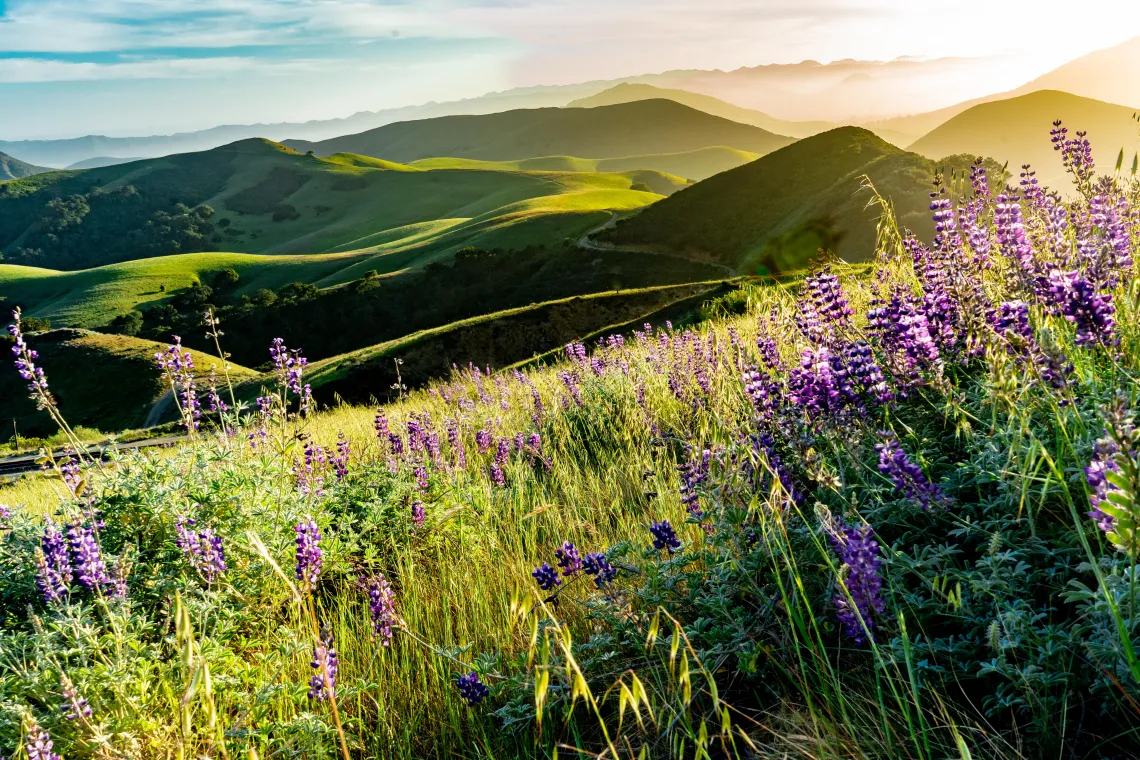
Bill Rumbler is known for his sweeping landscapes featuring the green hills of spring, fences running across brown fields, twisting oak trees, and shafts of sunlight illuminating the hills. His work has been shown locally at Morro Bay Art Center, Open Studios, Studios on the Park, the Photo Shop, and at The Gallery in Los Alamos. But his start in photography was in the Midwest where he was a photojournalist and reporter with a Chicago paper; nature didn’t call to him as a subject until he retired to San Luis Obispo County. “After Chicago, where things are flat and gray in Winter, I was excited by the green hills and gorgeous landscape, the lush grasses of Spring, and the rugged coastline of our County. So after one workshop in Owens Valley, I went out on my own and am mostly self-taught as a result of many trials and errors.”
I asked Bill about some of the trickier aspects of large scale landscape photography and how he would advise less experienced photographers. “First, pick the right time to go out; the best times are early morning and late afternoon and evening as the sun is setting. There are more shadows which add more dimensions and drama to the scene you are trying to capture.”
I noticed the fronds in the foreground of the photograph below and wondered if including them was a conscious choice. It was. “Look for a landscape with layers, like Renaissance paintings that have a foreground, a middle, and a background. Having something of interest like a windmill, a fence, or a rusty tractor in the foreground gives the viewer a sense of scale in a three-dimensional landscape. Also look for dramatic clouds or an impending storm.”
Although some of Bill’s photographs have been taken close to home, he tends to venture out to SLO County’s many back roads and trails. He suggests taking one good picture of Morro Rock and then moving on to other less photographed landscapes: “Get the SLO City map of trails or one of the many books about hikes in our County and then explore; that’s how I found my subject matter, often by chance or serendipity.”
Bill Rumbler is currently exhibited at the Gallery in Los Alamos. See more on Bill's website.
Cheryl Strahl is a versatile nature photographer, equally at home with landscapes, coastal views, and night skies, but she has a special affinity for wildlife. She began taking workshops after retiring and credits them with giving her new perspectives on photography. One recent workshop (Action Photo Tours) took place on a 650,000 acre ranch in Wyoming’s “Cowboy Country. “Workshops give you a chance to advance your skills and to acquire new ways of seeing what you want your camera to capture. Also the folks that lead workshops are familiar with the best locations in the most favorable light."
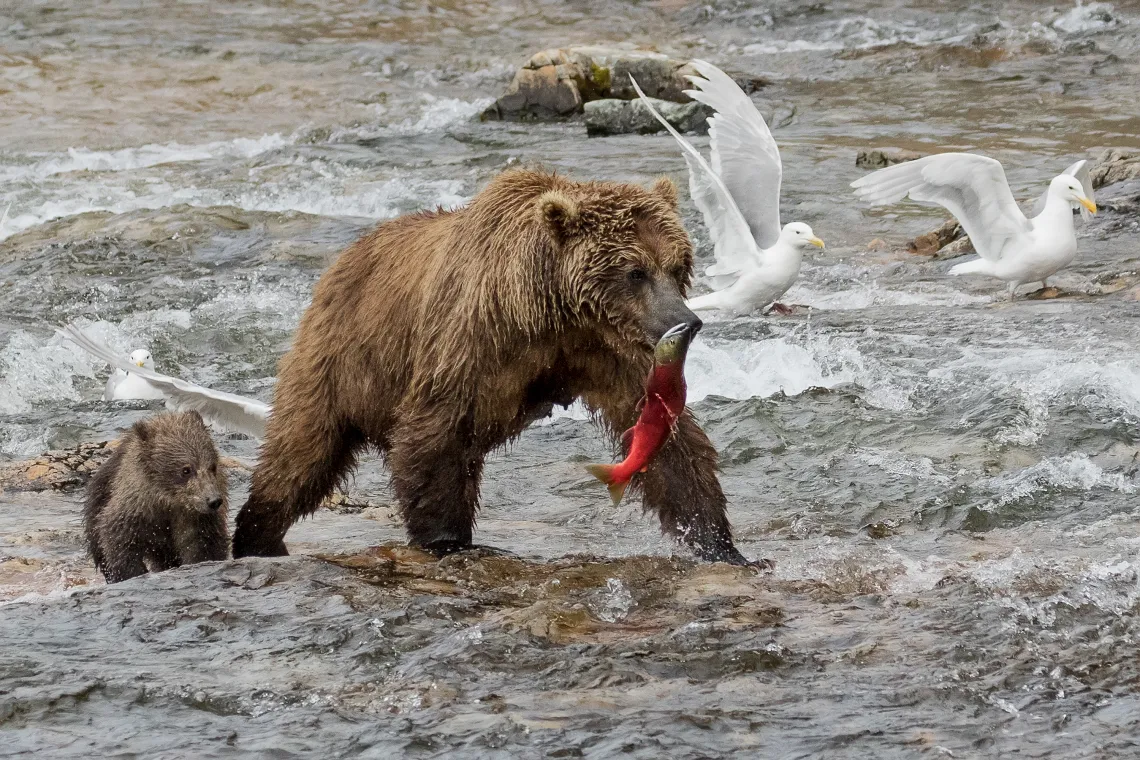
In Wyoming, she knew that photographing horses and their riders in motion meant using a fast shutter speed, but she points out that blurring their motion at a slower speed also can be effective. Another piece of advice is that using a camera’s burst mode to make multiple images is advisable when dealing with a fast-moving animal like a bear.
One of her favorite photography journeys was to a remote area of Alaska, inaccessible by road, where there were many opportunities for photographing wildlife, especially bears. “When I am taking photos of animals, I feel a certain kinship and am drawn to the emotional aspect of the human/animal connection.”
Her advice to those who may be new to wildlife photography is---above all--- to be patient. “The photography is on the wildlife’s time scale, not on our human one.” Over time, the light may change and the animals may move; such shifts offer different perspectives on the same subject. Of course, she stressed choosing the right time of day in terms of lighting and paying attention to what is in the foreground and background. She is a strong advocate of taking care to capture animals’ natural behavior, expression, and motion, which means photographing in wildlife’s natural habitat.
I asked whether different animals presented different challenges and the answer was, “Yes! Horses, coyotes, bison, and birds have different ways of moving and of grouping together.” Acknowledging that birds are a real challenge because of their rapid movements, she advises photographers to anticipate where they are moving toward and aim for that place, unless of course the bird seems fully settled on a branch like her image of a Pine Grosbeak in winter seen on her website.
I told Cheryl that I planned to buy one of her photos as it seemed to belong in my kitchen and aligned with what I like to cook. At first she was puzzled, but then knowing I was a big fish eater, she knew exactly which one: “The Plight of the Sockeye.”
Cheryl Strahl will have an exhibit in November-December at Spearhead Coffee in Paso Robles. See Cheryl's website for more pictures.
Tim Bryan is an outdoorsman who has long enjoyed fishing and skiing, but he did not make nature photography a focus of his work until about 15 years ago and considers himself largely self-taught. Living in Paso Robles his whole life, he wrote articles about the outdoors in the county for a magazine and needed photographs so he took them himself. Then after going into real estate professionally, he needed sharp and enticing photos of the ranchland he was selling in SLO’s North County. Like the three other photographers profiled here, he credits two workshops, one in the Badlands of South Dakota and another here, for giving him some important tools that he then could apply in his travels to places such as Africa, Canada, and the American West.
Tim is well known for his seascapes as well as photographs of waterfalls, rivers, oceans, and creeks---in other words, water. But photographing different kinds of water calls for different approaches. About waterfalls he advises, “Falls are best captured under cloudy or foggy conditions, early in the morning and it’s best if they are in shade. If you try to photograph in sun, you’ll have too much glare. What you want is diffused sunlight.” For seascapes the number one rule is “Be safe; you don’t know what’s under the water and the tides could be rising and catch you and your equipment unaware. Especially if you’re staying late for a sunset shot, never turn your back on the ocean. One minute it could be calm and the next, out of nowhere, a three-foot wave. And don’t walk back in pitch darkness.”
When photographing flowing streams, he suggests using a tripod and a longer exposure of about 1 second. If the ocean is taken with a short exposure, the result is a sharp photo capturing a moment in time; a longer exposure will make a more silky effect. Tim has even shot at an exposure of 4 minutes in order to get the effect he wants.
Tim admits that seascapes pose a particular challenge because there can be foregrounds like rocks, sand, and land, then the sea and then the sky. With that many gradations in exposure, using an automatic setting rather than manual settings may not yield the results the photographer was hoping for. As with most nature photography, time of day is the main thing---avoiding glare or scenes without interesting lighting like high noon! Other tricky scenes are those with turbulent water after extensive winter rains.
Those of us in San Luis Obispo County don’t have to go far to visit Tim’s favorite spots: the stretch between Cambria and San Simeon; Montana De Oro; Shell Beach, South of Big Sur; and the coastal streams off road after a rainy winter. With that in mind, he says to “Look for those streams off Highway 46 West & 41 after we’ve had a good winter soaking, but be careful to stay off private property!”
More photos are on Tim’s website.

Judith Amber, AKA Judith Bernstein, first learned to use a camera when she worked on a Kibbutz in Israel and took her father’s viewfinder camera. Although she did moderately well, she knew that she wasn’t good enough to accompany her writer friend Lee Warren to West Africa as photographer for “The Theatre of West Africa” (Prentice Hall, out of print). So her father came to the rescue again, buying her a Konica manual camera and some lessons with a good teacher. She unbelievably took 100 rolls of color and B&W film with her since at that time, 1971, there was nowhere in her travels to buy more of the film or to have it developed. Luckily, there were enough good shots of dancers, actors and musicians to use in the book and the Konica returned unharmed.
After moving to California from Minnesota in the 70s, she discovered the hills of Berkeley, where an occasional bobcat could be spotted, and the many incredible places for hiking such as Pt. Reyes National Seashore and the Mendocino area. With little nature photography experience, she knew she needed instruction and so went on workshops in Zion and Bryce National Parks, the Big Island of Hawaii, and the Eastern Sierras. During a photo critique session, one of the instructors told her, “I look at photography as I do musical scores. You are definitely NOT writing a symphony, but you make delightful chamber music. Stay small and intimate.”
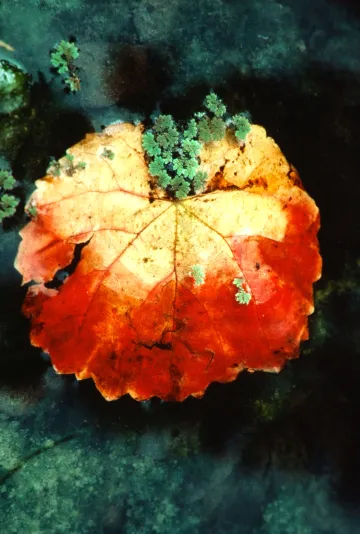
Years later (around 1989), she heeded that advice and won the national Sierra Club’s Grand Prize for a very intimate photo of just one fall oak leaf, topped with lichen, floating in a stream. She won a trip to Venezuela and was on the Club’s magazine cover. Then she convinced a local gallery in Ashland, Oregon to give her a show and decided to make nature photography her #1 avocation.
She prefers to look at nature from a very close point of view, finding patterns in tree shadows, the scattered petals of a Jacaranda tree, mussels clinging to a rock at low tide in Cambria, and scattered kelp on a beach in Pismo. She points out it’s best to use a closeup lens but even using a long-distance lens to avoid a bee sting can work. The diffused light from an overcast or foggy day is usually best, but as the other photographers point out, avoid midday glare. For her, it isn’t necessarily “cheating” to do some re-arrangement of the subject such as flower petals on a table or a dead bird she photographed for a still unpublished series called “de-compositions.”
“Look down at your feet, search for patterns of sea creatures clinging to rocks, and watch shadows as the light shifts over a few hours. You may find new subjects that are often overlooked but are an integral part of nature.”
For more images, contact Judith Amber.
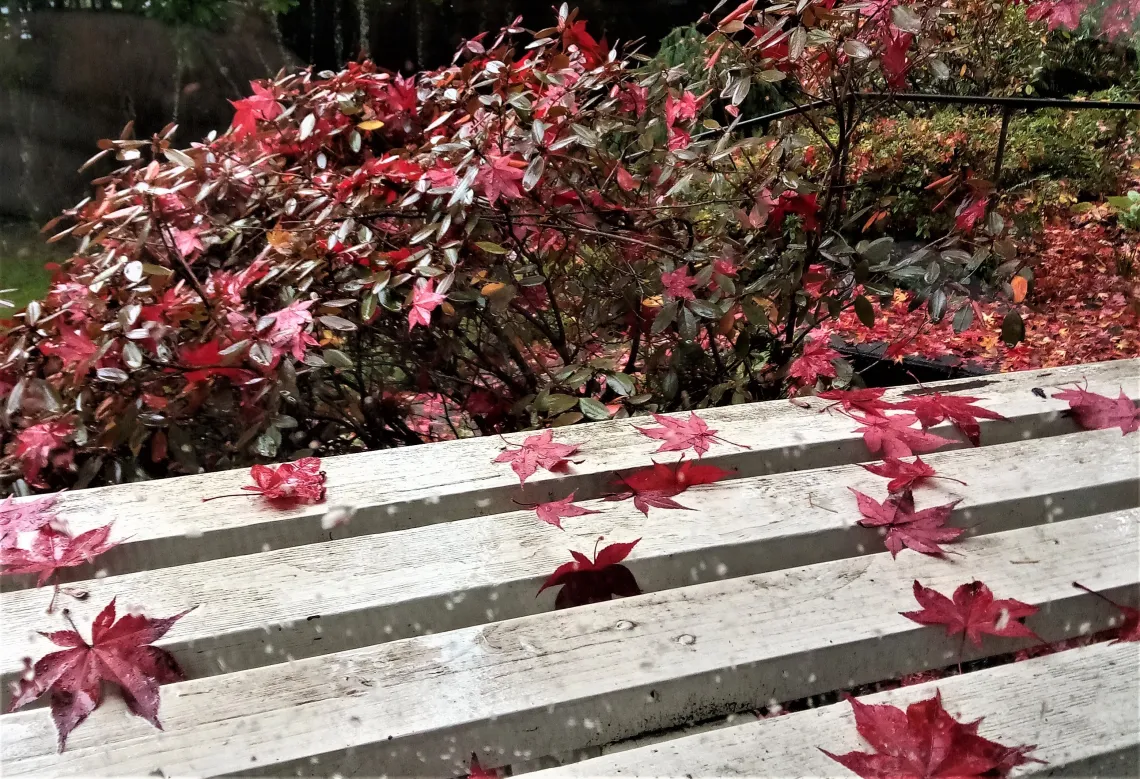
The photographers interviewed are all members of the Central Coast Photographic Society. Individually and as a group they have exhibited locally at The Photo Shop; the Mid State Fair; Art Center Morro Bay; the Clark Center; Studios on the Park, and in the New Times annual photo competition.