By Andrew Christie
At the dawn of nuclear energy, the new industry was securing the necessities for its survival (i.e. federal subsidies and indemnity from liability for the costs of any nuclear disaster) and the Atomic Energy Commission was making promises. Chief among those promises: A solution to the problem of how to permanently dispose of nuclear waste would soon be forthcoming, so plant permitting and construction could proceed immediately. Thus was the cart placed firmly before the horse.
Fifty years ago, the state of California finally brought common sense to the table and required the industry to put the horse and the cart in the correct order. The 1976 Nuclear Safeguards Act barred the licensing of any new nuclear power plants in the state until “there has been developed and that the United States through its authorized agency has approved and there exists a demonstrated technology or means for the…permanent and terminal disposition of high-level nuclear waste.”
PG&E, which had dreamed of a string of ten coastal nuclear plants from Eureka to San Diego, fought the law all the way to the Supreme Court. They lost.
Over the last twenty years, half a dozen bills have made their way to Sacramento in attempts to get around the law, accompanied by much handwaving from nuclear advocates. They failed.
In April, the latest round of failure unfolded when the Natural Resources Committee of the California Assembly killed a bill that would have opened up California to Small Modular Reactors (SMRs). About a week later, another bill would have expanded that proposed exemption from the law to include all “advanced” nuclear reactors. Before that vote could happen, beholding the fate of its predecessor, the bill’s author removed the legal exemption language and turned it into a “study bill.”
Neither of the most recent bills had much to say about nuclear waste, the reason for the existence of the Nuclear Safeguards Act. They simply suggested that because the reactor technology is new, the law – which is “decades-old” and therefore “dated” and “outmoded” -- should not apply to them.
The first bill, AB 1757, implied that smaller size equals less risk. In fact, SMRs may pose greater risks of radiological exposure to surrounding communities than currently operating reactors and would produce more expensive electricity because of diseconomies of scale.
The second bill, AB 2647, wanted to declare that “the state’s ban on new nuclear plants does not apply to modern designs licensed by the U.S. Nuclear Regulatory Commission (NRC) after January 1, 2005.” Removing that language and turning it into a study bill was enough to get it passed out of committee.
The bills were opposed by the Committee to Bridge the Gap, Sierra Club, Union of Concerned Scientists, and other environmental and public interest groups. We continue to oppose AB 2647, which, in its current form, would require the state to consider “the potential of nuclear energy…to complement renewable resources, enhance grid reliability, and reduce overall system costs,” a study that would cost millions. Curiously, the bill would not also require the state to study the potential for nuclear energy to crowd out renewables, reduce grid reliability, and increase overall system costs.)
We all pointed out that history has shown that new reactor designs cannot be counted on to reliably operate until they have decades of operating experience. In addition to this troubling fact is the likelihood that more nuclear power will not be needed in California due to advances in building out renewable, clean technologies such as wind and solar combined with energy storage. Thus, not only are attempts to skirt the Nuclear Safeguards Act unsafe, they are untimely and unnecessary.
Throwing one more bad ingredient into the mix: In its continued effort to gut the National Environmental Policy Act (NEPA) and advance a pro-nuclear agenda, the Trump administration is moving to exclude new nuclear reactors from federal environmental review, relaxing nuclear safety regulations and reducing security measures and safety inspections. What could go wrong? (In 2007, Barack Obama observed that the Nuclear Regulatory Commission had become a "captive of the industries that it regulates." After a decades-long identity crisis as an agency that both promotes and regulates the nuclear power industry, the NRC is now earnestly proving his point.)
“In the midst of the most severe erosion of nuclear safety regulations in U.S. history, it is reckless to consider lifting California’s moratorium. Nuclear safety cannot be compromised," said Haakon Williams, Executive Director of the Committee to Bridge the Gap.
What should California be doing instead? Let’s take a hint from PG&E, which, once upon a time, agreed to retire the Diablo Canyon Nuclear Power Plant by 2025, in part because it couldn’t compete with "the growth rate of distributed energy resources."
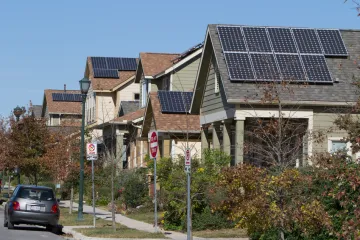
The Climate Center agrees: "The solution is clean, distributed, and resilient energy. By decentralizing power sources, solutions like microgrids, rooftop solar with battery storage, and virtual power plants (VPPs) can make electricity more reliable and affordable while reducing pollution. VPPs are networks of clean, distributed energy resources like smart thermostats, home batteries, smart plugs, electric water heaters, and electric vehicles. When aggregated, these resources can deliver energy during peak demand hours, creating savings for the VPP participants and all electricity customers by avoiding reliance on the strained electrical grid."