By Andrew Christie, Conservation Committee
Remember “From a Distance?”
It was everywhere in the 90s. Bette Midler’s biggest hit. A soft-rock anthem that sounded like it was extolling hope and peace and joy, playing in heavy rotation on every station on the dial. But the song’s actual message was disquieting: Up close, things don’t look so good, but if you back waaay up and regard the planet from outer space, it looks like “no one is in need and there are no guns, no bombs, and no disease.” If you get far enough away, all the unfortunate details disappear.
The opening chords of that ballad and that peculiar message should start playing in your head whenever you see another rousing argument for nuclear power and/or extending the life of the Diablo Canyon Nuclear Power Plant. Nuclear advocates do not hassle the details and they don’t look too close.
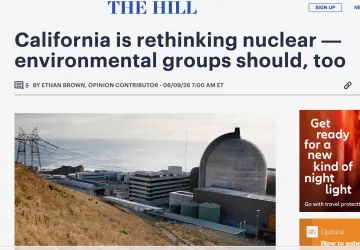
Such was the case with “California is rethinking nuclear – environmental groups should, too” in the June 9 edition of The Hill. Therein, one Ethan Brown takes a tack currently in vogue with the nuclear lobby: Nuclear is hip and happening, and its critics are behind the times. In doing so, he made three things obvious: Nuclear advocates have notably little to say about the extreme drawbacks of nuclear energy; what they cite as advantages that should outweigh those undisputed drawbacks are not really advantages; and their arguments based on safety, economics, and comparisons to renewable energy omit so much information and are so far behind the times as to be irrelevant to the current reality.
Herewith, we descend from Mr. Brown’s 30,000-foot level and get up close with those pesky details.
Darn that unyielding Sierra Club playbook
Mr. Brown writes:
“The Sierra Club’s Santa Lucia chapter filed comments with the California Energy Commission to oppose the extension [which] were not nuanced concerns about site-specific issues, but rather part of their broader playbook of unyielding opposition to nuclear power.”
Here Mr. Brown commences his habit of providing links to source documents that the reader can peruse and compare to Mr. Brown’s characterization of them. If the reader does so, it quickly becomes apparent that our chapter filed our comments on the docket the California Energy Commission maintains on Resource Planning and Reliability – i.e. not the venue for “concerns about site specific issues” – and that our comments consisted entirely of citations from the historical record on the reliability of Diablo’s power generation, citations from experts and energy agencies on Diablo’s role or lack thereof in maintaining grid reliability, and the actual cause of California’s 2020 power outages.
You know: Details.
Diablo vs. renewable energy
Mr. Brown writes:
“Three times since March 2025, renewables and nuclear have combined to power more than half of America’s electric grid for a full month. One can imagine these sources as complementary teammates in a carbon-free future.”
Here again, the reader can read the article at the link Mr. Brown provides, which is headlined “In a first, renewables beat natural gas on US grid last month” and is about the fact that last March “the nation got more electricity from renewables than it did from natural gas, which is typically the single-largest source of energy on the U.S. grid.” That historic first for wind and solar power is the subject of the article, which includes one passing reference to nuclear as an additional source of low-carbon energy. A useful chart is included that shows nuclear’s declining share of electricity generation over the last ten years, significantly outpaced by the larger and rising share of renewables.
Diablo Canyon generates 18,000 gigawatt-hours of electricity. California has required that the state’s renewable energy production account for 50% of retail sales by 2030. That will amount to about 100,000 gigawatt-hours, not including rooftop solar and energy efficiency measures.
It’s nice that Mr. Brown can imagine these sources as complementary teammates, but his imagination does not match up with reality. Senator John Laird put it succinctly in the May 6, 2026, Senate Rules Committee hearing on the reappointment of the California Energy Commission’s Vice Chair when he asked how compatible nuclear and renewable energy are. “It seems to me that one of the issues that isn’t always totally understood about Diablo Canyon is…if it turns out we have a real excess of renewables, we cannot modulate Diablo Canyon to deal with the fact that we have a lot of wind and a lot of solar in that moment. So how do we deal with that?” The CEC Vice Chair responded, “We still curtail [wind and solar].”
Why not the other way around, i.e. curtail Diablo to allow wind and solar on the grid, you may ask. As David Weisman noted in the May 19 edition of the Santa Barbara Independent, a 2011 MIT Energy Initiative study found that “Flexible operation of nuclear power plants dramatically impacts their profitability. Nuclear plants need to run as baseload units at high output levels to recover their high capital costs” – bad news for the “complementary teammates” scenario.
Senator Laird also wanted to know if things had changed since 2022 when California made a 180-degree turn on the planned closure of Diablo in 2025 due to the alleged inability of renewable energy to make up for the loss of Diablo’s 2,300 megawatts of energy production.
The CEC commissioner responded: “As we sit in 2026, given that we have added 30,000 megawatts of new resources since 2020 and we have another 28,000 to 30,000 resources in the pipeline under contract, we don't see the same structural deficit that we saw in 2022. So as long as we continue to take the planning with the criteria of increasing demand and making sure we're building at the rate we are building for, which I have confidence — we have been building 6,000 megawatts in 2024, almost seven in 2025 — so if we keep up with that, we are in a completely different situation in terms of pure reliability need of Diablo." (And yes, the California Energy Commission knows about AI and data centers.)
On safety
Mr. Brown writes:
“Diablo Canyon passed dozens of rigorous Nuclear Regulatory Commission safety reviews.”
Diablo’s defenders always cite the reams of reassuring studies PG&E has produced on the plant’s safety over the decades, approved by the NRC. The lens through which this massive output of paper is best viewed was provided by former California State Senator Sam Blakeslee on December 3, 2014, in testimony before the Environment and Public Works Committee of the U.S. Senate. Blakeslee is also a geophysicist, and he delivered to the committee 26 pages of technical documentation along with the blistering testimony of a scientist who has found that science is being distorted in service to a desired outcome. Blakeslee testified that when PG&E discovered, based on the available seismic data, that the earthquake faults around the plant could generate a level of ground motion more than twice as powerful as what the plant’s safety components were designed to withstand, the utility simply changed the “damping coefficient” – altering the numbers to make the problem go away on paper.
“There is no getting around the fact that PG&E has consistently down-played seismic hazards on the coast near its nuclear plants,” Blakeslee testified. “Especially disturbing is that during these past decades the NRC has repeatedly relaxed its seismic standards to accommodate the operation of Diablo Canyon…. The potential earthquakes affecting the plant have increased with each major study. But what’s equally striking is that the shaking predicted by PG&E for these increasing threats has systematically decreased as PG&E adopted less and less conservative analytical methodologies, and they did so with NRC approval.”
In 2011, Michael Peck, the NRC’s senior resident inspector for Diablo Canyon, had said essentially the same thing. His concerns were dismissed by the NRC. The same year, a major Associated Press investigation reported the widespread practice of the nuclear power industry of “loosening safety standards to keep aging reactors within operating rules…fudging calculations and assumption to yield answers that enable plants with deteriorating conditions to remain in compliance.”
Barack Obama observed in 2007 that the Nuclear Regulatory Commission is a "captive of the industries that it regulates." And that was before the NRC came under the control of Donald Trump and embarked on an aggressive program of eroding nuclear safety regulations without telling anyone.
As you read this, the Independent Peer Review Panel (IPRP) legally tasked with reviewing and approving PG&E’s latest updated seismic assessment for Diablo Canyon has said it "believes that the Update excluded or downplayed information from various studies conducted post-2015 that should be included in calculating the revised seismic hazard" and it’s waiting for PG&E to explain why the most recent data indicating a higher slip rate on two of the earthquake faults around the plant was not included and evaluated in its report. As of January, the IPRP was expecting that response “with full supporting documents…in the Spring of 2026.” They’re still waiting.
Get with the program, oldsters
Mr. Brown writes:
“Youth-led climate organizations…such as Sunrise Movement, Fridays for Future, and Zero Hour sign on to broad coalition letters led by legacy groups that offer passing critiques, but they don’t engage in local nuclear fights or publish detailed stances,” therefore, he concludes, “environmentalism hasn’t shed its anti-nuclear past, but the next generation seems reluctant to inherit it.”
The focus of all three named groups is social justice, divestiture from fossil fuels, and implementation of the Green New Deal, which calls for net-zero greenhouse gas emissions by using renewable energy sources, energy-efficiency, local distributed generation, and smart power grids. Nuclear is nowhere on that list, so yes, it is understandably not a focus. But all three groups, in the link Mr. Brown provides, agreed that “Relying only on large scale investments in renewable energy and environmental justice alone will not stave off climate disaster if Congress simultaneously puts its legislative foot on the gas to expand fossil fuel production and false solutions like carbon capture, hydrogen, biomass, biofuels, factory farm gas, and nuclear power.” (Looks like that “reluctance to inherit” is pointing in a different direction.)
By the same token, the 2015 Stanford University study that presented roadmaps for every state in America “to convert their all-purpose energy systems (for electricity, transportation, heating/cooling, and industry) to ones powered entirely by wind, water, and sunlight” explicitly excluded nuclear, so it, too, didn’t have much to say about that power source – other than noting that “state planning and incentive structures” should be designed to allow “nuclear power plants to retire under enforceable commitments.”
Mr. Brown writes:
“A student group at California Polytechnic State University, 20 miles from the site, organized to support the plant, and says none of their fellow students seem to disagree.”
Here’s a perspective on that support from NPR’s May 18 “California Report:"
“On the Cal Poly Campus in San Luis Obispo, a student advocacy club is hosting a meeting. It’s called ‘Nuclear is Clean Energy,’ or ‘NICE.’ Club president Zach Mousharrafie said their work on-campus has been pretty easy, since none of their fellow students seem to be anti-nuclear. ‘We haven’t experienced a nuclear disaster in our generation. Fukushima was in the 2010s? I was six years old,’ he said.”
Mr. Mousharrafie, go ahead and Google “Fukushima.”
Now how much would you pay?
Mr. Brown writes that we “must start embracing nuclear power for what it is: an imperfect but increasingly popular source of carbon-free energy” that “has its limitations.”
Specifically, those limitations are: “The levelized cost of electricity for advanced nuclear power was estimated at $110/MWh in 2023, whereas photovoltaic solar and onshore wind registered $55/MWh and $40/MWh respectively, with continued price drops expected in the coming decades. New reactors require significant upfront investment and notoriously experience delays and budget overruns. Nuclear also raises questions around radioactive waste storage, water use, and uranium mining.”
No argument there. But after Mr. Brown skims lightly past these “limitations,” he suggests we overlook them because “unlike solar and wind, nuclear generates energy around the clock, offering vital grid stability during nighttime, peak hours, and uncooperative weather.”
Mr. Brown, go ahead and Google “Battery Energy Storage.”
And seriously, upon learning that there is a more than 100% price difference between different carbon-free sources of electricity, what rational human being thinks I imagine these sources as complementary teammates rather than let’s do the cheaper one?
To be fair, the figures Mr. Brown cited compare the cost of new nuclear power plants, including construction, versus new solar and wind generation. Does that economic argument flip if the nuclear plant was built forty years ago and is fully amortized? The Diablo Canyon 2045 coalition of local business interests and business-minded local governments would like you to think so, and they cite a recent MIT study to back up the claim of big savings realized from not switching to renewable energy.
Here’s David Weisman again in the Santa Barbara Independent: “The MIT study assumes fixed costs will remain the same over time [and does not convey] the truth that ‘The global price of uranium increased approximately 84.9% between the period of 5/2023 to 1/2024’ according to PG&E, and that ongoing global conflicts and tension have increased volatility in uranium pricing and availability.”
The study also used a model with 20% lower costs than estimated by PG&E, and did not include the multi-billion dollar projected cost of the extension of the plant’s life from 2025 to 2030 or the “statutory fees” charged by the utility. The study also incorporated an assumption made by the Public Utilities Commission, circa September 2025, that the sky-high Trump tariffs subsequently slapped down by the Supreme Court would be in effect through 2029, greatly increasing the cost of components for wind and solar energy generation. Per The Utility Reform Network, the model relied upon by the MIT study to calculate Diablo’s costs through 2045 meant that “the use of these lower values will inflate the modeled benefits of extended operations and create unreliable results.”
And any operational savings PG&E would realize by delaying the transition to renewable energy would be separate from and unrelated to the process that sets the market price of energy -- i.e. it won’t change the cost of electricity for consumers. The Diablo 2045 folks and the state legislature should take heed.
The late Richard Grossman was a human rights and environmental activist who co-founded the Program on Corporations, Law & Democracy and advocated for municipal control of energy and a decentralized energy model. He was no stranger to the impacts of utilities defining “the nation’s investment and technology policies around energy,” or claims about the urgent need to expand and extend the reach of nuclear power. In 1998, he spoke about his experience in the mid-1970s when “California utilities, along with energy corporations from around the country, spent great sums of their ratepayers’ money” to discredit the ideas of advocates for energy efficiencies and a planned transition to renewables: “I recall vividly the steady stream of corporate lies asserting that without fifty nuclear power plants in California the people of the state would be freezing and starving, jobless, in the dark.”
Here we are again.
Mr. Brown made the best case he could for Diablo Canyon and nuclear power. That case might look pretty good…from a distance.