By Jill Stegman
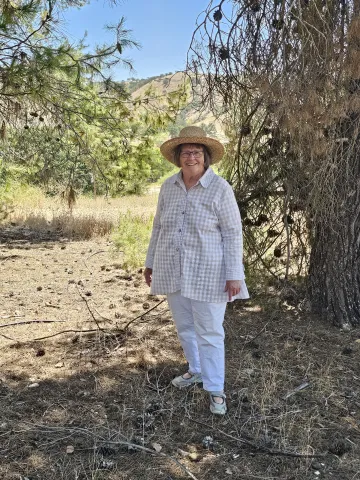
For Susan Harvey, our Conservation Committee Chair, environmental advocacy began long before she attended a public meeting or helped found a nonprofit organization. It started with a childhood spent exploring the foothills of Southern California.
“I grew up in SoCal in the Eagle Rock, Glendale area, at the toe of the Angeles Crest mountains,” she recalls. “On a clear day, the Los Angeles basin is extravagantly beautiful, cradled by the mountains. Who couldn’t appreciate that beauty?”
Her neighborhood was surrounded by undeveloped hills where children could wander freely, observing the rhythms of nature firsthand. Those experiences shaped a lifelong belief that access to nature matters. “People need to be able to be close to the opportunity to wander in open space,” she says, “close enough to recognize the changing seasons in nature and see the bugs and the birds, grasses and wild flowers.”
That connection to the natural world eventually led Harvey to a decades-long career in environmental leadership and advocacy in San Luis Obispo County.
Susan and her husband moved to the county in 1975, purchasing a home in California Valley on the Carrizo Plain. Self-employed for much of their lives, they eventually built a software consulting business serving manufacturing industries. But while her professional career centered on technology, her passion remained rooted in the landscape around her.
“We’ve always loved the desert, and Carrizo Plain is magnificent,” she says.
Harvey’s environmental activism took shape in 1999 when residents across San Luis Obispo County launched the SOAR initiative—Save Our Agricultural Resources—in response to the conversion of agricultural land into sprawling development.
Although the campaign itself was unsuccessful, it sparked something enduring. “The SOAR campaign was not successful,” Harvey explains, “but it did spawn a non-partisan group of folks in the Paso area” who founded Paso Watch to advocate for environmental protections, sustainable growth, and preservation of water resources in the Paso Robles groundwater basin.
Harvey became a founding member and helped guide the organization through multiple evolutions. Paso Watch became North County Watch as regional land-use issues expanded, and eventually evolved into California Land Watch, one of the county’s most influential environmental watchdog organizations. For much of its history, Harvey served as president.
Along the way, she became deeply involved with the Santa Lucia Chapter of the Sierra Club, serving on its Conservation Committee, Executive Committee, and as Executive Committee Chair.
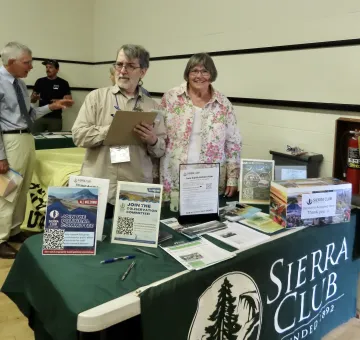
Throughout her years of advocacy, Harvey has developed a deep appreciation for the people who dedicate themselves to environmental causes. “One meets the nicest people when involved in environmental advocacy,” she says. “It’s hard work, and volunteers give enormous amounts of time, dedication, and dependable service.”
She believes the diversity of perspectives volunteers bring is one of the movement’s greatest strengths. “All the volunteers bring their own voices to the issues, and that brings an amazing, diverse, and much more effective quilt of ideas and viewpoints to issues and the solutions. I love that.”
Harvey’s philosophy of leadership is remarkably simple. She often returns to three principles she believes are essential for success in both life and advocacy. “If one wants to contribute anything to their life on a personal basis or in public advocacy,” she says, “to be successful, we need to pay attention, show up, and always tell the truth.”
The last principle, she emphasizes, is especially important. “It’s especially important to tell the truth, or nothing one says can be relied upon.”
She also encourages new advocates not to be intimidated by the complexity of environmental issues. “So much of advocacy relies on finding out what is going on—research. The more you know, the more you can connect the dots and increase your effectiveness.”
Her advice to newcomers is practical: “Don’t get discouraged. It’s a lot to figure out. Take it in little bits, and you’ll be surprised at how quickly you pull it all together.”
Still, Harvey is candid about the emotional challenges of environmental work. Progress often unfolds slowly, while environmental losses can happen quickly. “I think it’s important not to underestimate how difficult environmental advocacy is,” she says. “Change comes slowly, and negative impacts happen fast.”
The support of fellow advocates helps sustain that work over time. “Our family of fellow advocates is the first line and perhaps the best panacea.”
When asked what continues to motivate her after more than two decades of activism, Harvey points to the long view. Environmental protection is never truly finished. She often quotes her friend and mentor, Peter Douglas, the legendary former Executive Director of the California Coastal Commission: “The coast is never saved. It is always being saved.”
For Harvey, that lesson applies far beyond the shoreline. “So much of the really important issues take years and decades to succeed,” she says. “It becomes a lifelong dedication.”
Looking back on her journey, she sees it as one shaped by countless colleagues, friends, and mentors.
“I guess I was kind of like a blank canvas in 1999, and everyone has helped fill in the picture,” she reflects. “I’ve learned so much from everyone I’ve worked with. Advocates are such an amazing group of people.”
And after a lifetime of public service, she offers one final piece of advice that may be as important as any policy victory: “No matter how discouraged or upset you are in the moment, try to find a way to be gracious to the other.”
For Susan Harvey, environmental advocacy is ultimately about more than protecting land, water, and wildlife. It is about showing up, telling the truth, learning from others, and sustaining the relationships that make long-term change possible.