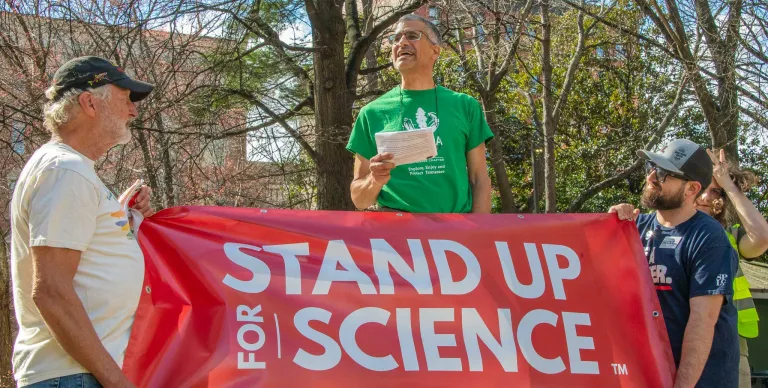
Vince Cianciolo speaking in Knoxville (Photo by Todd Waterman)
Tennesseans Stand Up for Science
On March 7, Sierra Club members and allies gathered across Tennessee for the national Stand Up for Science rallies. From Knoxville to Nashville, scientists, advocates and volunteers raised their voices in defense of evidence-based policy, environmental protection and the research that underpins it all. Full remarks from each speaker are below and there is a wonderful photo album from the Knoxville Rally shared by Todd Waterman.
Vince Cianciolo | Knoxville Retired nuclear physicist and Harvey Broome Group member Vince Cianciolo put the current moment in stark context — the Trump administration has already logged nearly 500 attacks on science in its first year, a rate ten times higher than during Trump's first term. His message: talk to people about science. Not preach — talk.
"In a functioning democracy we can, and will, debate opinions and policies. But those opinions and policies must be based on facts — or else such debate is meaningless theater."
Axel Ringe | Knoxville Former DOE scientific analyst Axel Ringe reminded the crowd that Sierra Club's power comes from grounding advocacy in verifiable facts — not emotion. From wetlands protection to bus rapid transit on I-40, the work holds up because the science does.
"We don't just scream 'the sky is falling' to sway peoples' emotions because that doesn't work in the long run."
Pat Cupples | Nashville Sierra Club Tennessee Chapter Director Pat Cupples brought it home — literally. From karst groundwater beneath Nashville's streets to citizen scientists planting native species in all 95 counties, the science isn't abstract. It's under our feet.
"Once we allow ourselves to see it through a scientist's eyes, we can't unsee it."
Knoxville- Vince Cianciolo
My name is Vince Cianciolo. I’m a retired nuclear physicist and I’m speaking today on behalf of the Harvey Broome Group of the Sierra Club, which is co-hosting this event.
The Sierra Club’s mission is to explore, enjoy, and protect the wild places of the earth. Competing priorities for natural resources make the “protect” part of the mission difficult under the best of circumstances. Eliminating funding for climate research, making climate databases unavailable, disabling climate satellites, and the latest insult - rescinding the EPA’s power to regulate greenhouse gases - all make it much, much harder.
I’ve been active in the Sierra Club for about a year now, but I’ve been a scientist all my life. It is the core of my being, and I take the attacks on science by the Trump administration very personally.
The Union of Concerned Scientists has documented close to 500 attacks on science by the current Trump administration in just its first year. Few, if any research efforts have made it through unscathed, but anything having to do with gender, race, vaccines, the environment in general, and climate in particular have come under concentrated fire. This is not normal. To put this unprecedented assault in context, there were, quote “only” 207 attacks on science during Trump’s entire first term. Still egregious, but a rate ten times lower. The rate under George W Bush was forty times lower, under Obama more than 200 times lower, and under Biden more than a thousand times lower.
I’ve seen the effects of these attacks up close and personal. I have friends whose research programs have been canceled. Others who have felt compelled to scrub grant applications to remove any mention of the contributions their research makes towards - god forbid - understanding climate change, improving climate resiliency, or welcoming anyone other than white males into the scientific community.
Science establishes a process to systematically question received wisdom. To separate truth from belief, which are so often not the same thing. As Neil deGrasse Tyson put it, “To be scientifically literate is to empower yourself to know when others are full of shit.” In a functioning democracy we can, and will, debate opinions and policies. But those opinions and policies must be based on facts, facts that are so often revealed by science, or else such debate is meaningless theater. This is why science is a cornerstone of our democracy. And I think this is the real reason Trump is attacking science. For someone who has turned lying into a perverse art form, exposure to the truth must be very threatening.
I think a big reason the attacks have had some success is that scientific opinion changes as new results come in, making communication difficult. This is the nature of the scientific process, and the reason it is so successful - by constantly checking results, incorrect ideas are eventually exposed. But for anyone not used to it, this comes off as wishy-washy. Simple, straightforward, but wrong can be much more appealing than “it depends”. It doesn’t help that scientific results are often counter to our common sense. And these days, more so than in the past, science is telling us things we don’t want to hear. When I was a kid, science promised the Jetsons - flying cars, space travel and unlimited power sources. Today, science is sounding warning bells about global warming, the sixth great extinction and looming dangers of artificial intelligence.
I suspect the only solution to the attacks on science is more and better communication from scientists. It is not what most of us were trained to do. By and large we’re not comfortable doing it. But it is so important. I can say I have been consistently surprised by people’s interest in topics as esoteric as my research on the origin of matter in the universe, and as topical as climate change. They usually welcome discussion.
So… I urge you to talk to people about science. Don’t preach, talk. Talk about why scientists change their minds and the difference between correlation and causation. Talk about climate change and evolution. Talk about the importance of biodiversity and how a choice to not vaccinate impacts others. You may not convince people in a one-off conversation, but you may just plant a seed.
Talk about your particular area of expertise and why you love it. Talk about phenomena people are curious about - why the sky is blue, why the moon has phases, how to find the planets in the night sky. When more people understand science, fall in love with it, support for these attacks will fade away.
Knoxville Axel Ringe
Hi. I’m Axel Ringe, retired from the US Department of Energy as a scientific analyst and program manager. I’ve worked with the Sierra Club for about 20 years using my science background to help the Club advance the interests of the environment and the people who live in and depend on it.
Science has always been about a process, about searching for the truth. It generally does this through what is termed the scientific method, which ideally involves observation, hypothesis generation, rigorous replicated testing, and formulation of improved hypotheses. Science is not perfect, but that it builds on observed facts and unbiased analyses is its strength. This characteristic inevitably puts it in conflict with political, religious, and social forces that have their own economic and cultural agendas.
The Sierra Club’s mission is to explore, enjoy, and protect the wild places of the earth;
To practice and promote the responsible use of the earth's ecosystems and resources;
To educate and enlist humanity to protect and restore the quality of the natural and human environment; and to use all lawful means to carry out these objectives.
Those are value statements, not statements of fact, but we base our policies and actions in support of our mission on verifiable facts derived from science.
For example, we believe that climate change is real, is happening now and accelerating, and is to a large extent caused by the burning of fossil fuels, as well as deforestation and industrial agriculture. Our belief rests on observational data which you’ve all seen such as the increase in global atmospheric CO2 levels and the accompanying geometric increase in global temperatures, the results of climate models based on the data, and the observed changes in climate and weather-related disasters.
Similarly, we believe that water polluted with sediment, toxins, hormone mimics, and oxygen robbing nutrients is harmful to aquatic ecosystems and to humans. That belief is based on observed facts which have in many cases been experimentally demonstrated.
We believe if the air we breathe is contaminated with particulate matter, ozone, volatile organic compounds it is harmful to our health. That has also been experimentally demonstrated.
So what’s the problem? There are two, really. One is that for a variety of reasons the public has lost faith in science. The reasons include educational shortcomings, the increasing complexity of scientific research, and the rise of social media which rewards emotion and opinion. The other problem is that economic and political forces believe that cleaning up the environment might cost them money. And those forces have a lot of money. So they lie to the public, they twist regulations to favor them, and they pass laws protecting themselves.
We in the Sierra Club, mostly on a volunteer basis, don’t think human and other lives and the environment we all live in should be a sacrifice zone for the profits of economic interests. Here in Tennessee we fight through education, advocacy and litigation to, for example, convince the Tennessee Valley Authority to abandon fossil fuels and adopt clean renewable energy technologies that won’t emit CO2, that won’t poison our rivers with coal ash toxins, that won’t contaminate our air with mercury, particulates, and nitrogen oxides. We’ve been at it for a long time, and sometimes we win and a lot of times we lose, but giving up doesn’t seem like a choice.
Transportation, primarily by private vehicles, is the most significant contributor to CO2 emissions in this country. It is also responsible for lowering the quality of life in our cities, exacerbating environmental injustices, and paving over much of our countryside. That hasn’t happened by accident; decisions were made by government and the auto industry one hundred years ago to strangle public transit and make the country dependent on autos and trucks. We want to change that, starting at the local level. We are currently preparing a proposal to alleviate the congestion on the I-40 corridor through Knox County by developing a bus rapid transit system to give people an alternative to sitting in traffic gridlock and get some of the cars off the road.
After the Supreme Court decided in 2023 by ignoring scientific evidence that isolated wetlands were no longer worthy of protection by the federal government, Tennessee last year passed legislation that removed protections from 80% of our wetlands. We, and our allies, were able to work with legislators and TDEC to retain some level of regulatory protections for many of our remaining wetlands.
We have been able to make a difference on these and other issues because we base our public outreach and our arguments before government and the courts on scientifically verifiable facts. We don’t just scream “the sky is falling” to sway peoples’ emotions because that doesn’t work in the long run. That’s what the other side does and it will eventually come back to bite them in the rear. Remember the tobacco industry; it took a long time but most of us now don’t have to live in choking clouds of tobacco smoke. So we thank the scientists who ask the questions and do the mostly unsung work to give us the research results and the facts that we can use to educate the public and present to the powers that be. We couldn’t do what we do without them.
Nashville- Pat Cupples
I want to start with gratitude.
I'm thankful for scientists. Those who have spoken today and so many brilliant minds that I get to work with week after week at Sierra Club. I'm so lucky to learn new things from experts in every facet of my work. I'm grateful for the people who dedicate their lives to understanding things the rest of us can't see — who spend years studying groundwater moving through limestone, the biodiversity of the Duck River, or the relationship between a native plant and the insects that evolved alongside it for ages. Through their endless hours of observation, we receive a gift. The gift of seeing clearly. And we certainly don't say thank you enough.
I'm not a scientist. But in my role with Sierra Club, I get to see the world through a scientist's eyes — we kayak and sample the water in Tennessee's rivers, we hike and survey our incredible park system, learning what's actually happening in the places most people often just pass by. What working alongside scientists has taught me is that the natural world is more intricate, more interconnected, and always more astonishing than our first glance.
Once we allow ourselves to see it through a scientist's eyes, we can't unsee it.
---
Take the ground beneath your feet right now.
Tennessee sits on top of limestone — karst topography, scientists call it. That's K-A-R-S-T, a word I learned while hiking in Cedars of Lebanon State Park. It's porous, riddled with passages, caves, sinkholes. Water doesn't just flow over this land. It moves through it, invisibly, sometimes for miles, surfacing in springs and streams and drinking wells far from where it entered the ground.
When someone proposes a landfill, a quarry, or a massive data center on karst land — without understanding how that underground water moves — they are not just making a local decision. They are making a decision that affects every well, every creek, every community downstream. Often without knowing it. Often without asking any questions. Right here in Nashville, is the Boring Company asking what happens when you bore a tunnel through Swiss cheese — and hit a void?
In a state that runs from the mountains to the Mississippi, one size does not fit all. One design does not fit all. That is what our LOCAL campaign is about — the right of Tennessee counties to look at the geology, the groundwater, the topography, and point out why not every open space should be a home for a landfill or data center. Scientists know that an open space is not undeveloped. Instead, nature is often a perfectly developed ecosystem. Science, modeling, and data informing local communities — that is at the core of our independent spirit in Tennessee.
Before I go, I want to tell you about some of the scientist volunteers in Sierra Club.
A chemist in East Tennessee — Dan Firth — realized that the reason we throw away so many valuable materials is that we don't have the funding or systems to capture them. So he researched solutions that would work in Tennessee and wrote legislation. The Tennessee Waste to Jobs Act is in front of the legislature right now and has incredible momentum— the work of a scientist who understood the circular economy well enough to put it into law. What we throw away is not a problem to bury. It is a resource, a source of jobs, an opportunity for Tennessee communities to keep value local.
We are doing the same with energy.
The sun shines on Tennessee. The wind blows. Geothermal energy sits beneath us. Scientists and engineers are unlocking innovations that would have seemed like science fiction a generation ago.
Yes, we took a hit when federal solar tax credits were cut. That hurt real people, real jobs, real momentum. But when scientists prove a solution that is more affordable and runs on a free, limitless source of fuel, they can't be held back for long. Right now, Sally and Joe Schiller are giving tours of their solar-powered farm in Clarksville — showing neighbors how to get through ice storms and volatile energy markets alike. Right now, Dan Terbstra is educating our community about plug-in balcony solar — putting renewable energy in the hands of renters and apartment dwellers who never thought solar was available to them. When science wins for the planet and the pocketbook at the same time, the argument is over.
---
Across Tennessee, neighbors are building their own chapter of that future.
Through our Homegrown National Park initiative, Tennesseans in all 95 counties are planting native species — in yards, schoolyards, community gardens — building living corridors for birds, butterflies, and pollinators. These plants evolved here. They belong here. They require less water and less maintenance because they work with our system, not against it. We aim to double the native areas in our Homegrown National Park by the end of 2026. This is the moment for citizen scientists to make an impact in their own backyard.
---
We are living in the most remarkable moment in human history to solve the problems in front of us. The knowledge exists. The innovations exist. The people exist — and many of them are standing right here today.
So this is my invitation. To everyone here. And to every elected official, every business leader, every decision-maker in this state:
The science is not your enemy. It is the most honest accounting we have of what our choices actually cost — and what they could save.
Protecting water systems now costs a fraction of cleaning them up later. Smart development costs less than the contamination that follows when we ignore the facts. Investing in renewable energy creates jobs that stay here in Tennessee — jobs designed for the future, not a bygone era.
Corporate interests will always show up, pushing for short-term gain. We will always be here too — paying attention, rooted in what the science is showing us, and unwilling to be silent about what's at stake.
This is what love for our planet looks like. And if we could see through the eyes of scientists, we would see all the opportunities in front of us.
Thank you.