Texans are once again recovering from a deadly weather disaster - this time, catastrophic flooding in Central Texas that has claimed the lives of at least 138 people. The question on everyone’s mind: What’s being done to make sure this doesn’t happen again? Buckle up.
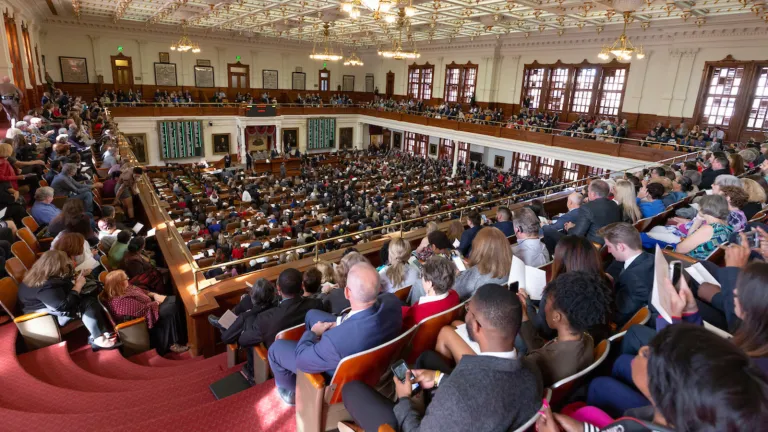
First, remember that back in mid-July, the Governor initially listed 17 items for “Special Session”, including three items related to flood recovery and emergency response, but also named many more partisan issues, including redrawing congressional maps to favor Republicans in the 2026 elections at the bequest of the President, and several other "red meat issues” like legislating bathroom use, access to abortion pills, and banning lobbying by cities and other political subdivisions. In response to the proposed gerrymandered congressional maps, more than 50 democrats in the House fled the state to stall voting on the maps until it was confirmed that some Democratic-led states would respond with their own redistricting plans. Our opinion? This race to the bottom of partisan politics hurts everyone.
In any case, the Democrats did return in mid-August and a new Special Session was announced with 18 charges, including camp safety (for the first time. While the Sierra Club had hoped that the legislature would seriously address not only camp safety and flood response but flood mitigation and long-term prevention, it doesn’t appear that it will happen.
We’ve seen this pattern before - like after Winter Storm Uri. We can’t expect our state’s leaders to do the right thing. Instead of preparing for the inevitable, they’d rather wait for a catastrophic storm, react just enough to claim they did something, then move on. Our leaders have had years to do something to prepare for and mitigate flooding, yet they have favored politics over people.
The first priority for Gov. Greg Abbott and the Texas Legislature during the second Special Session was again the mid-decade redistricting power grab at the expense of special session bills that could have addressed serious deficiencies in our state’s flood planning and response. The very first bill that passed the House of Representatives was HB 4 - the congressional maps - not flood response or recovery. The Senate quickly followed suit passing the bill on August 23 and sending it to the Governor’s office on August 27. He signed it into law that very day.
We expect that the Legislature will wrap up passage of some important bills related to floods, flood response and camp safety this week. The Legislature has approved several bills supported by the Sierra Club, which on the whole should protect more people from future disasters, though we believe they fall far short of what is needed.
One major bill - SB 2 (Relating to disaster preparedness, response, and recovery) by Sen. Charles Perry and Rep. Ken King - was passed by both the House and Senate, although there are differences in the two versions of the bill that still must be worked out between the two chambers. The slight differences between the two versions should be worked out next week.
The bill will lead to improvements in the way the state and local governments respond to disasters, including the need for better training, coordination, and management. SB 2 provides, among other provisions, for educational requirements for certain justices of the peace on managing mass fatality events, the revision of statutory provisions relating to required emergency management training for certain government officials, the licensing of emergency management coordinators of certain political subdivisions, the establishment of a statewide volunteer management system, and, among other provisions regarding mass fatality operations, the creation of a mass fatality operations rapid response team and a centralized mass fatality data management system.
SB 3 by Sen. Bettancourt is related to sirens and other early warning systems has also passed the Senate and the House. The bill does two things -requires the Texas Water Development Board to create rules and a program to determine where it makes sense to implement early warning siren systems (and related equipment) for floods and other emergencies - and creates a grant program at the Office of the Governor to provide grants to governmental entities. While Sierra Club argued that it made more sense for the TWDB to be the entity that actually grants the money, the bill does provide some coordination language and states that the Office of the Governor can deputize another state agency to run the program, a change the Sierra Club advocated for.
Another bill we support - HB 3 by Rep. Ken King - which relates to the creation and operation of the Texas Interoperability Council, as well as a grant program- has passed the House and has yet to be taken up by the Senate. By establishing the Texas Interoperability Council and a grant program, this bill provides much-needed resources to help local entities upgrade emergency communication infrastructure, train local first responders, and ensure effective coordination across jurisdictions. These investments will save lives, especially in rural or flood-prone areas where communication breakdowns can have devastating consequences, and where fire departments and EMS personnel can be several hours away.
SB 5 by Sen. Joan Huffman is a funding bill that provides money out of the “Rainy Day” fund for many of these programs though the House and Senate have not worked out the differences. The bill includes - depending on the version - from $200 million to $240 million in matching grants for future FEMA funding, $50 million for the early warning systems for local governments, $28 million for improved meteorological stations and forecasting, $24 million in the Senate version for a training facility for emergency and fire personnel for flooding rescues, and in the House version, $100 million for both the interoperability council grants as well as other communication and coordination funding. Again, while Sierra Club supported this legislation, we also called for additional funding for water data science, technical assistance, and flood buyout and conservation easements for lands that can help mitigate flooding.
The other major piece of legislation are competing approaches to camp safety, both of which are supported by the Sierra Club. It is worth noting that camp safety was not even on the call of the first special session, and the parents whose daughters lost their lives in the July 4th flood, began to organize themselves collectively and call for much stronger legislation than was initially offered.
First, HB 1 by Rep. Drew Darby focuses more narrowly on youth camps, significantly expanding the requirements for emergency planning and safety. Important provisions were added on the House floor that prohibits residential camp buildings from being located in flood plains, and the bill has important penalties - including up to criminal penalties - for camps that do not follow new rules that are developed on emergency planning and preparedness. The bill is expected to be taken up by the Senate this week.
SB 1 by Sen. Charles Perry is even broader. While less specific on the emergency plans, the bill covers a larger amount of camps and campgrounds, also in general bans residential camps in floodplains - with some exceptions for “lake” camps where there is a controlled dam, and includes the following provisions:
SB 1 includes a number of important measures which we support, including :
- Make some definitional changes, including defining floodplain and floodway in the health and safety code.
- Requires DHS to keep an updated list of licensed youth camps.
- Requires campgrounds located in a 100 year floodplain to provide emergency rooftop access ladders in cabins located within the floodplain, adopt flash flood evacuation plans, and implement their flash flood provisions when under a flash flood warning.
- Makes a general provision that the Department may not issue a license or relicense to youth camps with one or more cabins in the floodplain (with exceptions for lakes or pond cabins).
- Requires establishment of rules and procedures to deal with specific emergencies, including lost campers, injuries, fires and floods among other provisions.
- Requires camps that don’t meet the emergency plan standards adopted by DHS to resubmit a plan within 90 days
Assure that camps meet certain fire protection standards, referencing the 2021 edition of the Standard for Recreational Vehicle Parks and Campgrounds.
Sierra Club believes that the Legislature must pass both HB 1 and SB 1, and also establish very specific standards for what camps can build and how they can build in the 100-year and 500-year floodplain. SB 1 is being taken up by the House this week.
Finally, another bill supported by the Sierra Club, SB 14 by Sen. Charles Perry, deals not directly with floods but water conservation and reuse and requires cities to work with developers to consider lowering impact fees for developments that use advanced water conservation and water reuse technologies and measures. If developers of subdivision can show their development will lead to less water and wastewater use, they can pay less in impact fees, which should provide an incentive for saving water and reusing water - which could actually lessen downstream impacts.
So with some movement on flood response and better coordination, why do we continue to be disappointed in leadership’s focus?
Yes, the Sierra Club believes that HB 1, SB 1, HB 3, SB 3, and SB 5 (and some other bills on flood response that are moving through the process) are all good bills that will help save lives and prepare for future flooding, but they are largely reactive and ignore other solutions. But these leaders have known that people live and work in “Flash Flood Alley.” Other areas of the state like the coast are subject to tropical storms and hurricanes. That’s why lawmakers in 2019 directed the Texas Water Development Board (TWDB) to create the first State Flood Plan - an enormous, science-based effort that includes more than 4,600 flood mitigation strategies. Just a few months later, when it came time to fund those programs and solutions, they ignored TWDB recommendations, underfunded the state flood plan, and left local governments with their hands tied.
While the legislature did allocate $2.5 billion for water projects, this was mainly focused on water supply and wastewater treatment, not flood mitigation. A $1 billion annual investment was approved for the Texas Water Fund, which, if approved by voters this November, will start in 2027. Those funds will be split between a dozen competing programs. Meanwhile, the state approved billions in corporate subsidies and tax breaks for polluting industries.
When state leaders can find billions for corporate handouts, but not for protecting Texas families, it’s time to ask: Whose future do they care about?
They also failed to pass basic measures that would give counties the authority to regulate land use in flood-prone areas - tools that could have protected aquifer recharge zones and prevented development in low-lying land. Lawmakers also abandoned HB 13 (Rep. Ken King), a bipartisan bill that would have created a statewide emergency communications strategy after last year’s deadly wildfires. Fortunately, as mentioned, King did refile HB 13 as HB 3, which hopefully will pass before the end of the 2nd Special Session.
The State Flood Plan does outline a number of preventative measures such as adopting FEMA’s flood control standards and encouraging the development of even higher standards in communities with high flood risks, granting counties the authority to collect drainage fees to fund local flood mitigation infrastructure, the adoption and enforcement of modern building codes in unincorporated areas - and the recommendation to use the best available science, like Atlas 15 and climate projections, to guide the planning process going forward. Investments made before a disaster are exponentially more cost-effective than those made in the wake of destruction.
Some of these measures would be addressed if bills filed in Special Session were to pass and be signed by the Governor. For example, the Legislature did hold a hearing last week on a bill by Rep. Erin Zwiener - HB 117 - which would allow counties to regulate impervious cover for the expressed purpose of better mitigating floods. The bill however has not even been passed out of committee despite broad support. Another bill by Rep. Zwiener - also filed by Sen. Sarah Eckhardt - HB 108 in the House and SB 45 in the Senate - would allow counties to establish drainage utilities, impose drainage fees, and regulate land use for the purpose of flood management.
Another issue is the lack of action in Texas on building codes, which makes our infrastructure more climate resistant and protective from floods, hurricanes and other disasters. Rep. Ron Reynolds has filed important legislation to update the statewide building code both in cities (HB 306) and Counties (HB 225). Texas is still using a minimum 2006 code in our counties and 2012 in our cities. Unfortunately, those bills have not even been referred to committee.
Every Texan deserves to be safe in their home or place of work. We can’t stop the rain, but we can stop pretending that nothing can be done to prevent the worst from happening. Sierra Club will continue to press state leaders to address these issues in the interim even as the second Special Session comes to a close.
Join us by signing up for legislative updates.