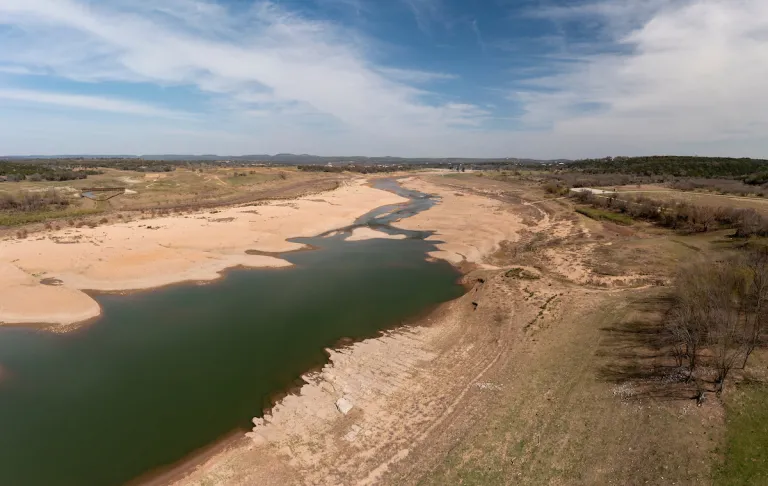
With the rapidly growing population, intensifying droughts, and water-guzzling industries like data centers expanding across the state, demand for water in Texas is rising fast. The Texas State Water Plan projects that by 2050, water demand will increase by 9%, while water supplies are expected to drop by 18%. This November, Texas voters have a historic opportunity to address this challenge with Proposition 4 on the ballot. If it passes, this proposition would lock in a massive investment in our state’s water needs: an annual dedication of $1 billion to the Texas Water Fund through 2047.
What Is the Texas Water Fund?
Established by the 88th Texas Legislature, the Texas Water Fund is a special fund in the state treasury created to finance various water projects across the state. This fund is administered by the Texas Water Development Board (TWDB) and includes ten separate programs, each having a different focus. Think of the Texas Water Fund as a toolbox with different tools in it, each designed to fix a particular water issue:
- New Water Supply for Texas Fund provides financial assistance to political subdivisions to develop new sources of water by turning currently unusable or inaccessible water into new supply. Examples of projects include seawater desalination, oil and gas wastewater (“produced water”) treatment and reuse, reservoirs, statewide water grid, acquisition of water from out of state, water and wastewater reuse projects, and aquifer storage and recovery. Of these, all except the last two raise concerns due to their potential impacts on ecosystems, equitable distribution of benefits and risks, and the lack of enforceable regulations to prevent harm to people and the environment.
- Flood Infrastructure Fund supports flood management efforts across the state by providing financial assistance to local governments for flood mitigation, flood control and drainage projects. To qualify for this funding, projects must be included in the State Flood Plan. Added to the Texas Water Fund by the 89th Legislature, the Flood Infrastructure Fund supports a wide range of projects, such as stormwater infrastructure, nature-based solutions, early flood warning systems, drainage systems, and acquisition of properties in flood-prone areas, among others.
- State Water Implementation Fund for Texas (SWIFT) provides financial assistance to help communities implement various water projects. By offering low-interest loans and flexible repayment options, SWIFT makes it easier for local entities to invest into long-term water solutions. Only projects listed in the State Water Plan are eligible for funding through SWIFT. Examples of projects include water conservation and reuse, construction of new pipelines, groundwater and marine desalination, reservoirs, purchasing of water rights, and others.
- Agricultural Water Conservation Fund - or Agricultural Water Conservation Grants Program - provides grants to state agencies and political subdivisions for agricultural irrigation projects. To be eligible for this funding, projects must support the goals outlined in the State Water Plan, including improving irrigation efficiency, boosting agriculture resilience to extreme weather, and encouraging new technologies and innovation. The Agricultural Water Conservation Fund was included in the Texas Water Fund by the 89th Legislature.
- Economically Distressed Areas Program (EDAP) offers grants and loans to local governments and nonprofit water supply corporations for residential water and wastewater projects in historically underserved communities. Added to the Texas Water Fund by the 89th Legislature, EDAP funds such projects as first-time water and wastewater services, upgrades to water supply and treatment systems, and improvements to wastewater collection and treatment infrastructure.
- Rural Water Assistance Fund offers low-cost financing for water and wastewater projects in small, rural political subdivisions. Eligible activities include water projects in the State Water Plan and a Regional Water Plan, wastewater collection and treatment, construction of wells, water service lines, and many others.
- State Revolving Funds: Clean Water State Revolving Fund and Drinking Water State Revolving Fund are federally and state-funded loan programs to help Texas communities finance water and wastewater infrastructure projects. TWDB receives an initial federal grant and uses it to provide low-interest loans for projects like building wastewater facilities and improving drinking water systems. As communities repay these loans, TWDB lends these funds to new projects.
- Texas Water Development Fund (DFund) provides state loans to political subdivisions and nonprofit water supply corporations for regional wastewater, flood mitigation, water quality enhancements, and water supply projects consistent with the State Water Plan. This program also allows borrowers to bundle different types of water projects into a single loan.
- State Participation Program helps local water entities fund regional water supply, wastewater, or flood control projects by providing state funding for excess capacity that local sponsors can’t afford on their own. This program encourages building “right-sized” infrastructure that meets current and future needs by allowing TWDB to temporarily share ownership and reduce upfront local costs.
- Water Loan Assistance Fund provides a combination of grants and low-interest loans to support water conservation and water loss reduction projects in communities with a population not exceeding 150,000. Eligible projects address aging infrastructure, construction of new infrastructure, water conservation, and others.
Why Public Engagement Matters On Prop 4
If passed this fall, Proposition 4 will unlock $1 billion in annual funding for a wide range of water projects across Texas – everything from long-overdue infrastructure upgrades and flood mitigation to improvements in historically underserved communities and other sustainable water solutions.
But while this funding presents a major opportunity, how it gets spent is just as important. The $1 billion will go into the Texas Water Fund, which must be divided across several programs. At least half of the money is required to go to two specific programs: the New Water Supply for Texas Fund and SWIFT. However, there’s no rule on how that half must be split between the two. The concern is that a large portion could be directed toward controversial or environmentally harmful projects, such as seawater desalination, reservoirs, or toxic produced water reuse – all eligible under the New Water Supply for Texas Fund.
The remaining 50% of the funding will be divided among eight other programs, many of which support more sustainable and community-focused projects. But again, no specific amounts are required for each program. This gives TWDB broad discretion in how the money is allocated. That’s why public engagement will be essential if the proposition passes: so communities can help shape funding priorities and ensure investments reflect cost-effective and sustainable water solutions.
The bottom line is clear: Texas desperately needs funding for water, but how that funding is used will shape the state’s water future for decades to come. Stay tuned for our weekly Proposition 4 Educational Series, where we’ll share more information on how you can get involved in the water funding allocation decisions.