Big Bend National Park Camping, Hiking or Backpacking - February 18-22(or 23) Wednesday - Sunday (or Monday)
Note all of the trips are full - Contact Jim Robarge at robargeDSC@gmail.com to be placed on the waiting list.
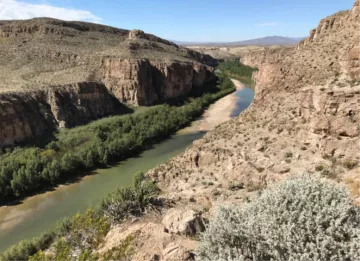
The Big Bend of Texas has been shaped by eruptions, folds, faults, wind, water, and human management into a fabric of scrubby desert, forested mountains, canyons, pinnacles, and pour-offs. The region and the national park take their names from the giant curve the Rio Grande makes as it flows south, east, and north around the land. Climate and vegetation in the park vary dramatically with elevations from 7,825 feet at Emory Peak to 1,680 feet on the Rio Grande. Remnant Ponderosa pines, Douglas firs, aspens, maples, and oaks can be found at elevations above 6,000 feet. As elevations decrease, forests yield to junipers, then to desert plant communities of agave, yucca, sotol, ocotillo, mesquite, creosote and cactus. The park’s mammal community includes mountain lions, foxes, bobcats, bears, javelinas, mule deer, and white tail deer.
For more information about the park, visit http://www.nps.gov/bibe.
The 2026 Outing:
The Dallas Group of Sierra Club has a long history of outings to hike, camp, and backpack in the Big Bend. This year’s outing offers a choice of three trip itineraries. Two include backpacking. One offers day hikes that return to the same camp each night. Choose your preferred itineraries when you register. For trip 1, hikers should arrive after 1:00 p.m. and before dark on Wednesday, February 18 at the Chisos Basin Group Campground R. For trip 2 & 3, hikers should arrive after 1:00 p.m. and before dark on Wednesday, February 18 at the Chisos Basin Group Campground, sites P & Q. Each trip itinerary has limits for number of participants and/or tents. Early registration is advised.
Itinerary:
Trip 1: Day Hiking and Exploring Big Bend
This itinerary is ideal for people in good condition who would like to day hike in different areas of Big Bend National Park. Contact the trip leader about questions and concerns. This trip will give you the opportunity to explore more of Big Bend National Park than any of the other trips but will require a bit of driving. If you've never been to Big Bend, this trip offers an excellent opportunity to explore the park from end-to-end.
Wednesday, Feb. 18: Arrive before dark to camp at Chisos Basin Group Campsite R.
Thursday, Feb. 19: We will leave the group camp site after breakfast and drive to Rio Grande Village at the far eastern end of the park – about 30 miles. From there, we will day hike to the famous Hot Springs area. The day hike is a 6 miles round trip with very little elevation gain/loss. At the Hot Springs, we can soak in the spring and explore the historic buildings. If time permits, we may also take a short hike into the mouth of Boquillas Canyon before returning to our camp.
Friday, Feb. 20: This is our hard day. We will day hike to the South Rim of the Chisos Mountains. This is considered by most experts as the best hike in Texas. You’ll enjoy fantastic views of Big Bend and the mountains of Mexico. The total hike is about 12 miles with about 2,000 feet of elevation gain/ loss, but there are some options for a shorter hike for anyone not up to this length of hike.
Saturday, Feb. 21: On our last full day, we will drive the Ross Maxwell Scenic Drive to visit the western part of the park. Our first stop will be an easy 4-mile day hike to visit the top of Burro Mesa Pour-off. After our hike, we will continue driving south to visit the Castolon historic area followed by a visit to the mouth of Santa Elena Canyon. We will then return to our group campsite in the Chisos. This day has about 90 miles of driving.
Sunday, Feb. 22: Break camp Sunday morning to travel home.
Leader: Arthur Kuehne, arthur@akuehne.com, 214-608-3210
Trip 2: The High Chisos (Note: the High Chisos trip is full - we are happy to place you on a waiting list.)
This itinerary is suitable for experienced and beginner backpackers in good physical condition.
Contact the trip leader about questions and concerns.
Wednesday, Feb. 18: Arrive before dark to camp at Chisos Basin Group Campsites Q.
Thursday, Feb. 19: After breakfast, hike the scenic Laguna Meadows Trail, connecting to Colima Trail where we will setup camp for two nights (5 miles, gradual 2,100 ascent).
Friday, Feb. 20: This is our day to day hike some of the premier trails of Big Bend. From camp we’ll hike South on the Boot Canyon Trail and around the Southwest Rim to enjoy the spectacular views. We'll loop back North and continue on to explore the Laguna Meadow before returning to camp (6 miles, 500ft gain).
Saturday, Feb. 21: We’ll break camp and hike down the Pinnacles Trails to summit Emory Peak (elevation 7,832’), the tallest mountain in Big Bend National park. From the peak we’ll have 360-degree views and a leisurely lunch. Then hiking on to camp at Boulder Meadow (6 miles, 1,400 gain).
Sunday, Feb. 22: On the last day pack up early and leave camp to hike a couple of miles to the basin for breakfast. Head out on the Window View Trail by 9 am stopping at the Window for a nice view. Then hiking out on the Oak Spring Trail to Sam Nail Ranch to pick up a stored car and return to the basin (7 miles, ~450ft of loss). Begin travel to home on Sunday afternoon.
Monday, Feb. 23: Complete the drive home as necessary.
Leader: Christian Costello, j.christian.costello@gmail.com 972-591-1547
Trip 3: Outer Mountain Loop Hike
This strenuous but rewarding hike offers a variety of biomes that define Big Bend - from steep, rocky climbs through the forested Chisos Mountains to cactus-dodging treks across gently rolling, un-shaded desert. A high level of fitness and the ability to bear the weight of four or more liters of water at a time are musts. Note, if Boots Springs is dry, then participants will need to carry 7 - 8 liters of water up the Pinnacles Trail the first day.
Wednesday, Feb. 18: Arrive in the afternoon at Group Campsite P. Some of us will drive to Homer Wilson Ranch to cache water for use later during our hike.
Thursday, Feb. 19: From the Basin trailhead, hike into the Chisos Mountains via the Pinnacles Trail to Boot Spring. After loading up on water, hike the Juniper Canyon Trail to our dry campsite beyond Upper Juniper Springs. Total of 6.4 miles, 1,800’ ascent, 1,700’ descent.
Friday, Feb. 20: Continue down the Juniper Canyon Trail and along the Dodson Trail to camp at Fresno Creek. Total of 9.2 miles for the day. 1,700’ descent, 900’ ascent.
Saturday, Feb. 21: Hike the Dodson Trail. We will stop at the Homer Wilson Ranch, pick up cached water and continue another two miles up the Blue Creek Trail to camp in a dry wash. Total of 8 miles. 2,000’ descent, 1,800’ ascent.
Sunday, Feb. 22: Continue hiking northeast and make the steep climb back into the high country, then trek down the Laguna Trail to return to the basin campground, group site R. Total 7.2 miles. About 2000’ ascent, 1300’ descent. In all, we will have hiked 30.8 miles and gained a cumulative 6,500 feet of elevation. Begin travel to home on Sunday afternoon.
Monday, Feb. 23: Complete the drive home as necessary.
Leader: Jim Robarge, robargeDSC@gmail.com 972-505-9567
Trip leaders reserve the right to modify these itineraries due to weather, trail conditions, changes to park rules, group strength, and other factors.
To Register: Check availability before registering
After reading all of the information on this web page. If you have questions, contact the trip organizer or any of the trip leaders. Then, if you want to go on this trip, follow these steps:
- Fill Out Forms: Open this PDF. It has three forms, a general information form, a trip participation form and a medical form. You can print these forms and fill them out by hand, or you can fill them out on your computer and then print and sign them, or you can download the form, fill them out on your computer and save them. Photos of the forms are not acceptable.
- Pay for the trip: The fee for this trip is $100.00 per person. Click here to pay for the trip. The trip fee covers expenses for the group campsite, hiking permits, and expenses of the Dallas Sierra Club's outings program. Excess funds benefit the Dallas Sierra Club's conservation efforts.
- Send your forms and payment: Send your forms and payment (if paying by check or money order) to Jim Robarge, 2615 Woodside Drive, Highland Village, TX 75077 OR email your forms (the pdf you filled out) to robargeDSC@gmail.com (and mail only check).
Your registration will be confirmed by email or phone.
Additional Costs:
There’s an additional entry pass fee of $30 per vehicle on entry into Big Bend National Park, but the fee is waived if anyone in the car presents a National Parks pass. The entry pass is good for 7 days.
Cancellations:
The $100 trip fee is non-refundable.
If the Sierra Club cancels the outing for any reason, your $100.00 trip fee will be refunded in full, but Sierra Club is not responsible for and will not refund any payments you may have made for airfare, lodging, or other expenses. You might want to consider trip insurance if you anticipate significant expenses.
Gear:
Each person is responsible for bringing personal gear and food. Sharing a tent or other gear with a friend is fine. A basic gear list follows. We encourage calling leaders with gear questions. If your loaded pack exceeds 25 to 30 pounds before you add water (2.2 pounds per liter), lighten your load!
- Tent, sleeping bag, sleep pad: A backpacker needs a lightweight tent, a sleeping bag, and an air mattress or sleep pad. The function of the air mattress is to insulate you from cold ground.
- Backpack: For Trips 2 or 3, you’ll need a backpack for all your gear, food and water. For day hikes, you might offload your pack or most of its gear into your tent or the bear boxes by most camps. Consider adding a lightweight rucksack for water and essentials on day hikes. For Trip 1, you will need a daypack large enough for water, lunch, extra clothing, your first aid kit, etc.
- Food: The food you pack, and carry depends on your trip’s daily itinerary and your taste. Most hikers prepare a hot meal in the early evening. Dehydrated foods requiring only boiling water and a short wait for rehydration are available at outing stores, but good and less expensive meal alternatives are available from grocery stores. Hikers generally bring a no-cook meal for lunch. Some will eat a quick cooked breakfast; others a no-cook breakfast. Bring snacks for the trail. Ground fires and wood fires are prohibited in BBNP. Charcoal fires are allowed in the grills provided at group campsites, but we recommend cooking with tiny, canned fuel stoves because they don’t emit smoke or embers.
- Water: Water from the visitor centers and group campgrounds needs no treatment. Except from those sources, water for drinking must be treated by tablets, filtration, or boiling. Ask your trip leader’s recommendation regarding how much water capacity to bring and how much to carry each day.
- Clothing: Layers are key to comfort, given the range of possible weather conditions. Five layers for your torso are recommended (including a rain/wind shell), two layers for your legs. (One layer could be rain pants, which double as thermal protection.) Denim become chilly and heavy when wet and should be avoided. Wear tested boots or trail runners and two layers of socks (thin sock on the inside to preclude blisters). Bring gloves and a cap to keep your head warm at night. Don’t forget a hat, sunglasses and sunscreen for UV protection.
- Other stuff: Don’t forget a headlamp or flashlight and personal health and first aid items. Bring or share a lightweight garden trowel and tissue for personal waste disposal plus a zip-lock bag for used tissues. That’s right—pack out the paper!
Bears:
Common in the 1900s, black bears disappeared from the Big Bend until they re-colonized in the late 1980s. They don’t completely hibernate in the Big Bend but spend most of the winter in dens. Mothers give birth to cubs in February. Sites where Trips 1 and 3 will camp have metal bear-proof boxes for food storage. Take precautions to avoid losing your food to bears, deer or smaller critters:
• Store food and items that smell in the bear boxes. Otherwise, always keep those items on your person, in your control.
• Don’t eat in your tent or store food or items with food spills in your tent.
• Prepare meals away from your sleeping area.
• Disperse cooking water over a wide area, away from camp.
• Store trash in your food bag (within a separate plastic bag).
• Pack out all leftover food and trash.
Weather:
Mid to late February weather in Big Bend is usually good with highs in the 70s and lows around 40. February is usually dry with clear skies. Extremes can range from the 90s to the 20s with occasional sleet or snow. There can also be quite a bit of variation in the park due to elevation differences.
Maps:
Maps of Big Bend National Park are available at www.nps.gov/bibe/planyourvisit/maps.htm, including an excellent printable map of trails and camps in the Chisos Mountains and a map of the Chisos Basin and Rio Grande Village. A good paper map of the whole park with topography is National Geographic Trails Illustrated Map 225, available online and at stores for $14.95.
Leave No Trace:
Leave-no-trace wilderness ethics are expected of all participants. All trash must be packed out; human waste buried and used toilet paper packed out. (Bring a zip-lock bag.) Pets, firearms and smoking are not allowed.
Medical:
Our leaders have trained for wilderness first aid, but they are not medical professionals. Participants are encouraged to bring first aid supplies for personal use and to inform leaders about a medical condition such as diabetes, heart problems or allergic reactions that could require emergency treatment. Tell the leader where you store vital medications you could need. Medical information you provide may be shared with medical professionals who treat you in the event of injury or sickness.
Group = Safety:
Participants who leave the led group without leader consent will be asked to sign out of the trip and will no longer be part of the outing. If you leave the outing, don’t hike alone and always hike on a trail. Most deaths in wild areas occur when a solo hiker becomes incapacitated before being found. When leaving camp, especially at night, be careful to not get disoriented.
Minors:
Minors may participate with leader consent if always accompanied by their parent or legal guardian.
California Seller of Travel Law: Because the Sierra Club is a California nonprofit corporation and California has a "Seller of Travel" law; we’re required to post this notice:
CST 2087766-40. Registration as a seller of travel does not constitute approval by the State of California.
Okay, we’ve complied.