Vermont Leadership Release Bold Proposal To Reduce Carbon Emissions From the Largest Source: Transportation
MONTPELIER, VT -- Today, key legislative leaders released a proposal to address climate change in the 2021 Vermont Transportation Bill. As the transportation sector makes up nearly half of Vermont’s carbon emissions, these key proposals will produce results to immediately begin achieving the requirements of the Global Warming Solutions Act.
Historically, members of the House Committee on Transportation wait for the Governor and the Agency of Transportation to submit a draft transportation budget of their priorities. Members of the transportation committee then deliberate on how to incorporate their priorities into an already established budget.
However, today, these legislators are letting the Governor and Lt. Governor know that the following proposals are transportation priorities and that these concepts will be part of what the Transportation Committee plans to be in the 2021(FY22) Transportation Bill.
The proposal includes four key areas of transportation policy:
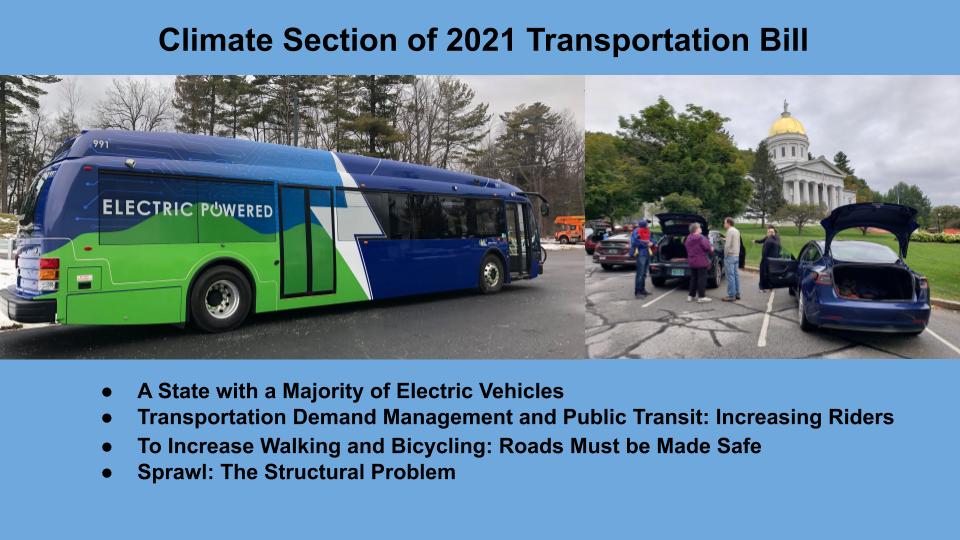
- A State with a Majority of Electric Vehicles
- Transportation Demand Management and Public Transit: Increasing Riders
- To Increase Walking and Bicycling: Roads Must be Made Safe
- Sprawl: The Structural Problem
In January, Members of the House Transportation Committee will be introducing legislation in the 2021 Session of the Legislature to create a Climate Section of the Transportation Program (T-Bill).
"The Global Warming Solutions Act" creates pressure on the State to act on behalf of Vermonters to drastically reduce our greenhouse gas emissions. Serious action will follow the passage of this act. Our proposal to create a climate section in the Transportation Program - the T-Bill, is the first example of this pressure. Nothing in this proposal is new. As a matter of fact, most of the thirteen elements exist in Vermont already. This proposal lifts us from the token level of EV, carpool and transit incentives, and charging infrastructure, to a serious level that will result in EV take over of the automobile, truck, and bus market and truly complete safe streets and roads for pedestrians and bicycles. With this proposal, Vermont will live up to the environment leadership position we no longer hold,” said Curt McCormack, House Transportation Committee Chair, Burlington.
“The draft budgets that the legislature has received from Gov. Scott over the years shows that he is not putting climate front and center - where it needs to be. By reducing our reliance on fossil fuel here in Vermont we improve the economy and the health of our citizens while doing our part to reduce emissions. Although I won’t be there in the next biennium I’m excited the legislature is moving forward now to do this hard work. I’ll be doing my part from the sidelines and cheering everyone on,” said Representative Mary Sullivan, Burlington.
“We can and must take a great leap forward with these proposals to transform the energy we use to fuel Vermonters' transportation needs. I drive one of the thousands of electric vehicles registered in Vermont, but we need tens and then hundreds of thousands of cleaner vehicles in the next decade to meet our emissions reduction goals. With these investments in incentives and charging infrastructure we can eliminate the cost and range barriers and get more Vermonters making the switch to vehicles that are cheaper to maintain, more fun to operate, and far less expensive to fuel than their gas-guzzling counterparts, " - said Representative Mike McCarthy, St. Albans City,
“Whether you live in downtown or on a dirt road, Vermonters have the ability to use transportation demand management practices to lower our state's carbon footprint. Due to COVID-19 Employers scrambled to find implement solutions for telecommuting and remote work. We have the opportunity now to build on that quick pivot by implementing best practices that put in place single person, single-vehicle trips reductions. Let's build back our transportation patterns for the better, and change behaviors with the help of legislation that is forward-thinking," said Representative Becca White, Hartford.
"The Climate section of the T bill will provide a clear path forward for realizing the goals of cutting carbon emissions from the transportation sector, as now mandated by the Global Warming Solutions Act. In the realm of public transit, we can build on existing pilot projects creating more efficient and accessible route designs while moving to an all-electric fleet. Investment in transit electrification, along with projects and programs to attract new public transit riders, will cut vehicle emissions while also saving Vermonters money," said Representative Mollie Burke, Brattleboro.
Vermont Leadership drastically reducing carbon emissions from the largest source: transportation
Offered by House Committee on Transportation members
Rep. McCormack, Chair (Burlington)
Rep. Burke (Brattleboro)
Rep. McCarthy (St. Albans City)
Rep. Sullivan (Burlington)
Rep. White (Hartford)
In January, members of the House Transportation Committee will be introducing legislation in the 2021 Session of the Legislature to create a Climate Section of the Transportation Program (T-Bill). As the transportation sector makes up nearly half of Vermont’s carbon emissions, these key proposals will produce results to immediately begin achieving the requirements of the Global Warming Solutions Act.
Although the threat of the COVID 19 crisis is still evident, Vermont can proactively work on these measures to develop a 21st Century Transportation system that is Clean, Accessible and Affordable. Vermont can ensure that all people and communities can have their transportation needs met while helping the Vermont economy and increasing Vermonters’ quality of life. Many of these thirteen solutions can be achieved with reappropriating of existing revenues.
A State with a Majority of Electric Vehicles (EVs)
1. Ensure that Support for Existing EV/Used EV/Vehicle Replacement and Repair Incentive Programs is in Proportion to Meeting the state’s Climate Requirements.
Incentives have been successful in increasing the sale of EVs in other states. The Vermont "New EV Incentive Program" that went into effect in December 2019 has already helped 254 EV sales (as of August 25, 2020). As demonstrated in other states and in Europe (in the first half of 2020, 48% of car sales in Norway were fully electric EVs), the most effective things that governments can do is to provide for enough charging stations and incentivize the purchase of EVs.
2. Adequate amount of Level II charging stations in downtowns, schools, park and rides.
While Vermont utilities are offering incentives of providing level II charging equipment, Vermont should consider incentivizing the installation costs and other methods to enable greater access to Level II charging.
3. All New Transit Buses and School Buses are Electric
Transit and school buses last on the road for around 12 years, too long a time to be investing in new fossil fuel powered buses. The time has passed for slow, phase-ins. It is time to act.
4. Require Employers of 50 or more employees to provide Level II Electric Vehicle (EV) Chargers at the workplace.
While presently upwards of 85% of EV charging takes place at home mostly on Level II chargers, availability of Level IIs at workplaces, parking lots and downtowns continues to be sufficiently scant to discourage EV purchases. This State mandate should come with partial funds to install the chargers with the means for the employer to charge the commuter for the charge.
5. Update the Vermont Building Energy Code requirement for EV charging stations for Multi-unit Dwellings to provide Charging stations.
This would apply to new buildings. The state shall also look at requiring that all retrofitted buildings and existing structures reach that goal.
Transportation Demand Management and Public Transit: Increasing Riders
6. Employers of 50+Employees must have Transportation Demand Management (TDM)
As many Vermonters will be returning to in-person work, Vermont employees must adopt a TDM to discourage single occupancy automobile commutes by employees.
7. Continue Providing Fare-Free Transit
The Federal Cares Act funding has allowed all Vermont Transit Operators to provide fare-free transit during the COVID-19 crisis. A continuation of fare-free transit should be continued to protect drivers and passengers while also providing increased transit equity.
8. Support Innovative Micro-transit Solutions to Ensure Last Mile Options are Available for all Vermonters.
Innovative micro transits options, such as the pilot program in Montpelier, should be encouraged in all communities.
To Increase Walking and Bicycling: Roads Must be Made Safe
9. Require Serious Complete Streets
Presently this concept in the law is advisory. Hence, we are not seeing many complete streets even when re-constructing.
10. Bicycle Corridor Priority
The Bicycle/Pedestrian Program lacks a clear goal/strategy to accomplish safe roads in the short term. Even the most highly rated corridors on the VTRANS Bicycle Corridor Priority map are not safe yet, including in heavy traffic urban areas of the state such as in Chittenden and Rutland Counties. Starting with the “High Use Priority” bicycle corridors, these corridors need to be made safe as soon as possible.
11. Roundabout Development
VTRANS should explore building roundabouts state wide.
Sprawl: The Structural Problem
12. Discourage Sprawl Development through Stricter Transportation Criteria
Act 250 reform has been largely stalled in the legislature, with too many communities not only allowing but encouraging sprawl development.
13. Authorize Congestion Pricing for Chittenden County
Like electricity, we have to plan, design and build for the peak demand on highways. If the peak can be reduced instead, there are tremendous savings in dollars, land and pollution, including CO2 emissions.