Thank you to all of our volunteers, partners, donors, and supporters who helped us push back and fight for the things we care about this year. Here are the highlights from the year
Top highlights of the year
Fighting new methane gas plants
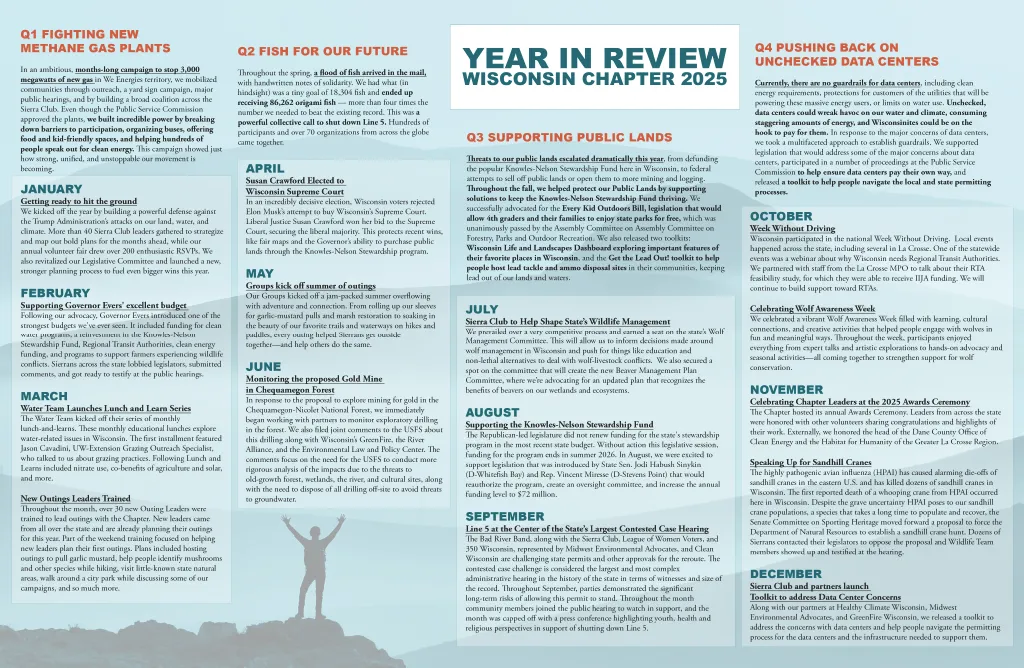
In an ambitious, months-long campaign to stop 3,000 megawatts of new gas in We Energies' territory, we mobilized communities through outreach, a yard sign campaign, major public hearings, and by building a broad coalition across the Sierra Club. Even though the Public Service Commission approved the plants, we built incredible power by breaking down barriers to participation, organizing buses, offering food and kid-friendly spaces, and helping hundreds of people speak out for clean energy. This campaign showed just how strong, unified, and unstoppable our movement is becoming.
Fish for our Future
Throughout the spring, a flood of fish arrived in the mail, with handwritten notes of solidarity. We had what (in hindsight) was a tiny goal of 18,304 fish and ended up receiving 86,262 origami fish — more than four times the number we needed to beat the existing record. This was a powerful collective call to shut down Line 5. Hundreds of participants and over 70 organizations from across the globe came together.
Supporting public lands
Threats to our public lands escalated dramatically this year, from defunding the popular Knowles-Nelson Stewardship Fund here in Wisconsin, to federal attempts to sell off public lands or open them to more mining and logging. Throughout the fall, we helped protect our Public Lands by supporting solutions to keep the Knowles-Nelson Stewardship Fund thriving. We successfully advocated for the Every Kid Outdoors Bill, legislation that would allow 4th graders and their families to enjoy state parks for free, which was unanimously passed by the Assembly Committee on Assembly Committee on Forestry, Parks and Outdoor Recreation. We also released two toolkits: Wisconsin Life and Landscapes Dashboard exploring important features of their favorite places in Wisconsin, and the Get the Lead Out! toolkit to help people host lead tackle and ammo disposal sites in their communities, keeping lead out of our lands and waters.
Pushing back on unchecked data centers
Currently, there are no guardrails for data centers, including clean energy requirements, protections for customers of the utilities that will be powering these massive energy users, or limits on water use. Unchecked, data centers could wreak havoc on our water and climate, consuming staggering amounts of energy, and Wisconsinites could be on the hook to pay for them. In response to the major concerns of data centers, we took a multifaceted approach to establish guardrails. We supported legislation that would address some of the major concerns about data centers, participated in a number of proceedings at the Public Service Commission to help ensure data centers pay their own way, and released a toolkit to help people navigate the local and state permitting processes.
Monthly Highlights
January
Getting ready to hit the ground
We kicked off the year by building a powerful defense against the Trump Administration’s attacks on our land, water, and climate. More than 40 Sierra Club leaders gathered to strategize and map out bold plans for the months ahead, while our annual volunteer fair drew over 200 enthusiastic RSVPs. We also revitalized our Legislative Committee and launched a new, stronger planning process to fuel even bigger wins this year.
Volunteer Fair
On January 23, we hosted our annual Virtual Volunteer Fair. There were 200 RSVPs and sixty attendees. We’re working to plug all these new people into our Teams and Groups, and train them as Outings leaders to create a bigger, better Chapter, ready for what this moment needs. Whether it’s fighting back against the Trump Administration, pushing for funding to clean up PFAS, or a desire to lead outings to remind everyone of the beauty of the state and the need to protect it, we are seeing a surge of interest from people across the state who want to make a difference.
Pushing back on new fossil fuel infrastructure
On Thursday, January 30th the Sierra Club filed testimony against We Energies’ proposal to charge residential gas customers to construct an LNG storage facility in Oak Creek. In the first year alone, the facility would cost $64.3 million to construct and operate, with those costs passed on to We Energies customers.
February
Supporting Governor Evers' excellent budget
Following our advocacy, Governor Evers introduced one of the strongest budgets we've ever seen. It included funding for clean water programs, include PFAS and lead pipes, a reinvestment in the Knowles-Nelson Stewardship Fund, Regional Transit Authorities, programs to support farmers experiencing wolf-livestock conflicts and crop damage from sandhill cranes, and clean energy funding to reduce energy burden as well. Sierrans across the state lobbied legislators, submitted comments, and got ready to testify at the public hearings.
Volunteer Night
We hosted a volunteer night where people took on various tasks, like data entry, letter stuffing, material creation, social media, etc. This was made for people who wanted to dip their toes in to volunteering but didn’t want to commit to a specific role.
We had 15 new volunteers attend, including one woman who it was her first time volunteering for any organization before. Four people who attended have joined a team and every one said they'll come back and volunteer again.
The top tasks people worked on were making origami fish in honor of shutting down Line 5 and completing backpack kits that help kids connect to nature that are being donated to a nearby school.
March
Line 5 reroute construction put on hold
In response to our lawsuit, the Judge ensured that construction of Line 5 reroute would not be allowed to move forward until the legal proceeding concluded later in 2025. This is an important delay as Enbridge wants the re-route completed before their court-ordered shutdown at the end of June 2026.
Water Team Launches Lunch and Learn Series
The Water Team kicked off their series of monthly lunch-and-learns. These monthly educational lunches explore water-related issues in Wisconsin. The first installment featured Jason Cavadini, UW-Extension Grazing Outreach Specialist, who talked to us about grazing practices. Following Lunch and Learns included nitrate use, co-benefits of agriculture and solar, and more.
New Outings Leaders Trained
Throughout the month, over 30 new Outing Leaders were trained to lead outings with the Chapter. New leaders came from all over the state and are already planning their outings for this year. Part of the weekend training focused on helping new leaders plan their first outings. Plans included hosting outings to pull garlic mustard, help people identify mushrooms and other species while hiking, visit little-known state natural areas, walk around a city park while discussing some of our campaigns, and so much more.
Oak Creek Hearings
Our coalition packed the room for the public hearings on the new oak creek gas plant south of Milwaukee, Wisconsin. The room was packed, and the second hearing ran out of time before everyone could testify. To increase access to the hearing, we provided activities for kids, food for attendees, and a bus and carpools.
April
Conservation Congress Results Show Support for Clean Water, Wildlife
Sierra Club members and thousands of other Wisconsinites participated in the Conservation Congress hearings, where voters overwhelmingly supported protections for drinking water, solutions for farmer-wildlife conflict, and protections from lead and oil pollution.
Susan Crawford Elected to Wisconsin Supreme Court
In an incredibly decisive election, Wisconsin voters rejected Elon Musk’s attempt to buy Wisconsin’s Supreme Court. Liberal Justice Susan Crawford won her bid to the Supreme Court, securing the liberal majority. This protects recent wins, like fair maps and the Governor’s ability to purchase public lands through the Knowles-Nelson Stewardship program.
West High Students Make Origami Fish
As part of our campaign to break the world record for largest collection of origami fish, as a call to shut down Line 5, we spent the day, with partner Healthy Climate Wisconsin, at a local high school talking to the students about Line 5 and folding fish with them.
Celebrating International Beaver Day
This year, to honor International Beaver Day, the Wisconsin Chapter Wildlife Team engaged in a variety of activities to help bring awareness to the ecological benefits that beavers provide on the landscape, with a special emphasis on how valuable beavers are for Wisconsinites.
Here is a summary of our beaver outreach by our team of “beaver believers”:
- The team was successful in getting letters to the editor published in several different outlets across Wisconsin.
- This includes one letter getting attention on social media being shared by famous Beaver Believer, Heidi Perryman, all over the country inspiring even more awareness!
- A beaver blitz of cute photos along with important beaver facts were shared across the Wisconsin chapter social media platforms. (Check them out on Facebook, & Instagram)
- On April 5th we hosted a table at the Trout Unlimited event in Hayward, WI. It was a great opportunity to discuss beaver benefits and build relationships with other outdoor enthusiasts regarding coexistence between beaver and trout. (Photo with Wildlife team volunteers featured above)
- The Wildlife Team created a new Beaver Flyer that outlines the benefits beavers provide as nature’s ecosystem engineers!
People and Wolves Showing
The Wildlife Team hosted a screening of two documentaries and a conversation about the importance of coexisting with wolves and fighting to protect them in Wisconsin from irresponsible management. Almost 70 people attended the showing and we engaged a number of high school students that hated been involved previously.
Supporting the Governor’s Budget
The Wisconsin Chapter’s legislative program organized and mobilized support for Governor Ever’s proposed budget. Over the course of April, dozens of Sierra Club members weighed in on the process both digitally and in-person at four public budget hearings.
Earth Day
An earth day event at the state capitol with lots of art, folding origami fish to stop line 5, and displaying banners in the rotunda with parts per million of carbon painted on them.
May
Groups kick off summer of outings
Our Groups kicked off a jam-packed summer overflowing with adventure and connection. From rolling up our sleeves for garlic-mustard pulls and marsh restoration to soaking in the beauty of our favorite trails and waterways on hikes and paddles, every outing helped Sierrans get outside together—and help others do the same.
Conservation Congress Results Show Support for Clean Water, Wildlife
The released results of the Conservation Congress Spring Hearing showed Wisconsinites throughout the state support protections for drinking water, solutions for farmer-wildlife conflict, and protections for our land and waters.
- Clean water was overwhelmingly supported by voters, with over 68% of voters supporting PFAS safeguards and 79% supporting funding for nonpoint source pollution control and safeguards.
- Voters also supported programs that help farmers facing damage from wildlife. Common sense solutions like fencing, lights, and fladry have been proven to reduce, and sometimes eliminate, wolf-livestock conflicts. This allows wolves to continue their ecosystem functions and reduces livestock loss for farmers. 63% of voters supported financial assistance for farmers to move forward with these non-lethal solutions.
- Similarly, 69% of voters supported creating a Sandhill Crane Stamp to help farmers reduce crane-caused crop damage. Programs for seed treatment to prevent crop loss from sandhill crane and for non-lethal wolf-livestock conflicts were included in the state budget.
- Voters supported efforts to protect our lands, waters, and wildlife from pollution. Voters in every single county and 90% of voters statewide supported a requirement that pipeline companies provide more information about spills. This is likely in response to the Jefferson County Enbridge oil spill in 2024. Initially, Enbridge reported it was only a 2-gallon spill, but it turned out to be the largest oil spill in Wisconsin’s history at 69,300 gallons measured.
- 57% of voters also supported phasing out the use of lead ammunition and fishing tackle, so it is not left behind in the environment. Once in the environment, lead persists for hundreds of years. Often, bald eagles and other species will pick up pieces of toxic lead fragments left behind from bullets or fishing gear. And just like humans, these creatures can face dire health consequences from lead exposure. Each year in the United States, 10-20 million animals and birds die from lead poisoning.
- Finally, 77% of voters in all but two counties favored requirements that all active bear baits on Wisconsin public lands - federal, state, and county - be labeled with the owner's name. This will help conservation wardens in situations when they need to quickly contact bear bait owners, ensuring a quick remedy to any issues with bait stations on public lands.
June
Monitoring the proposed Gold Mine in Chequamegon Forest
In response to the proposal to explore mining for gold in the Chequamegon-Nicolet National Forest, we immediately began working with partners to monitor exploratory drilling in the forest. We also filed joint comments to the USFS about this drilling along with Wisconsin’s GreenFire, the River Alliance, and the Environmental Law and Policy Center. The comments focus on the need for the USFS to conduct more rigorous analysis of the impacts due to the threats to old-growth forest, wetlands, the river, and cultural sites, along with the need to dispose of all drilling off-site to avoid threats to groundwater.
Volunteers prepare Fish for the Future Display
Throughout the month, dozens of volunteers came into the office during the day or attended weekly volunteer nights to count origami fish and help prepare the elements for the world-record-breaking Fish for the Future display.
July
Gold Mine in Chequamegon Forest
In response to the proposal to explore mining for gold in the Chequamegon-Nicolet National Forest, we immediately began working with partners to monitor exploratory drilling in the forest. We also filed joint comments to the USFS about this drilling along with Wisconsin’s GreenFire, the River Alliance, and the Environmental Law and Policy Center. The comments focus on the need for the USFS to conduct more rigorous analysis of the impacts due to the threats to old-growth forest, wetlands, the river, and cultural sites along with the need to dispose of all drilling off-site to avoid threats to groundwater.
Sierra Club to Help Shape State’s Wildlife Management
We prevailed over a very competitive process and earned a seat on the state’s Wolf Management Committee. This will allow us to inform decisions made around wolf management in Wisconsin and push for things like education and non-lethal alternatives to deal with wolf-livestock conflicts. We also secured a spot on the committee that will create the new Beaver Management Plan Committee, where we’re advocating for an updated plan that recognizes the benefits of beavers on our wetlands and ecosystems.
86,262 fish!
We had what (in hindsight) was a tiny goal of 18,304 fish and ended up receiving 86,262 origami fish — more than four times the number we needed to beat the existing record.
People from all 50 states, Puerto Rico, D.C., Canada, Mexico, and even the Netherlands sent in fish. Boxes arrived with not just folded paper, but handwritten notes of hope, solidarity, and love for the Great Lakes.
And then, on July 12, we gathered together — volunteers, staff, supporters, and friends — to bring those fish to life in a massive, joy-filled event. Together, we laid out the full display, celebrated our record-smashing success, and felt the power of what we had built. 86,262 fish were displayed in an incredible exhibit in Milwaukee.
August
Chapter Teams raise $20,000
Sierra Club Teams worked together to plan our Locally Grown, Nationally Known fundraiser and raise $20,000 to support our work to protect Wisconsin’s lands, water, wildlife, and climate. Thank you to our great teams!
Supporting the Knowles-Nelson Stewardship Fund
The Republican-led legislature did not renew funding for the state's stewardship program in the most recent state budget. Without action this legislative session, funding for the program ends in summer 2026. In August, we were excited to support legislation that was introduced by State Sen. Jodi Habush Sinykin (D-Whitefish Bay) and Rep. Vincent Miresse (D-Stevens Point) that would reauthorize the program, create an oversight committee, and increase the annual funding level to $72 million.
Line 5 Contested Case Potluck
Sierra Club joined other environmental groups and the Bad River Band in challenging state permits for the proposed Line 5 reroute in last 2024. In August of this year the first day in a month long contested case hearing was held in Ashland, Wisconsin. The day beforehand we hosted a community potluck for members of the movement to gather and spend time together. There were upwards of 40 attendees. On the day of the hearing we engaged with the press and helped organize support for the legal teams arguing our case.
Happy Hours in La Crosse and Madison
The Chapter co-hosted Happy Hours with our Groups in La Crosse and Madison. It was a place for donors, Group and Chapter volunteers, and other leaders to connect, commiserate, and enjoy some great food and community.
September
Line 5 at the Center of the State’s Largest Contested Case Hearing
The Bad River Band, along with the Sierra Club, League of Women Voters, and 350 Wisconsin, represented by Midwest Environmental Advocates, and Clean Wisconsin are challenging state permits and other approvals for the reroute. The contested case challenge is considered the largest and most complex administrative hearing in the history of the state in terms of witnesses and size of the record. Throughout September, parties demonstrated the significant long-term risks of allowing this permit to stand. Throughout the month community members joined the public hearing to watch in support, and the month was capped off with a press conference highlighting youth, health and religious perspectives in support of shutting down Line 5.
Wisconsin Life and Landscapes Dashboard Release
The new dashboard and interactive map allow you to explore Wisconsin’s lands and waters through the lens of the global 30x30 initiative—the ambitious goal to protect 30% of lands and waters by 2030. From forests and wetlands to prairies and culturally important sites, the Layers of Wisconsin Life and Landscapes dashboard lets you see the diversity of habitats across the state, understand their crucial roles in climate mitigation, biodiversity, and human well-being, and even discover what’s thriving right in your own backyard.
Locally Grown, Nationally Known
This year the Wisconsin Chapter combined two of our annual fundraisers: Locally Grown, Nationally Known and Team Sierra and we are happy to say that this was our most successful year yet! We reached a higher goal than prior years, our Locally Grown program was a beautiful way to appreciate our state and uplift our work, and for the first time, every single team surpassed their fundraising goal!
Sierra Club releases New “Get the Lead Out” Toolkit
We released a new “Get the Lead Out” toolkit with information about lead tackle and ammo in our environment and the iimpacts on wildlife and humans. The kit includes a step-by-step guide on how to safely dispose of lead tackle, instructions for building a collection container, and ideas for spreading awareness in your community. You’ll also get a poster and sticker to help label your container and share the message with others. Together, these resources make it easy to take action and keep loons, eagles, turtles, and other wildlife safe.
Public Lands Month
This year, to honor our lands, showcase how important they are, and to protect them for future generations, we had a month of activities to enjoy and celebrate our lands, actions to stand up for them, and new tools to help you advocate for them. Read on for the highlights of the month, along with recordings and links if you missed them and want to check them out or use them for continued advocacy for our public lands.
🌟Highlights
- Over 350 people signed up for Public Lands events throughout the month
- In response to public outcry, the Democrats in the Wisconsin State Legislature introduced a new, major bill that would reauthorize funding for the Knowles-Nelson Stewardship Fund, just in time for Public Lands Month
- Thanks to our advocacy, the Every Kid Outdoors Bill, legislation that would allow 4th Graders and their families to enjoy state parks for free, unanimously passed the Assembly Committee on Assembly Committee on Forestry, Parks and Outdoor Recreation.
- In less than a week, over 100 people accessed the new Wisconsin Life and Lands Dashboard to learn about the important features of their favorite places and what they can do to protect them
- We launched a new Get the Lead Out! Program and already 40 people volunteered to host lead tackle and ammo disposal sites in their communities, keeping lead out of our lands and waters.
October
Week Without Driving
Wisconsin participated in the national Week Without Driving. Local events happened across the state, including several in La Crosse. One of the statewide events was a webinar about why Wisconsin needs Regional Transit Authorities. We partnered with staff from the La Crosse MPO to talk about their RTA feasibility study, for which they were able to receive IIJA funding. We will continue to build support toward RTAs.
Celebrating Wolf Awareness Week
We celebrated a vibrant Wolf Awareness Week filled with learning, cultural connections, and creative activities that helped people engage with wolves in fun and meaningful ways. Throughout the week, participants enjoyed everything from expert talks and artistic explorations to hands-on advocacy and seasonal activities—all coming together to strengthen support for wolf conservation.
1st Place in Applefest Parade
In early October we participated in the Bayfield Apple Festival parade with a float uplifting the Line 5 pipeline and why it's important to keep our waters clean and free of oil. This was the third year we participated and we won first prize (again!) in the nonprofit and business category. We had both returning participants and new members who joined us and got involved in the work to shut down Line 5. This was hosted the day after a community event to screenprint water protection messages and many participants attended both events.
Fish for the Future swims to the Wisconsin State Capitol
A new art installation in the Wisconsin State Capitol rotunda is capturing the movement to shut down Line 5. “Fish for the Future,” a massive collective effort to protect the Great Lakes and shut down the Line 5 oil pipeline, officially broke the world record this summer for the largest display of origami fish at 86,262 origami fish– crushing the previous world record at 18,303 fish. Origami fish were sent in from all 50 states, as well as Washington, D.C., Puerto Rico, Canada, Mexico, and the Netherlands.
The new Capitol installation follows the legal hearings challenging the Wisconsin Department of Natural Resources’ (DNR) decision to grant key state permits for the Line 5 reroute project, which would continue to jeopardize the water and safety of the Bad River Band of Lake Superior Chippewa and surrounding areas.
We launched the installation with a press conference with fish folders, representatives from organizations working to shut down Line 5, and Representative Francesca Hong.
November
Celebrating Chapter Leaders at the 2025 Awards Ceremony
The Chapter hosted its annual Awards Ceremony. Leaders from across the state were honored with other volunteers sharing congratulations and highlights of their work. Externally, we honored the head of the Dane County Office of Clean Energy and the Habitat for Humanity of the Greater La Crosse Region.
Yellowstone Presentation with Rick McIntyre
We hosted Rick as he talked about his 30 years of work in Yellowstone and experiences with iconic wolves. Watch it here: https://youtu.be/7SpnCazHAg4
Data Center Accountability Bill Introduced
At the same time that We Energies announced plans for a massive buildout of energy infrastructure to fuel the growing proposals for data centers, legislation was introduced to protect against some of the worst impacts of data centers.
The legislation requires:
- Quarterly electricity and water usage reports and proposals (as many of the data center owners will not state how much electricity or water they plan to use).
- The data centers provide good, family-supporting construction jobs if they are going to move forward.
- In order to be eligible for the tax credit, a data center must meet labor standards and use at least 70% renewable energy.
- All data centers to be LEED certified or the equivalent.
- Data center owners pay an annual fee that funds renewable energy, energy efficiency, and low-income energy assistance programs.
- The Wisconsin Public Service Commission (PSC) ensures large customers like data centers pay their fair share.
The bill comes as utilities like We Energies have declared plans to build new gas infrastructure to power data centers. We Energies filed new plans to add nearly 3 gigawatts of new energy capacity to power data centers, including two new gas plants with a combined capacity of approximately 1.4 gigawatts.
Speaking Up for Sandhill Cranes
The highly pathogenic avian influenza (HPAI) has caused alarming die-offs of sandhill cranes in the eastern U.S. and has killed dozens of sandhill cranes in Wisconsin. The first reported death of a whooping crane from HPAI occurred here in Wisconsin. Despite the grave uncertainty HPAI poses to our sandhill crane populations, a species that takes a long time to populate and recover, the Senate Committee on Sporting Heritage moved forward a proposal to force the Department of Natural Resources to establish a sandhill crane hunt. Dozens of Sierrans contacted their legislators to oppose the proposal and Wildlife Team members showed up and testified at the hearing.
December
Chapter Launches new Action Hours
In December, the Chapter launched our new, monthly Action Hours. For one hour each month, Sierrans gather together online and take action. You’ll get important updates on some of our biggest campaigns and join together as we take collective action to protect Wisconsin’s lands, water, wildlife, and climate. December’s Action Hour was focused on data center accountability legislation, the Knowles-Nelson Stewardship Fund, and sandhill cranes.
Sierra Club and partners launch Toolkit to address Data Center Concerns
Along with our partners at Healthy Climate Wisconsin, Midwest Environmental Advocates, and GreenFire Wisconsin, we released a toolkit to address the concerns with data centers and help people navigate the permitting process for the data centers and the infrastructure needed to support them.
What really makes a better beltline?
As the Wisconsin Department of Transportation is pushing to expand the Beltline in Madison, which would impact largely Black and Latino neighborhoods, a nationally-protected forest, and an important waterway.
📣🐟 The Fish Keep Swimming!
Today is the first day of a six-month-long Fish for the Future installation at Garver Feed Mill in Madison. Some of the 86,262 fish that broke the world record will be hanging on the walls until next summer!
Stop by and check it out! This is the perfect cap to a year of hard work to protect the Great Lakes, climate, and treaty rights. Thank you to the hundreds of incredible volunteers, near and far, who brought this work to life and continue to work every day to shut down Line 5.
Supporting Right to Know Legislation
The Chapter launched an action alert and submitted testimony on legislation that would require notification to well owners if their water is contaminated. Read our full testimony here.
Major setback could mean end to gas plant on Lake Superior Shore
In a Minnesota Public Utilities Commission filing by Minnesota Power, the company announced that it will withdraw from the proposed Nemadji Trail Energy Center (NTEC) gas plant project, which it had been developing with Dairyland Power Cooperative (based in Wisconsin) and Basin Electric Power Cooperative (based in North Dakota). Minnesota Power had been a 50% owner and planned to build and operate the plant.
Download the printable snapshot of the year here
Donate here to help us push forward with an even better 2026