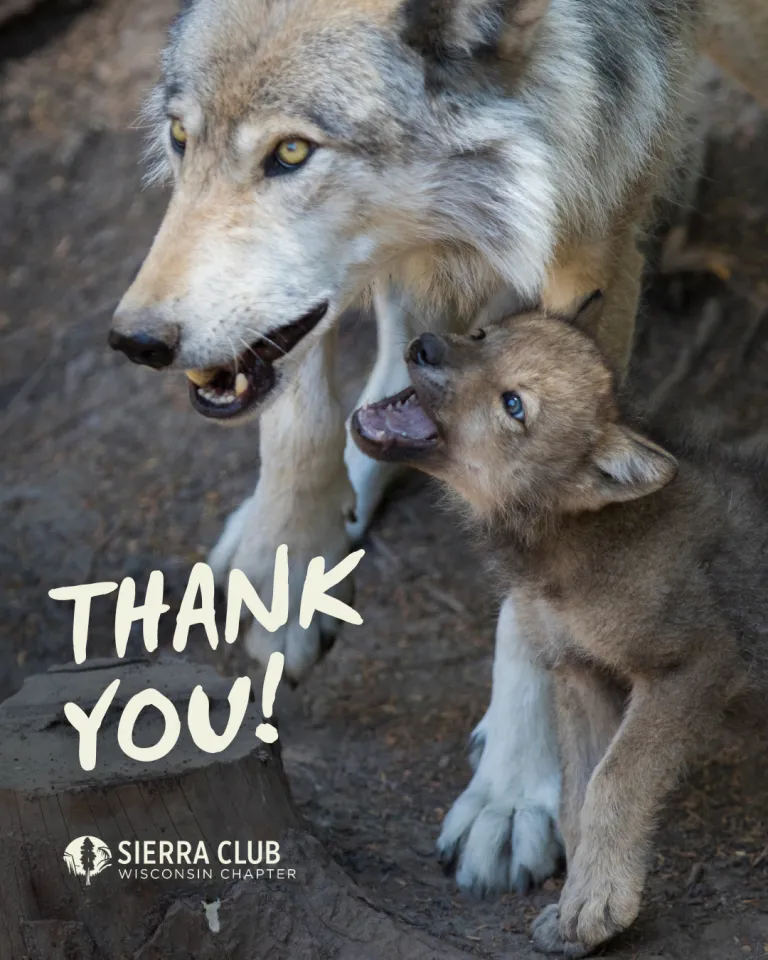
This year’s Wolf Awareness Week was, once again, fun, informative, and this year, family-focused! Our theme this year was “Wolf families,” using a different lens each day to examine Wisconsin wolf families - how wolf families survive together and the challenges our Wisconsin wolf families still face today.
Here’s a recap of the daily activities, links, and learnings. Jump to a recap of each day:
- Sign-Up Sunday
- Ma’iingan Monday
- Wolf Tales Tuesday
- Wolf Country Wednesday
- Tracking Trivia Thursday
- Fun with Wolves Friday
- ESA Saturday
Early Start Saturday
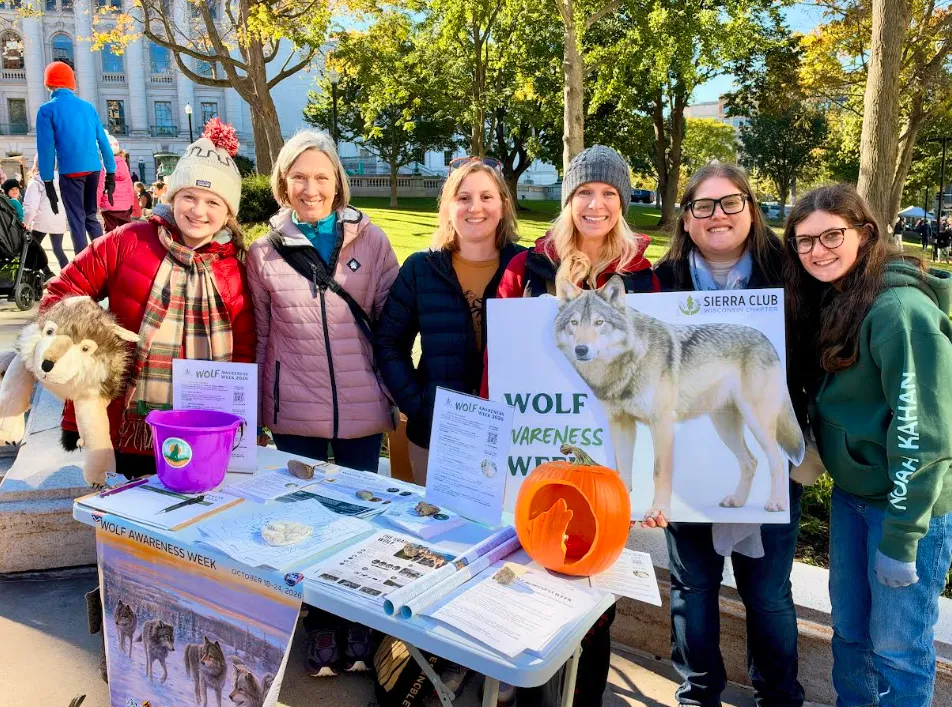
We enjoyed meeting people at the Dane County Farmer’s Market to talk about Wolf Awareness Week and our plans. Thanks to all who stopped by our booth!
Sign Up Sunday
We kicked off the official week with information about wolves and how they interact as families.
Here are some ways wolf packs organize around family to survive:
A wolf pack typically consists of:
- A breeding pair (the parents)
- Their pups
- Older offspring from previous years
- Occasionally a few unrelated adults
This mirrors human extended families or clans that live together, share work, and protect common resources.
Parents lead the family (not “alphas”)
The idea of an “alpha wolf” is outdated. Wolf parents lead the pack the same way human parents lead a household: through experience, guidance, and natural authority — not constant aggression.
Cooperative parenting and alloparenting (Wait, what is that?)
Older siblings help raise younger pups - feeding, guarding, and socializing them. This is alloparenting, and it’s extremely similar to human siblings helping with childcare. This cooperative care increases pup survival, just as shared caregiving strengthens human families.
Rich communication systems - Wolves communicate through:
- Vocalizations (howls, whines, growls)
- Body posture
- Scent marking
These systems maintain social order, express emotion, and coordinate group activity, much like human language, tone, and body language.
Shared territory and resource protection
Wolf families defend a territory together, just as human families defend homes, land, or shared resources. Territory size varies with food availability, and conflicts with neighboring packs are a major cause of mortality - similar to how human groups historically defended land.
Life‑stage transitions mirror human development: Young wolves:
- Stay with parents for 1-3 years
- Learn skills
- Help raise siblings
- Eventually disperse to start their own families
This is remarkably similar to human adolescence moving into adulthood, and then into forming new households of their own. (Source)
Isn’t it cool how much we have in common with wolves?
Ma’iingan Monday (Ojibwe for wolf)
We highlighted the cultural significance of Ma’iingan and took action to urge the Wisconsin Department of Natural Resources and Natural Resources Board to consult meaningfully with Tribes on wolf management.
The cultural significance of Ma’iingan goes beyond the understanding of wolves as a critical keystone species. It goes far deeper. It’s a spiritual connection, where their fates are intertwined. For additional information, please read what Tribal Nations in Wisconsin contributed on the cultural significance of wolves in the Wisconsin Wolf Management Plan (pages 62-68 in the linked PDF).
If you haven’t watched this yet - It’s a must watch! Peter David, a wildlife biologist retired from the Great Lakes Indian Fish and Wildlife Commission, shared the Ojibwe's relationship with Ma’iingian, or the wolf, from its origins in the Creation Story to its application to contemporary wolf stewardship with us, and it is a must-watch. Please check it out here

Tribal Nations’ role in wolf stewardship rests on more than cultural and spiritual beliefs:
- Ojibwe Nations retained treaty rights in northern Wisconsin’s ceded territories, and Lac Courte Oreilles v. Voigt affirmed those rights and established a state–Tribal co-management framework for natural resources there.
- Governor Evers’ 2019 Executive Order #18 further directs cabinet agencies to recognize Tribal sovereignty, engage Tribal governments on a government-to-government basis when policies directly affect them, and appropriately consult them when impacts may be indirect.
Please Take Action: Read GLIFWC objects to the recent culling of Ma'iinganag (Wolves) in Price County. Then, to support Ma’iingan, use the Sierra Club’s pre-drafted action alert to send a message to the Wisconsin Department of Natural Resources and Natural Resources Board.
Wolf Tales Tuesday
We joined with the Chapter’s Book Club for a discussion of Wolfish: Wolf, Self, and the Stories We Tell About Fear by Erica Berry.
We also created a list of everyone’s favorite “wolf tales” in one place. This will be a resource to share throughout the year. Thanks to all those who provided input when registering for our Wolf Awareness Week.
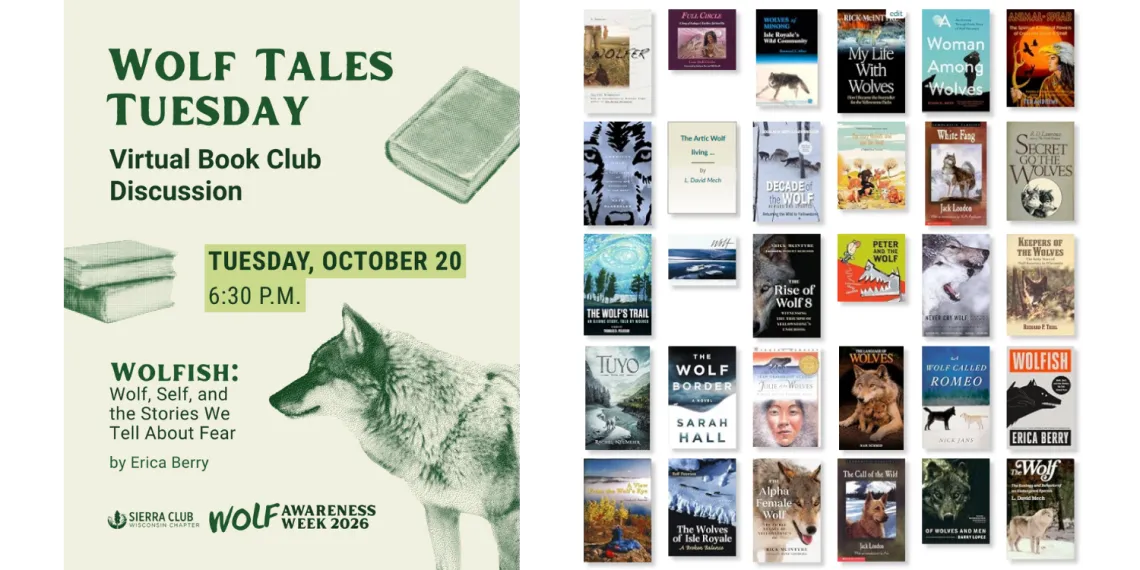
Here is the compiled “Favorite Wolf Tales” list
You can also view the list on Goodreads here
Wolf Country Wednesday
On the Wednesday of Wolf Awareness Week, we like to feature someone who is living or working with wolves in Wisconsin.
This year, we heard from our own Wildlife Team member, Olivia Deering, from UW-Madison who has been researching a wolf family for three years in Columbia County, possibly the southernmost wolf pack in our state, referred to as the Bog pack.
It is not as far north for a wolf family as many people might think! You might be surprised to learn about this wolf pack and what they are teaching us.
Watch the presentation with Olivia here.
Tracking Trivia Thursday
It’s a pretty rare thing to see a wolf in the wild, especially here in Wisconsin. However, you might have more luck seeing wolf tracks! Tracking wolves can be a fun winter hobby or part of citizen science efforts to collect wolf data as part of our wolf monitoring.
The Wisconsin DNR conducts winter track surveys as part of its ongoing wolf monitoring. Per the DNR’s website,
“DNR staff, trained volunteers, and other agency collaborators conduct winter snow track surveys in areas with known or suspected wolf packs to collect data on wolf packs and numbers. Historically, this information was used to estimate a minimum number of wolves in the state and was critical for monitoring progress toward population recovery goals.”
For our “Tracking Trivia Thursday” feature, we reached out to Steve Meurett from our partners at the Timber Wolf Information Network (TWIN) to learn more. Check out our conversation with Steve Meurett from TWIN here.
In this quick 11-minute video, Steve shares with us:
- Background on the TWIN organization and his role
- TWIN’s highly sought-after tracking workshops they have planned for 2026-2027
- Some beginning tips for identifying tracks
Thank you to Steve for his time and TWIN for their partnership. Be sure to subscribe to the TWIN YouTube channel to see all their cool wolf videos throughout the year!
Take Our Tracking Trivia Quiz - Now is the time to apply Steve’s tracking tips and test yourself! With photos from TWIN, we created a little quiz to see if you can correctly identify what you see in the photos. Have fun with this 14 question quiz!
Fun with Wolves Friday
We have found that connecting to nature, especially wolves, through art is an important part of our advocacy, and we will continue that tradition this year!

Wolf Coloring Sheet- This has been a fan favorite for the past five years, so we continued the tradition!
Please enjoy our custom-designed “2026 Wolf Advocate” coloring page by our graphic designer, Caitlin Moeller. We want to thank her for all her help with Wolf Awareness Week! This year's design features a wolf and pup in keeping with our wolf family theme. Just for fun - Can you find the hidden outline of Wisconsin in the coloring sheet?
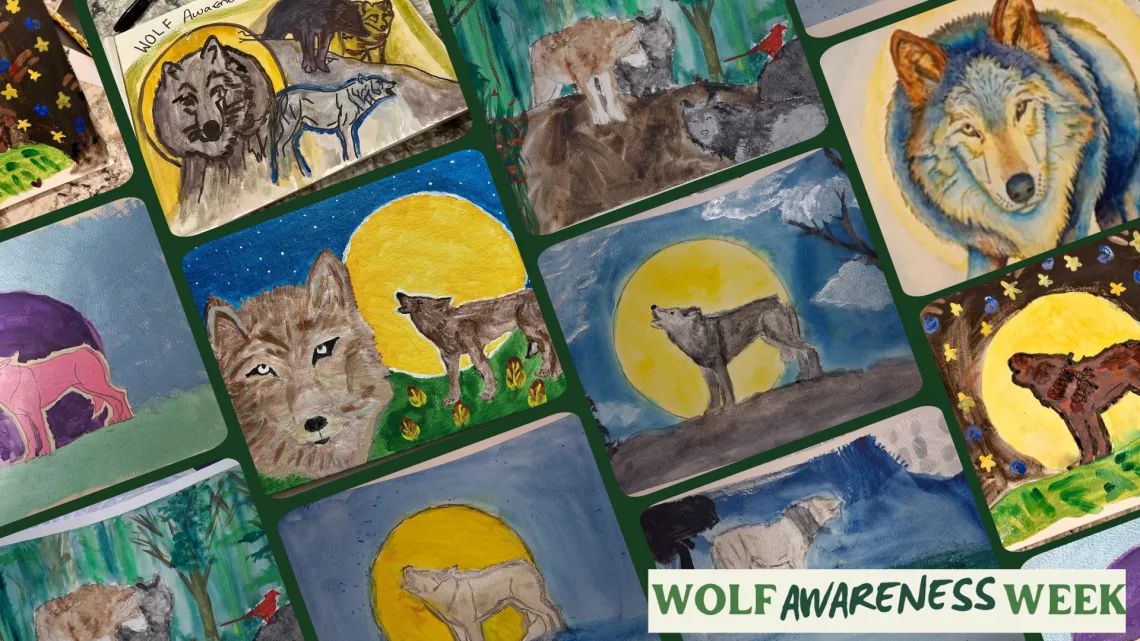
Madison artist, Helen Klebesadel, demonstrated how to do an image transfer to watercolor paper with this wolf image and demonstrate how to do simple watercolor painting in a short time even if you have never painted before.
We had events in Stratford, Lake Geneva, Shioctin, and Madison. Check out some of the beautiful work!
ESA Saturday
We wrapped up with some action to protect the Endangered Species Act. First, let’s heard from our Sierra Club National Wildlife Campaign Manager, Ben Greuel, who is actually based in Milwaukee, WI. In this two minute video Ben explains why we need to support the Endangered Species Act today - more than ever! He also tells how we can help do exactly that.
“ESA Saturday” call to action video - (2 minutes)
Make your voices heard! We want lawmakers to hear from our pack this week. Speak up for wolves, and all endangered species, by sending this email to Tell Congress to Protect the Endangered Species Act!
Thank you so much for joining us for our 2026 Wolf Awareness Week!
Check out recaps from previous years here.
Continue to follow our Wolf Action Page for regular updates for ways to ensure science-based management of Wisconsin’s wolves.