Most recent update:
Limiting Wolf-Farmer Conflicts
The Department of Natural Resources (DNR) has announced new rulemaking about reimbursement for animal (livestock, pets, and hunting dogs) deaths from wolves. The Wildlife Team supports a tiered approach that prioritizes farmers and pays them in full right away, while deprioritizing out-of-state repeat hounders and eliminating their funding.
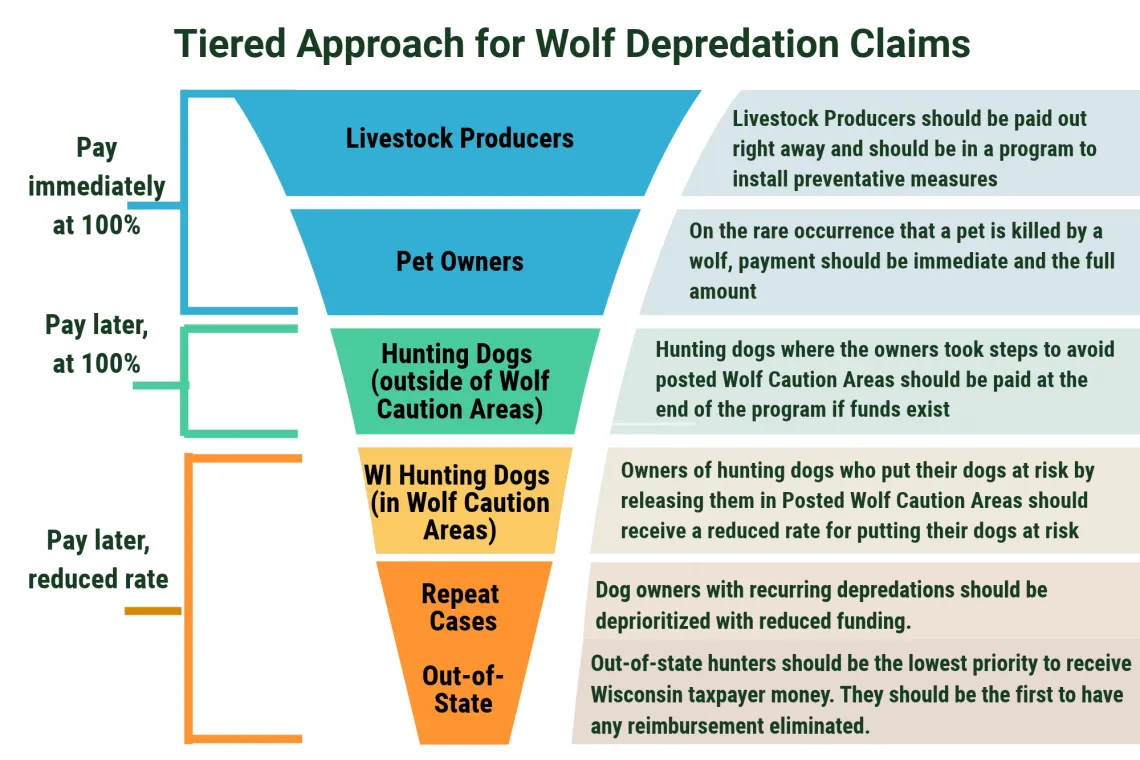
Hound‑training claims arise when bear hunters voluntarily release unleashed, often GPS-collared hunting dogs in pursuit of bears—often in posted “wolf caution” areas—fully aware of the risks and danger involved. In contrast to unavoidable agricultural conflicts, these incidents are the result of a chosen recreational activity practiced by a very small minority of Wisconsin residents and a substantial number of non‑residents.
Wisconsin taxpayers should not subsidize repeated losses for individuals who do not live here, do not purchase a license to train dogs here, and do not contribute revenue to the DNR. The highest‑paid claimant is from Minnesota and received $17,624.20 for eight dogs. Among the top ten claimants, three are from Minnesota, Colorado, and Texas, totaling $36,654.44. (All financial data and reimbursement totals are pulled from a WDNR open records request from September 2025.) These claims should be the lowest priority, if not denied entirely, when funds are insufficient.
Earlier this summer, at a Wolf Advisory Meeting, the DNR confirmed that predator-proof fencing has been working 100% of the time at the farms where it has been installed. That is one reason depredations are significantly down this year in Wisconsin. State and federal officials should prioritize helping the remaining farms install this fencing and other depredation-prevention methods.
A public comment period and hearing will follow when DNR releases the draft rule. Stay tuned.
Upcoming: 2026 Wolf Awareness Week
Sunday, October 18-24. Activities throughout the week.
Wolf Awareness Week 2026 takes place October 18-24. Please plan to join us for this exciting week focusing on wolf ecology, dispelling persistent myths, and promoting coexistence with these keystone species.
New for 2026: Our theme this year will be “Wolf families,” using a different lens each day to examine Wisconsin wolf families - how wolf families survive together and the challenges our Wisconsin wolf families still face today.
How it works: By signing up for our educational week, you will receive an email for each day with fun content, an opt-in activity you can do on your own, as well as invitations to join us for special virtual evening events throughout the week.
Perks of the Pack: By signing up, you will automatically receive a special 2026 custom Wolf Awareness Week sticker in the mail and also be entered to win a 1,000-piece wolf jigsaw puzzle by Sam Zimmerman / Zhaawanoogiizhik, an Ojibwe artist whose work we featured during Wolf Awareness Week last year!
Howl Yeah: Hope you can join our wolf family for a fun-filled week!
"The strength of the wolf is the pack." — Rudyard Kipling
Why it Matters
Wolves are incredibly important animals to our ecosystems and are important to the Ojibwe Tribe. No wolf hunt should occur until there is an inclusive, fair, and science-based planning process.
Apex predators like wolves are vital for maintaining balanced and robust ecosystems. Scientists and researchers continue discovering how wolves leave lasting and significant impressions on the landscapes. “As humans, we often like to think that we have the ability to mimic the ecological roles of predators, and therefore it may be okay to have some areas devoid of large predators,” said Sean Johnson-Bice, lead author of the study and a Ph.D. candidate at the University of Manitoba. “However, our work shows that there is such a wide diversity of ways that individual predators affect ecosystems that we could never realistically replicate their effects across entire ecosystems.”
From ensuring that forests and wildlife populations remain healthy to keeping prey populations in check, the presence of wolves in Wisconsin’s forests enhances biodiversity. It plays a crucial role in ecosystem health.
Beyond their vital roles in maintaining healthy ecosystems and reducing vehicle collisions, wolves hold deep cultural significance for many of Wisconsin's people. The Great Lakes Indian Fish and Wildlife Commission explains that wolves, known as "Ma'iingan," are revered as relatives by the Ojibwe. The Bad River Band of Lake Superior Chippewa, who hold wolves in exceptionally high regard, even designates wolves as a "Tribally Protected Species."
The bond between the Ojibwe people and wolves is rooted in their creation story, where the Creator chose Ma'iingan to be the companion of the Original Man. This sacred connection is so profound that the Ojibwe believe that what happens to wolves also happens to them -- that their fates are intricately intertwined.
Since February 10, 2022, the gray wolves in Wisconsin remain federally protected under the Endangered Species Act as a “listed” species. As a listed species, it is illegal to harm, harass, hunt, kill, trap wolves in Wisconsin without permit.
Should wolves in Wisconsin lose these federal protections under the Endangered Species Act, the management of wolves will return to the state of Wisconsin and the Wisconsin DNR Wolf management plan and WI laws will go into effect.
Learn More: https://www.sierraclub.org/wisconsin/issues/protecting-wisconsins-wolves
Recent Updates

Summer Wrap-Up: Protecting Forests, Line 5 Disasters, and No to Data Center Gas Plants

Dark Skies, Bright Future Program