Data Centers - Local Government Resources

The Southeastern PA Data Center Community Protection Team has developed some materials that build on templates and guidance from other organizations to create a toolkit for local governments to defend against the challenges we face from the boom of data center proposals in our area.
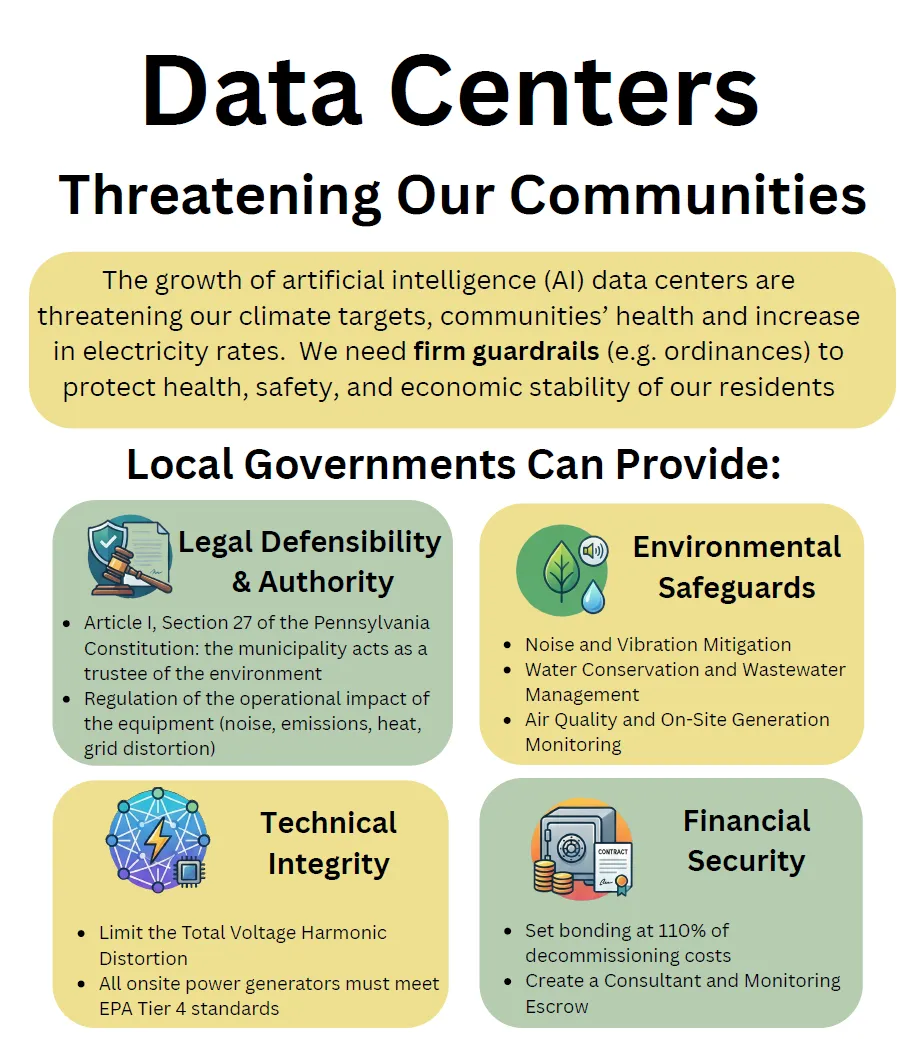
 

Don't count on Pennsylvania legislation or a possible moratorium to buy us time. Local governments need to take proactive action by passing local ordinances ASAP.


Start Here

  1. Why Your Municipality Needs a Strong Data Center Ordinance
  2. Responsible Data Center Checklist
  3. Data Center Ordinance FAQ for Residents
  4. Data Center Myths and Facts

Common Scenarios

Impacts to Understand

Take Action - Resources for Activists

For Municipal Officials

Ver 7.2 Release Notes

What is new in this consolidated version

- v7.2 restored non-regression protections from the original model, including AERMOD/EPA-
preferred modeling, the 2,000-foot stack-to-Sensitive-Receptor modeling trigger, output-based NOx and PM limits, methane LDAR, Chapter 94 overload protection, QRA thermal-radiation thresholds,
public annual summaries, and telemetered monitoring.

- v7.2 restored and strengthened transparency, public-record, no-blanket-NDA, protective-order,
public-study, annual-reporting, audit, Right-to-Know, and Sunshine Act safeguards.

- v7.2 added gas infrastructure and pipeline-impact disclosure, associated-energy-infrastructure
anti-segmentation, gas-specific emergency response, methane inventory, intergovernmental notice,
and material-change triggers for new or expanded gas infrastructure.

- v7.2 added SCR, ammonia slip, reagent storage, secondary pollutant, stack testing, SCR bypass,
catalyst degradation, spent catalyst, and monitoring safeguards.

- v7.2 added this reader orientation and a master revision-history cross-reference so first-time
readers understand the package structure and version sequence.

- v7.2 strengthens cooling and water-resource protections by requiring true non-evaporative closed-
loop cooling for primary IT cooling and facility heat rejection; prohibiting evaporative cooling, cooling towers, open-loop/once-through cooling, adiabatic/wet-assist operation, routine cooling-water withdrawal from any source, and cooling blowdown; and adding a zero routine cooling-water demonstration.

- v7.2 clarifies checklist language regarding aggregation/anti-evasion and strengthens
applicant/operator-funded study, reporting, peer-review, and monitoring language, subject to
adopted fee schedules, escrow procedures, itemized billing, and applicable fee-dispute rights.

- v7.2 adds turbine-specific and behind-the-meter generation controls, including strict treatment of
simple-cycle/aeroderivative turbines, prohibition of water-consuming CCGT/HRSG/steam-cycle
configurations, turbine inlet cooling/wet-compression/fogging restrictions, startup/shutdown/ramping modeling, turbine-specific noise review, continuous or parametric monitoring, and explicit aggregation of redundant, black-start, bridge-power, mobile, rental, future-pad, and adjacent/affiliate-owned generation.

- v7.2 added the state/federal permit backstop, ozone nonattainment explanation, and closed-loop
coolant/chemical management requirements.

- v7.2 clarified citizen-facing materials by explaining municipal versus
county/state/federal/basin/sewer/water-authority/utility roles and simplifying selected anti-evasion,
scenario, and public-hearing language. It did not change operative ordinance standards.

- v7.2 clarifies ongoing compliance verification, annual municipal compliance review, operator-
funded monitoring/inspection/third-party review, remedies for violations, and the principle that approval is not a one-time event. The update preserves lawful fee/escrow guardrails: reasonable and necessary costs, adopted fee schedules, itemized billing, and applicable dispute procedures.

- v7.1 added a Project / Common Plan of Development concept, strengthened Unified Development
aggregation, and added anti-segmentation certification language to address separate parcels, separate
tenants, separate meters, affiliates, phased applications, and common infrastructure structures.

 - v7.2 added Cumulative Impact Review Area, Cumulative Source, Receiving Environment, and Concurrent
or Pending Application provisions so genuinely separate nearby LLDC applications are reviewed for
combined effects on the same neighboring communities without incorrectly treating unrelated applicants as
one project.

- v7.2 added no-first-in-time entitlement, coordinated technical-review, common receptor/modeling protocol,
and solicitor scenario-playbook provisions for same-day, pending, approved-but-unbuilt, and operating
nearby data-center scenarios.

For Solicitors / Technical Review

A strong ordinance does not ban data centers; it requires responsible siting, objective standards, and proof of compliance. Large fossil-fueled generation serving a data center has separate impacts and should be reviewed as a separate land use.


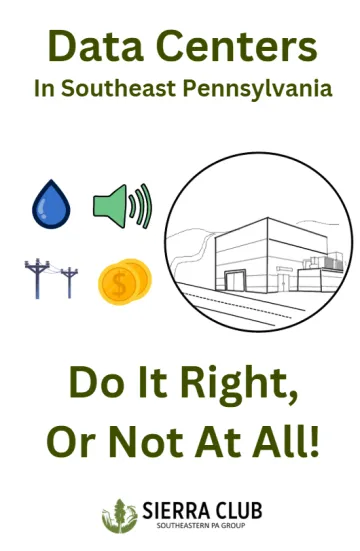
data center one page


do it right

CONTACT INFO

To ask a question or learn how you can contribute to the Data Center team, use the SPG Volunteer Interest Form. A volunteer leader will get back to you.

Model Comparisons & Analysis of Passed Local Ordinances

Analyzing other models and local ordinances that have been offered to local governments based on the model ordinance our volunteers have developed:

PennFuture Model Ordinance Comparison

Area

More Complete

Reason

Grid ImpactSierra Club SPGDetailed harmonic limits and load curtailment plans
Air QualitySierra Club SPGMandated Tier 4 engines and dispersion modeling.
Well ProtectionPennFutureLegal presumption of liability and 3,000-ft well testing.
AestheticsPennFuturePrescriptive plant counts and facade design requirements
Comms/RFSierra Club SPGDedicated section on PA-STARNet and cellular shadowing.
EfficiencySierra Club SPGMandatory PUE/WUE reporting and cooling mandates.

The two model ordinances offer different levels of "completeness" depending on the regulatory focus. The Sierra Club SPG ordinance (on this page) is more technically complete regarding operational performance and infrastructure impacts, while the PennFuture (Version 2.0) ordinance is more complete regarding land-use aesthetics and private well protection.

1. Air Quality and Emissions

  • More Complete: Sierra Club
  • The Sierra Club ordinance provides a highly detailed framework for emissions, mandating a Tier 4 Final standard for all diesel generators, regardless of their "emergency" status. It includes specific dispersion modeling triggers based on facility capacity or proximity to receptors and sets output-based limits (lb/MWh) for non-emergency operations.
  • In contrast, PennFuture focuses primarily on screening backup equipment visually and for noise, without specifying engine emission tiers or detailed air impact modeling.

2. Noise and Vibration

  • More Complete: Sierra Club (Technical Metrics); PennFuture (Time-Based Limits)
  • Sierra Club is technically more robust, requiring one-third octave band analysis to detect low-frequency humming and applying a 5 dBA "tonal penalty". It also mandates permanent, continuous sound monitoring for facilities near sensitive receptors.
  • PennFuture provides a more detailed regulatory table for noise limits, distinguishing between Daytime, Evening, and Nighttime hours across different zoning districts. It also includes extensive "Pure Tone" tables for evaluation.

3. Water Resource Management

  • More Complete: PennFuture (Groundwater/Well Protection); Sierra Club (Cooling Technology)
  • PennFuture excels in protecting local aquifers. It requires a 3,000-foot well-testing radius, detailed hydrogeologic studies, and a legal presumption that the operator is responsible for any adverse well impacts within 60 months of operation.
  • Sierra Club is more complete regarding cooling efficiency. It mandates closed-loop cooling as the "bright-line" requirement and prohibits open-loop systems. It also requires reporting on Water Usage Effectiveness (WUE).

4. Power Quality and Grid Reliability

  • More Complete: Sierra Club
  • The Sierra Club ordinance is significantly more comprehensive in this area. It establishes strict Total Voltage Harmonic Distortion (VTHD) limits of 5.0% to prevent grid instability. It also requires a Reliability and Load Management Plan that dictates how a facility must curtail non-critical loads during grid emergencies.
  • PennFuture only requires documentation from the utility provider certifying that sufficient capacity exists.

5. Communications and Public Safety

  • More Complete: Sierra Club
  • The Sierra Club ordinance includes an entire section dedicated to preventing interference with public safety radio systems (PA-STARNet) and mitigating cellular "shadowing" caused by large structures. It requires baseline and post-construction RF/EMI assessments by qualified professionals.
  • PennFuture does not provide specific standards for communications interference or RF safety.

6. Siting and Aesthetics

  • More Complete: PennFuture
  • PennFuture provides more detailed landscape buffer requirements (25-foot width) with specific counts and sizes for evergreen and deciduous trees. It also mandates aesthetic design elements for building facades, such as material changes or step-backs every 150 feet.
  • Sierra Club focuses on setbacks for high-impact components like generators but provides fewer prescriptive standards for building aesthetics.

7. Financial Security and Decommissioning

  • More Complete: Sierra Club
  • Both ordinances require a 110% decommissioning surety. However, the Sierra Club ordinance provides a more detailed escrow mechanism to ensure the municipality can hire independent experts for ongoing technical audits and complaint investigations.


Chesco/Montco Ordinance Guide Comparison
Chadds Ford Twp Ordinance - Analysis

Technical Analysis: Enhancing Chadds Ford Ordinance No. 184 for Long-Term Community Protection
While the proposed Chadds Ford Ordinance (Ordinance 184) adopts many industry-leading measures, a side-by-side comparison with the Data Center Model Ordinance (Draft v6.1) reveals several critical technical and procedural gaps. Addressing these "deficiencies" will ensure the Township is not only protected from immediate nuisances but also from long-term grid instability and fiscal cost-shifting.

1. Inadequate Noise and Acoustic Safeguards

  • Permissible Decibel Levels: Ordinance 184 sets a maximum nighttime limit of 52 dBA at sensitive receptor property lines. The model ordinance establishes a significantly more protective nighttime cap of 40 dBA, noting that continuous industrial noise above this level is scientifically documented to cause sleep disruption and stress.
  • Measurement Methodology: While Ordinance 184 identifies the nuisance of "Pure Tones," the model ordinance mandates one-third octave band analysis to capture low-frequency tonal impacts (the constant "hum") more accurately than standard dBA measurements.

2. Missing Numeric Power Quality Standards

  • Harmonic Distortion: The model ordinance establishes clear, objective "bright-line" standards to protect the local grid from "flicker, sags, and swells". It mandates that Large-Load Data Centers (LLDCs) must not exceed a Total Voltage Harmonic Distortion (VTHD) of 5.0% and individual voltage harmonics of 3.0% at the Point of Common Coupling (PCC).
  • Chadds Ford Gaps: Ordinance 184 requires a "Grid Impact Study" but fails to include these specific, numeric thresholds for harmonic distortion, leaving the definition of "grid integrity" open to subjective interpretation by utility providers.

3. Lack of Non-Combustion Energy Requirements

  • Mandatory Capacity Floor: To fulfill the municipality's duty to conserve clean air under the Environmental Rights Amendment, the model ordinance requires LLDCs to provide a minimum of 20% of their total emergency backup power capacity through non-combustion technology, such as Battery Energy Storage Systems (BESS).
  • Chadds Ford Gaps: Ordinance 184 mandates Tier 4 Final diesel engines but does not require any portion of the backup load to be served by cleaner, non-combustion alternatives.

4. Deficient Communications Resilience and Public Safety

  • Predictive Assessments: The model ordinance requires a robust predictive assessment of RF/EMI emission and coupling pathways specifically addressing compatibility with public safety systems like PA-STARNet.
  • Cellular "Shadowing" Mitigation: A key community protection in the model is the requirement for developers to mitigate "shadowing"—where the massive physical structure of the data center degrades neighborhood cellular coverage.
  • Chadds Ford Gaps: Ordinance 184 only requires a general certification of FCC Part 15 compliance, missing these specific public safety resilience and neighborhood coverage mitigation protocols.

5. Absence of Electricity Rate and Fiscal Transparency

  • Cost-Shifting Protections: The model ordinance includes a legislative finding that data centers receiving negotiated, below-market utility rates may shift infrastructure and transmission costs to other local ratepayers.
  • Mandatory Disclosure: To evaluate the true net fiscal impact, the model requires applicants to disclose their effective electricity rate, rate schedule, and contract duration. This information is also used to verify that the developer has the long-term financial capacity to fund mandated environmental safeguards.
  • Chadds Ford Gaps: Chadds Ford's "Impact Analysis" lacks these specific financial transparency requirements, leaving the Township unable to verify if the project is subsidized by local residents' utility bills.

6. Missing Resource-Efficiency KPIs and GHG Reporting

  • PUE and WUE Monitoring: The model mandates annual reporting of Power Usage Effectiveness (PUE) and Water Usage Effectiveness (WUE). Crucially, it includes a "degradation trigger"—if efficiency worsens by more than 10%, the operator must submit a corrective action plan.
  • Greenhouse Gas (GHG) Reporting: To align with Commonwealth climate goals, the model requires annual reporting of Scope 1 and Scope 2 GHG emissions in carbon-dioxide equivalents.
  • Chadds Ford Gaps: Ordinance 184 does not require these standardized efficiency metrics or emissions reporting.

7. Loophole for "Bridge Power" and Temporary Units

  • Prohibition on "Dirty Bridge Power": The model ordinance explicitly prohibits using any non-Tier-4 diesel generator for construction, commissioning, or early operations, rejecting "supply-chain delays" as a valid excuse.
  • Chadds Ford Gaps: Ordinance 184 lacks explicit "bridge power" safeguards, potentially allowing for the operation of dirtier, temporary generators for extended periods prior to full utility service.
     
Upper Merion Twp Ordinance - Analysis

This report evaluates the Upper Merion Data Center Ordinance (the "Township Ordinance") in comparison to the SPG Data Center Model Ordinance (Draft v6.1) (the "Model Ordinance"). While the Township Ordinance contains several strong localized protections, it lacks critical technical, financial, and legal safeguards found in the Model Ordinance that are necessary to mitigate the unique impacts of Large-Load Data Centers (LLDCs).

Critical Shortcomings and Recommended Enhancements
  1. Noise and Acoustic Protections
  • The Gap: The Township Ordinance sets a residential property line limit of 50 dBA. The Model Ordinance recommends a more protective baseline of 45 dBA during the day and 40 dBA at night.
  • The "Hum" Problem: Data centers produce a constant, low-frequency hum. The Model Ordinance mandates a 5 dBA "tonal penalty" if a prominent discrete tone is detected, effectively lowering the allowed limit to account for the nuisance. Upper Merion currently lacks this penalty.
  • Recommendation: Lower the residential noise cap to 45/40 dBA and adopt the 5 dBA tonal penalty. Additionally, mandate continuous, permanent sound monitoring stations for any facility within 1,000 feet of a residence to ensure 24/7 compliance.

2. Power Quality and Grid Integrity

  • The Gap: Upper Merion requires a "will-serve" letter from the utility but lacks specific technical standards for power quality. Large-load facilities can cause "flicker, sags, and swells" that damage residential appliances and electronics.
  • Recommendation: Adopt the Model’s specific performance standards at the Point of Common Coupling (PCC), capping Total Voltage Harmonic Distortion (VTHD) at 5.0% and individual harmonics at 3.0%.

3. Financial Security and Decommissioning

  • The Gap: The Township Ordinance does not require a decommissioning bond, leaving the community vulnerable to "stranded assets" if a facility is abandoned.
  • Recommendation: Require a decommissioning surety equal to 110% of estimated costs, to be updated every few years to account for inflation and technology changes.

4. Transparency and the "NDA Trap"

  • The Gap: Developers often use Non-Disclosure Agreements (NDAs) to hide negotiated electricity rates. Without this data, the Township cannot accurately assess the long-term financial viability of the facility or its impact on other ratepayers.
  • Recommendation: Implement the Model’s "Protective Order" mechanism. This compels the disclosure of rates to the Township Solicitor and consultants under a confidential release valve, ensuring the facility can afford its long-term environmental and mitigation obligations.

5. Legal Defensibility (UCC Preemption)

  • The Gap: Municipalities in Pennsylvania are prohibited from creating their own building codes under the Uniform Construction Code (UCC). Without proper framing, technical mandates (like soundproofing) can be struck down in court.
  • Recommendation: Incorporate the Model Ordinance’s "Construction Code Savings Clause". This explicitly defines all requirements as land-use and operational conditions rather than building construction standards, protecting the ordinance from state-level preemption.

6. Infrastructure Protection (Wastewater)

  • The Gap: While Upper Merion requires public sewer and closed-loop systems, it lacks capacity-based triggers to prevent municipal system failure.
  • Recommendation: Adopt the 95% capacity trigger, which prohibits discharges that would cause the municipal treatment plant to reach "near-overload" status or trigger state-mandated connection bans under 25 PA Code Chapter 94.
Strengths of the Current Upper Merion Draft

The Township Ordinance contains several commendable provisions that should be retained:

  • Strong Setbacks: The mandatory 1,000-foot setback from residential lots for both buildings and mechanical equipment is a high-standard protection.
  • Reserved Parking: The requirement for Reserved Parking Areas is a forward-thinking way to manage future changes in operational intensity.
  • Public Engagement: Mandating a public informational meeting prior to the conditional use application ensures early community transparency.
  • Aesthetic Controls: The requirement for differentiated building facades in Heavy Industrial zones helps mitigate the visual impact of these massive industrial structures.
Summary Recommendation

To ensure Upper Merion remains a leader in balanced industrial development, the Township should integrate the Model Ordinance's technical and legal scaffolding into its current draft. This will transform the ordinance from a basic land-use document into a comprehensive, technically precise, and legally defensible regulatory framework that protects both the local grid and the peace and quiet of Township residents.

Want help analyzing your data center ordinance? Or assess your exposure to the risks that a new data center proposal might bring based on the ordinances currently on the books? Or want to learn about our process? We can help! All analysis is confidential and free. Contact us with the SPG Volunteer Interest Form.

Proposals in Southeastern PA

Here are the data center proposals that we are aware of in southeastern PA - updated April, 2026

Based on the Data Center Proposal Tracker for Pennsylvania - interactive map
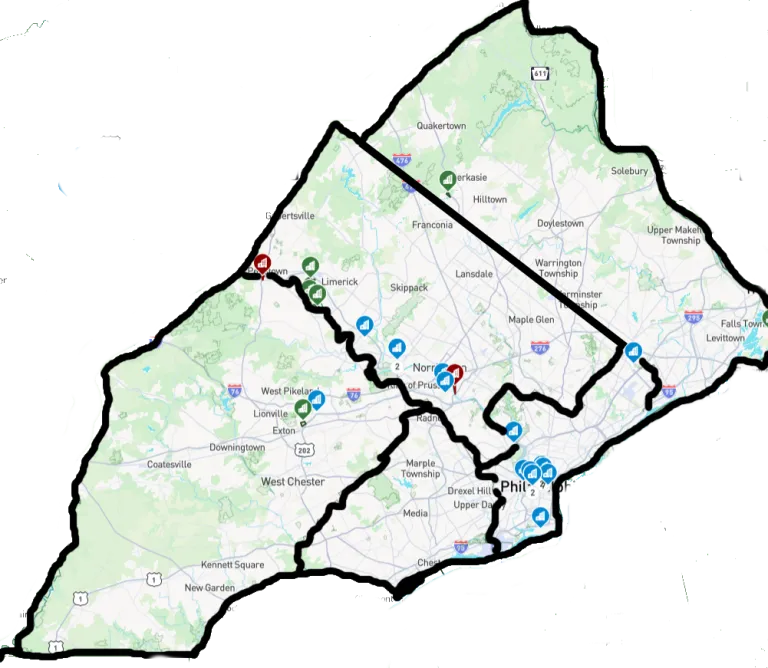
data center proposals se pa
  • Limerick Twp (Laurel)
  • Limerick Twp (Linfield)
  • E Vincent Twp (Pennhurst)
  • E Whiteland Twp
  • Falls Twp (AWS Keystone)
  • Plymouth Twp (Conshohocken)
  • E Whiteland Twp - Operating
  • Collegeville - Operating
  • Norristown - Operating (2)
  • Eagleville - Operating
  • Upper Merion Twp - Operating (2)
  • Fairless Hills - Operating
  • Philadelphia - Operating (15)
  • North Coventry Twp - Withdrawn

Closed Loop Cooling Systems

One of the key elements of our recommended data center regulations is to require a "closed loop" water cooling system. Industry leaders like Microsoft and Crusoe are transitioning to closed-loop and air-cooled systems that eliminate water evaporation, significantly reducing the impact on local watersheds. While older facilities pose higher risks, modern design standards allow these complexes to operate as sustainable digital anchors. 

data center cooling