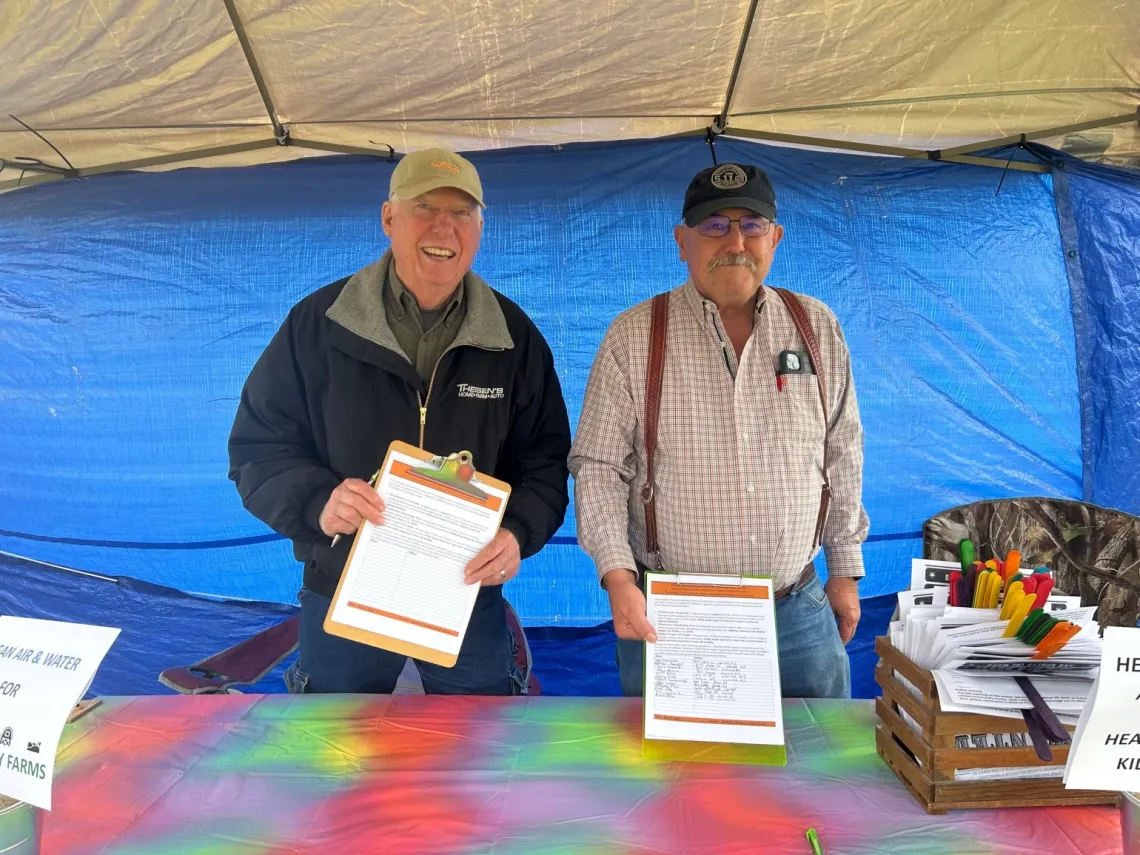
Feedlot Fighters Sierra Club Kansas Conservation Chair Felix Revello (left), and his friend, Merrill Cauble collecting signatures protesting cattle feedlot at a recent event in Larned, Kansas.
By Felix Revello, Conservation Chair and Craig Volland, Agriculture Chair, Sierra Club Kansas Chapter
Answer. An 88,000 head cattle feedlot excreting 5.7 million pounds of manure a day on top of a designated “sensitive groundwater area.”
That designation identifies shallow aquifers below highly permeable sandy soils and geological structures which are extremely vulnerable to pollution from above. Construction on this feedlot is under way in Pawnee County about 10 miles south of Larned. An overwhelming majority of residents in the Larned area strongly oppose the mega-feedlot, which would severely intensify feedlot stench from two existing feedlots just south of Larned. That’s where Sierra Club comes into the fight.
By the way, when we call this a “mega-feedlot,” it’s not just because it will hold huge numbers of animals. It will cover 640 acres, one square mile of land!
Feedlot Fighters Merrill Cauble and Felix Revello, Kansas Chapter Conservation Chair have been running a ground war on this mega-feedlot proposal since the fall of 2024. Both live in Pawnee County. Merrill is an old-time cattleman who has lived in Pawnee County all his life and detests the idea of another feedlot further ruining our rural environment. Felix moved to Pawnee County to serve as Chief Ranger at Fort Larned National Historic Site thirty years ago. Of course he's fighting the feedlot because that’s what Sierra Club members do to preserve our environment and protect human health. Fighting right along with Merrill and Felix is Kansas Chapter CAFO Specialist Craig Volland.
Craig has been providing technical support for the Feedlot Fighters and concerned residents of Larned and rural Pawnee County who are opposing this proposed cattle mega-feedlot. The feedlot is planned by ILS Feeders LLC which already operates three cattle feedlots in Pawnee County with a combined capacity of 72,000 head. Folks have a long history of enduring odor and dust from those sites. At one site, groundwater monitoring data since 2001 show nitrate levels several times higher than the human health standard. Samples obtained recently by the Feedlot Fighters show that the existing feedlots are likely affecting the water wells of nearby residents. KDHE should have conducted this investigation years ago.
Like the existing feedlots, the new site will sit on highly permeable soils over the relatively shallow Great Bend Prairie aquifer, not a good place for a huge animal confinement operation. According to a KDHE official who spoke at the March 25, 2025 public hearing, feedlot operators love quick-draining sandy soils because they don’t get mucky after rains. What he didn't mention is the potential threat to the aquifer. The plan is for runoff from the manure laden surface to be captured by four big, 20-foot-deep wastewater ponds (one at each corner of the feedlot) and periodically pumped out onto nearby highly permeable crop fields. The pond bottoms lie only slightly above the minimum required 10 feet separation distance from groundwater. The exact distance is not known because the depth to groundwater was determined from distant wells. Through their letters and petitions, the Feedlot Fighters and local residents did achieve important concessions when ILS agreed to a much tighter standard for wastewater seepage from the bottom of the ponds, and KDHE required monitoring wells near the feedlot.
However, another important threat to groundwater is the disposition of the manure that piles up. According to the company’s Nutrient Management Plan, the feedlot would produce more than 107,000 tons per year of solid manure requiring some 30,000 acres, or 47 square miles, of crop land for utilization. Due to a loophole in the regulatory regime, feedlot operators can export this solid waste to any entity, anywhere, with no supervision over how it is utilized. At the existing feedlots, ILS utilizes this loophole by exporting the manure to ILS Farms, another entity that it controls. We suspect that, with so many tons to get rid of, ILS may apply this manure so heavily that it escapes the root zones before crops can utilize it, allowing nitrates to rapidly enter the underlying shallow aquifer. These suspicions arise because residential wells near manured fields show elevated nitrate levels.
KDHE issued the permit in late April 2025 and Sierra Club and concerned residents, have initiated an internal appeal on the remaining issues discussed above. In addition to the export loophole, the only protection nearby residents receive from air pollution is the required 4000-foot separation distance from their homes. This 4,000-foot standard is the same for a 1,000 head feedlot or an 88,000-foot feedlot, which is absurdly ineffective for mega-feedlots. A search of the literature indicates that pathogenic bacteria, some drug-resistant, can be transported several to many miles downwind of feedlots. Feedlot Fighters are working on ways to get KDHE to require cleanup of the pollution from the existing feedlots before the proposed 88,000 head environmental disaster becomes operational… even if that would mean withdrawing their approval of the permit.
We acknowledge and thank the Socially Responsible Agriculture Project (SRAP), a national organization that helps citizens organize to fight animal factories, for their valuable assistance in guiding our efforts. SRAP faithfully kept this fight on track over many months. The Facebook page they created, Pawnee Citizens Advocating for Rural Environment and Economy, has more information on feedlot pollution and actions we’ve taken.
Now is the time for all of us, Sierra Club members and supporters, to join the fray. Tell Governor Kelly that KDHE must withdraw its approval of the mega-feedlots permit. No permit for this project should be approved unless and until the following conditions are satisfied.
- Water and air pollution at existing feedlots south of Larned must be investigated and fully remediated and used as a guide to design and operate the proposed 88,000 head mega-feedlot;
- Test wells must be installed near wastewater ponds to accurately determine depth to groundwater to verify compliance with the 10-foot required minimum separation distance for wastewater ponds;
- Require monitoring wells at fields where manure irrigation water from wastewater ponds is applied;
- Establish a monitoring plan to report how much and to where solid manure is exported.
Call Governor Kelly: (877) 579-6757
Write Governor Kelly
Kansas State Capitol Building
300 SW 10th Ave.
Suite 241-S
Topeka, KS 66612-1590