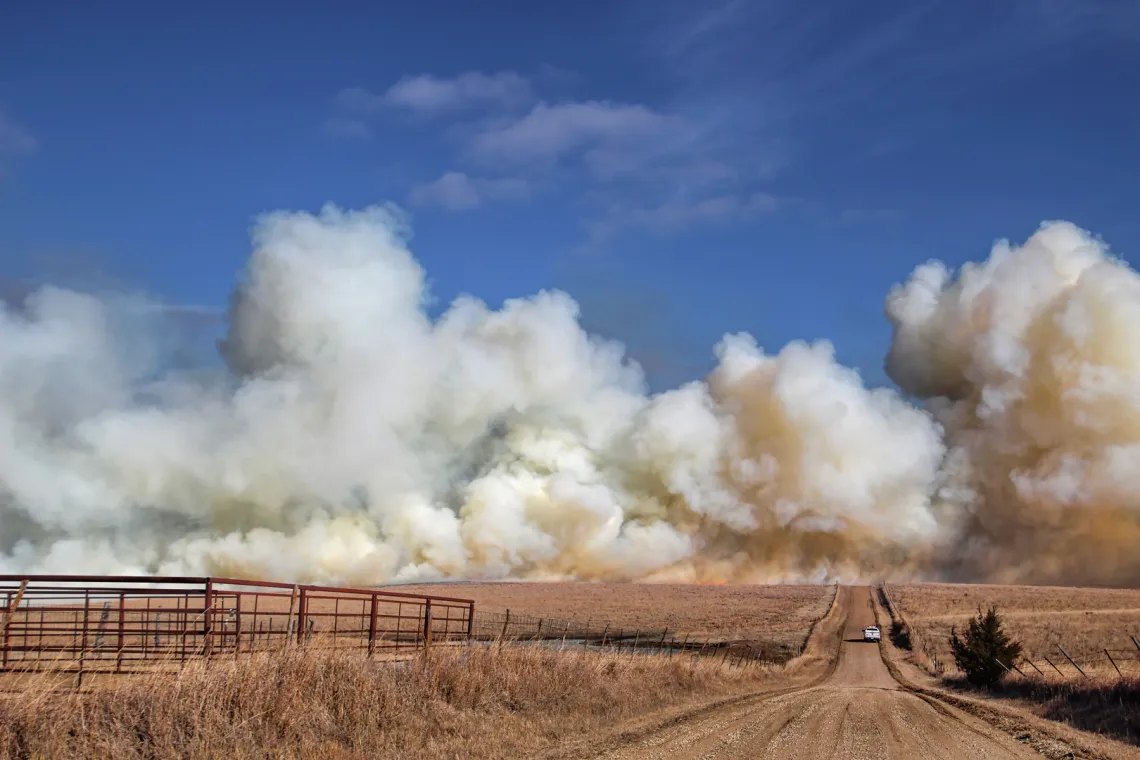
Prairie Fire | Photo Tom Arnhold, Sierra Club Kansas Chapter
By Craig Volland, Chair, Air Quality Committee
On April 5, 2024, in the midst of the annual prescribed burning of Flint Hills grasslands, the residents of Wichita, Kansas and Ponca City, Oklahoma suffered extremely high levels of fine particulate pollution (PM2.5).. Monitors near Wichita showed levels classified as “Hazardous” and “Very Unhealthy” according to EPA’s Air Now index. The smoke was so thick that southeasterly winds also caused a rare exceedance at the Cedar Bluff background monitor near Hays, Kansas.
As soon as this data was verified, we asked KDHE’s Bureau of Air to to take steps to prevent future events. Under pressure from Sierra Club and regulators, KDHE began convening bimonthly meetings to review and update the 2010 Smoke Management Plan (SMP). These meetings have included a variety of stakeholders: Kansas Chapter volunteers Gerry Snyder and Craig Volland, representatives from local public health agencies, the Nature Conservancy, county and state fire control agencies, USEPA, Flint Hills ranchers, and other livestock interests.
We soon learned that KDHE’s main concern was that the extraordinarily high PM2.5 measurements on April 5 had violated the national three-year average limit for PM2.5. In their May 2024 review, EPA had lowered that standard from 12 ug/m 3 to 9 ug/m. See Figure 7 below, posted by KDHE in the latest SMP draft..
Unfortunately ,the EPA Exceptional Events Rule exempts data related to wildfires or prescribed burning on “wildlands." The Flint Hills is classified as a “wildland”, even though it includes numerous towns and cities such as Manhattan, Junction City, Cottonwood Falls, and is one of the most tightly managed rural landscapes in the country. Approval of this exemption sought by KDHE was contingent on an update of what became the 2010 SMP.
The latest SMP draft version of the SMP does includes a few improvements. Ranchers are encouraged to conduct their burns in late summer and early fall instead of early spring.
KDHE"s smoke model will warm about atmospheric inversions that prevent vertical dispersion of smoke. And, KDHE is working with the National Weather Service to
create a more real-time public notification of smoke conditions during the spring burn. It’s unclear how that will work out.
Thanks to Gerry’s efforts, the SMP will include a more detailed description of audiences needing this weather information, such as public schools that conduct outdoor activities for their students. Still missing is an official air quality monitor in the Manhattan/Junction city area. In reality, the updated SMP would be business as usual, and any response by ranchers and land managers is voluntary.
At the end of our January 29, 2026 meeting, KDHE noted that EPA is in the process of retracting the new 9 ug/m 3 PM2.5 standard, so it is unclear where we go from here. Meanwhile,
volunteers will continue to utilize the four Purple Air monitors that Gerry installed last year with Chapter members around Manhattan. We learned from the EPA representative at the meetings that they have an inventory of Purple Airs available for use by the public.
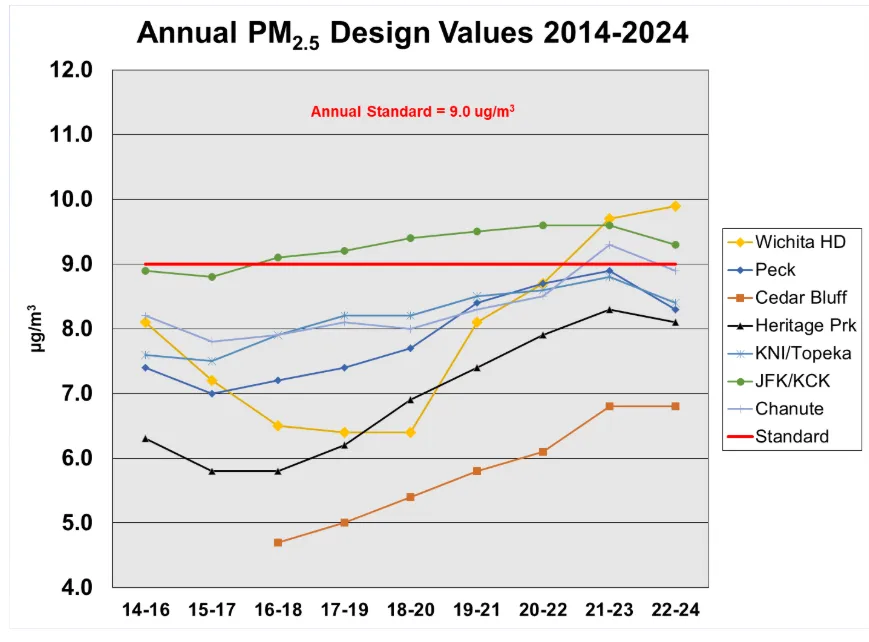
Fig. 7. PM2.5 Annual Design Values 2014 to 2024.
Source: KDHE from draft SMP revisions.