Zack Pistora, Kansas Chapter Director & Environmental Lobbyist
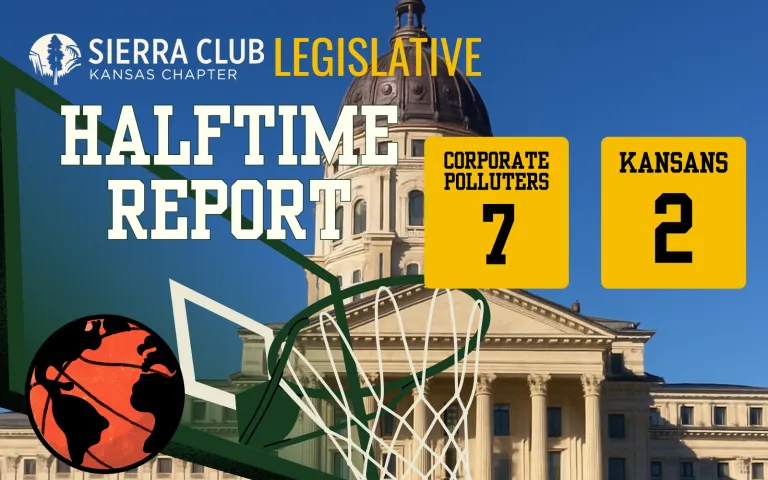
Every year, 125 Kansas House members & 40 state Senators arrive at the Statehouse in Topeka for a 90-day session to pass new laws and a state budget. Last week was the Turnaround Deadline, a cutoff date for bills to advance from one chamber to another… essentially, the halftime of the session.
At Sierra Club, what’s important aren’t the political points scored by Republicans and Democrats, but who ultimately wins out between Kansans (and our ecosystems) and corporate polluters, who rob our environment and our healthy future for their own profits or power.
Unfortunately, at halftime, corporate polluters and their lawmaker buddies are ahead.
Corporate Polluters have early lead with HB 2476: Liability Shield for Pesticide Manufacturers
Monied interests got out to an early lead with a steal and fastbreak, as pesticide manufacturers & big Ag put up HB 2476 to steal away the ability for Kansans to sue pesticide companies in court for failing to warn about potential health risks, like causing cancer, on the pesticide label, so long as the label meets EPA requirements. [Yes, the same EPA that just said we don’t need to worry about greenhouse gases and climate change and had its staff cut by 20%]. So, this de-facto liability shield for chemical pesticide peddlers got through the Kansas House carried by Republicans on a mostly party line vote (81-36). We anticipate HB 2476 getting a hearing soon in the Senate Agriculture and Natural Resources Committee, so Kansans - and state Senators who care about protecting Kansans’ legal rights - need to step up their defense.
House Leadership blocked debate on funding bills for land conservation and water programs.
A couple of House bills that would’ve helped Kansans and our environment by way of funding land conservation and water programs showed promise after advancing out of committee. HB 2063 would’ve added $16 million for land conservation (think. improving agricultural practices, restoring habitat and wildlife, and expanding nature-based recreation), while HB 2558 would’ve added $25 million to the State Water Plan Fund, building upon the progress and popular response to the State’s water work. These bills successfully passed the committee with bipartisan support, but were blocked by House “leadership”, not even allowing the bills to come up for debate.
Too many missed shots, too little time for environmentally-positive bills.
Certainly, there are multiple legislative bills that would be environmentally positive and good for Kansans. The Senate passed SB 184 - the Drycleaner Environmental Response Act - (37-2 vote) that would update fees and penalties to allow more cleanup of contamination caused by drycleaning facilities. The House passed HB 2462 (123-1), which would prompt KDHE to develop rules and regulations to allow for the potable reuse of treated wastewater, a bill that would help to save Kansas’ precious water resources. We’ll see how far these bills in the second half.
However, by and large, the Kansas Legislature had too many missed opportunities, or “missed shots,” and not enough time to forward bills that would’ve benefitted people and the environment. Several bills, even bills drafted by Republicans, didn’t secure playing time. HB 2764 - that would’ve prohibited the sale of products that intentionally contained PFAS forever chemicals - never got a hearing. Neither did SB 400, a bill to require data centers to use closed-loop water systems, nor HB 2682 that would’ve helped to regulate inappropriate and harmful spreading of biosolids and waste upon Kansas lands. Another bill, backed by Sierra Club, that proposed to protect Kansas waters and rural communities from swine-waste spreading (HB 2693), also was benched in Committee and never received a hearing. HB 2669 - a bill to allow Kansans the freedom to install solar panels atop their own homes, even in HOAs - never received a hearing either, but its twin, SB 144 did get a hearing, but ultimately stalled out in Committee.