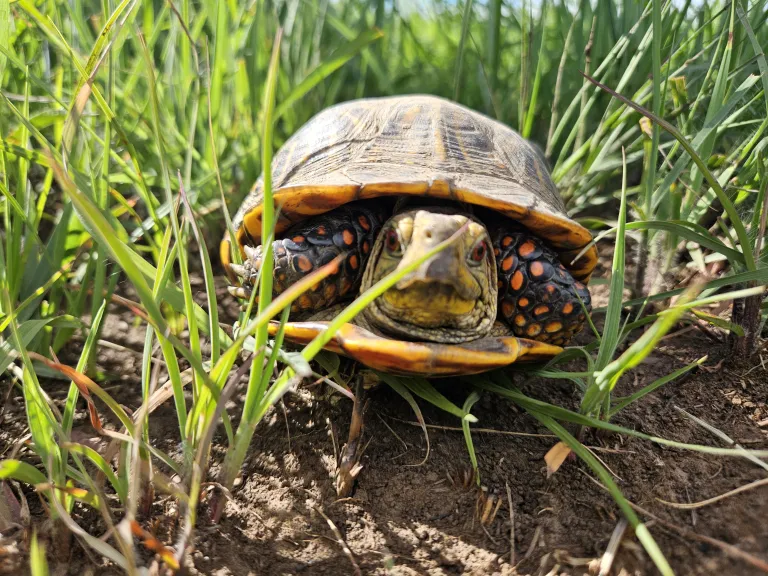
Take Action to Protect the Ornate Box Turtle - Sign the Petition NOW!
Margaret Kramar, Turtle Team Member, Sierra Club Kansas Chapter
When is the last time that you saw an ornate box turtle crossing a driveway or scuttling through the grass?
Although they are the Kansas state reptile, ornate box turtle populations are in serious decline statewide, according to a recent field study conducted by the seven zoos in Kansas affiliated with the Association of Zoos and Aquariums. Although turtle races have been considered an innocent tradition since their inception in the 1920s, biologists are warning us that large numbers of turtles are likely being killed by turtle races.
In order to reverse this decline, the Kansas Chapter of the Sierra Club urges its our members to contact organizations considering holding turtle races this year to find alternative activities to replace these events.
Here is the link to discover whether a turtle race is planned for your community: https://www.turtle-conservation.com/map
*Note: This map has not been updated since the early 2020s. Some races may have been abandoned while others may be new since then.
Why are turtle races detrimental, or even fatal, for turtles?
Crowding them together in small spaces not only causes them extreme stress, but transmits disease. Also, the ornate box turtle is philopatric, which is defined as the tendency of an animal to remain in or return to the area of its birth. So if a captured turtle is not returned to the exact location that it came from, it might not thrive in its new, unfamiliar habitat, or risk being hit by a car as it wanders lost while trying to return home. Further, the Kansas Department of Wildlife and Parks has reported that in Kansas, ornate box turtles are being trafficked in the worldwide illegal wildlife trade, where a single animal may fetch over $1,000. If a large number of turtles captured by children are confined to one place, the criminals do not have to work very hard to find them.
Keeping a turtle as a pet is not only miserable for the turtle, but leads to a decline in the population, because a turtle confined to a box in a person’s home will never be able to reproduce. Research shows that the loss of just a few reproductive females can cause a local population to go extinct. Any collecting, illegal or legal, reduces reproductive potential of wild populations. In captivity, a turtle probably is not being fed a proper diet or getting sufficient exercise, as it is severely restricted in its activities. It doesn’t have the opportunity to be warmed by the sunlight in search of a tasty mulberry, or dig into the ground when it gets too hot. Cooped up in a box or tub, it will never make any other turtle friends, and ornate box turtles have been found “bromating,” or hibernating together during the winter in large groups.
Having a pet turtle, or participating in turtle races, does not teach children anything about turtles that they could not better learn from observing them in the wild, according to Dr. Benjamin Reed, a biology professor at Washburn University in Topeka who studies the ornate box turtle. The number of activities involving competition, fun and games that could be substituted for turtle races is endless, and dogs and cats make better pets.
Join our campaign and reach out to your community
The Kansas Chapter of the Sierra Club hopes that you will reach out to your community about the detriments of turtle races, and discourage people from keeping them in captivity. Please join our campaign of “Love Them and Leave Them in the Wild” so that future children might come across a box turtle in the wild.