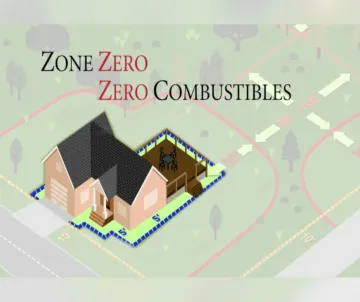
Zone 0 encompasses the first five feet around the perimeter of homes and structures. Wildfire preparedness in Zone 0 is crucial for protecting against ember attacks, the leading cause of home ignition in wildfires. Minimizing flammable materials in this zone can drastically reduce fire risk.
After the LA fires, Governor Newsom directed the State Board of Forestry to accelerate its work to adopt regulations that require ember-resistant zones within five feet of structures located in areas designated as Very High-Risk Fire Hazard Severity, that are essentially sterilized of all vegetation, except for mature trees (i.e., trees that have completed their primary growth and are no longer growing rapidly). His executive order also stipulated that, following public input, final rules for Zone 0 must be finalized by the end of 2025, and thereafter, homeowners be given three years to comply.
For Fire Hazard Severity Zones (FHSV) not designated as very high-risk, no specific changes have been decreed as yet. However, most experts advocate that only well-spaced, small fire-resistant plants with higher moisture content and lower oil, resin, or sap content be considered for planting in Zone 0 in these areas.
Vegetation management in Zone 0, however, is not without controversy. Max Moritz, a Cooperative Extension wildfire specialist and adjunct professor of environmental science at UC Santa Barbara, along with Luca Carmignani, an assistant professor of mechanical engineering at San Diego State University, argue that the California proposal’s current emphasis on highly prescriptive vegetation removal is “overly simplistic”. Their observations are that well-maintained, well-hydrated, fire-resistant plants and trees can help protect homes from wind-blown embers and can slow the spread of fire in some instances. Whether or not their input is considered when making final Zone 0 recommendations remains to be seen.
Other less controversial recommendations for Zone 0 in all fire risk hazard severity zones include the following:
- Clear dead leaves, pine needles, and dry vegetation
- Landscape with stone or gravel rather than bark or mulch
- Remove the attached wooden fences
- Remove or replace wooden decks and patios with fire-resistant materials such as
- Fire-retardant-treated (FRT) wood
- Fire-rated composite boards
- Autoclaved aerated concrete (AAC)
- Aluminum
- PVC
- Composite decking
- Fire-treated wood
- Concrete decking.
- No flammable plastic garbage or recycling bins
- No combustible decoratives
- No firewood
- Tree limbs that are at least 10 feet away from roof ridgelines, chimneys, and stovepipe outlets, and no lower than 10 feet from the ground
- Remove all dead or dying branches.
The Loma Prieta Forest Protection Committee will continue the discussion about defensible space in Zones 1 and 2 in a future newsletter.