Walk through the Santa Cruz Mountains, and you can feel it instantly: the shift in the air, the hush in the understory, the sense that something ancient is watching.
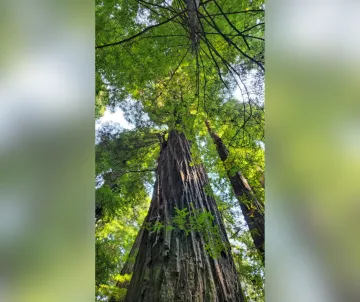
The presence of old-growth redwoods in the Santa Cruz Mountains is what remains of a vast forest that once stretched unbroken in the range from Big Sur to what is now the Presidio in San Francisco. Those that still stand are survivors of relentless logging in the 19th and early 20th centuries, standing tall and embodying beauty, resilience, and ancient history. Ranging in age between 300 and 1,800 years, some are survivors of whatever reshaped the forest long before Europeans arrived on the West Coast. All have witnessed centuries of change and upheaval.
According to the Santa Cruz Mountains Bioregional Council (SCMBC), four percent of the original old-growth redwoods originally present in this range remains, and, sadly, within the boundaries of the Loma Prieta Chapter, less than one percent. Aside from the small area in San Mateo County of Big Basin State Park, the largest area of old-growth in the Santa Cruz Mountains, the estimated total acreage of redwoods in the Loma Prieta Chapter’s region is less than 200 acres*. What remains is typically found in small groves and micro-pockets, often hidden deep in canyons or preserved thanks to a combination of luck and the dedication of local advocates.
Yet those groves and pockets matter. They are living archives of California’s natural history, and they anchor ecosystems that younger forests simply can’t replicate. The remaining old-growth redwoods are not merely trees; they are living legacies, integral to the health of the environment and the history of the land. Protecting them is not just an environmental act; it’s a commitment to memory, to place, and to the idea that some things are too valuable to lose twice.
*This figure is derived from mapped grove acreage from San Mateo County Parks, Midpeninsula Regional Open Space District, and California State Parks, plus approximations of smaller remnant patches.
Where can old-growth redwoods be found in the Loma Prieta Chapter?

Heritage Grove, credit: Bruce Washburn, www.flickr.com/btwashburn Heritage Grove, Sam McDonald Park, San Mateo
If you want to stand among the largest redwoods in the Santa Cruz Mountains that are north of Big Basin, Heritage Grove in Sam McDonald Park is the place. Heritage Grove is a compact but breathtaking 37‑acre stand of true old‑growth, saved from logging by local residents who refused to let the last giants there fall. The trees here tower over a lush understory of tanoak and huckleberry, and the grove feels like a cathedral: quiet, cool, and deeply alive. This trail will also lead you to the Loma Prieta Chapter Hikers' Hut.
- Peters Creek Grove/Portola Redwoods State Park
Hidden deep in a canyon and reached by starting at the park’s headquarters, taking the Slate Creek Trail, then going left on the Bear Creek Trail to the Peters Creek Loop Trail, the 80 to 100-acre Peters Creek Grove in Portola Redwoods State Park is one of the most impressive old‑growth redwood forests left in the region and well worth the long hike. Some trees are more than a millennium old. The remoteness that once protected it still does; it’s a place where you can walk for miles and feel like you’ve stepped back in time.
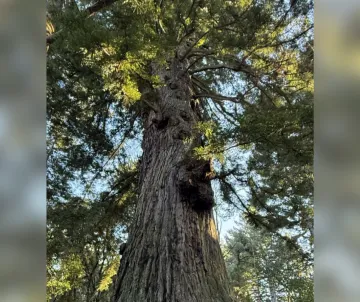
Courtesy of San Mateo Daily Journal, credit: Aaron Velasquez The Methuselah Tree/El Corte de Madera Creek Preserve
This single ancient redwood, more than 1,800 years old, is a remnant of a once‑vast forest. It stands alone now in El Corte de Madera Creek Open Space Preserve, a survivor of waves of logging that erased nearly every other old‑growth tree in the surrounding hills. Visiting it is a reminder of how much was lost and of the responsibility we have to protect what remains.
- Pescadero Creek County Park near Loma Mar, San Mateo County
Micro-pockets of old-growth and individual elders can be found in Pescadero Creek County Park. They can be visited or viewed on many trails, including the Canyon Trail, the Tarwater Loop Trail, the Brook Trail Loop, the Jones Gulch Trail, the
Pescadero Creek Loop, and on the Bravo and Towne Fire Roads. A few elders can be seen on the ridge between Pescadero Creek and Heritage Grove.
- The Bear Creek Redwoods near Los Gatos, Santa Clara County
Santa Clara County was logged even more heavily than San Mateo County, and most forests are now second‑growth. A good example of where a few old-growth trees can be found is in small stands off the Alma and Redwood Springs Trails in the Bear Creek Redwoods.
- Scattered Remnants
Vegetation maps from the Midpeninsula Open Space District (historic) and LIDAR data suggest a handful of old-growth individuals still persist in Santa Clara County in steep ravines and inaccessible slopes. They’re not marked on maps, and they’re rarely visited, but they matter. Each one is a genetic and ecological treasure.
- Redwoods in San Benito County
Because the coast redwood is a fog-dependent coastal species, the hot, dry, rain-shadowed interior valley is too inhospitable to support them, and native redwood forests never formed. There have been recent attempts to plant redwoods in San Benito County near Aromas, but there is no published data on their current status.
Why Old-Growth Groves Matter More Than Ever
Old‑growth forests are irreplaceable on any human timescale. They store vastly more carbon than younger forests, provide habitat for species that cannot survive elsewhere, moderate local climate, protect watersheds, withstand fire better than younger stands, and offer cultural, spiritual, and scientific value that defies measurement.
In an era of climate change, wildfire, and development pressure, these groves are not just beautiful; they’re essential.
How We Can Protect the Last Old‑Growth in the Loma Prieta Chapter’s Region
Protection today looks different compared to a century ago. The threats have changed, and so have the solutions.
- Prioritize home‑hardening over forest thinning
Large fire-adapted trees like redwoods are not the wildfire threat. Embers and home vulnerabilities are. Shifting policy toward defensible space and fire‑resilient buildings reduces pressure on older trees under the banner of “fuel reduction.”
- Scrutinize timber harvest plans
Even small logging proposals can threaten remnant old‑growth. Public comments matter; agencies listen when communities speak.
- Support land managers who protect legacy redwood trees
Land management entities such as Midpeninsula Regional Open Space District, Peninsula Open Space Trust, Sempervirens Fund, and California State Parks all play a role in advocating for “no‑cut” policies for old‑growth and large‑diameter future old-growth trees.
- Expand conservation easements
Some old‑growth remnants sit on private land. Conservation easements can permanently protect them without requiring public acquisition.
- Build public awareness
Most people in the Bay Area have no idea that old‑growth still exists in their backyard. Awareness fuels advocacy, and advocacy protects forests.
A Future Rooted in the Past
The Loma Prieta Chapter’s region will never again hold the vast redwood forests that once blanketed its slopes, but the groves that remain- Heritage Grove, Peters Creek, the Methuselah Tree, and the hidden elders scattered across the hills- are more than relics. They are living teachers, reminders of resilience, and anchors for the forests of the future.
Learn More
Characteristics of Old-Growth Redwoods
Old-Growth: What it Means and Why it Matters
Structural Characteristics of an Old-Growth Coast Redwood Stand
The Ghost Forest, by Greg King, PublicAffairs, 2023