An underground story of roots, microbes, and the quiet climate heroes nobody invites to conferences
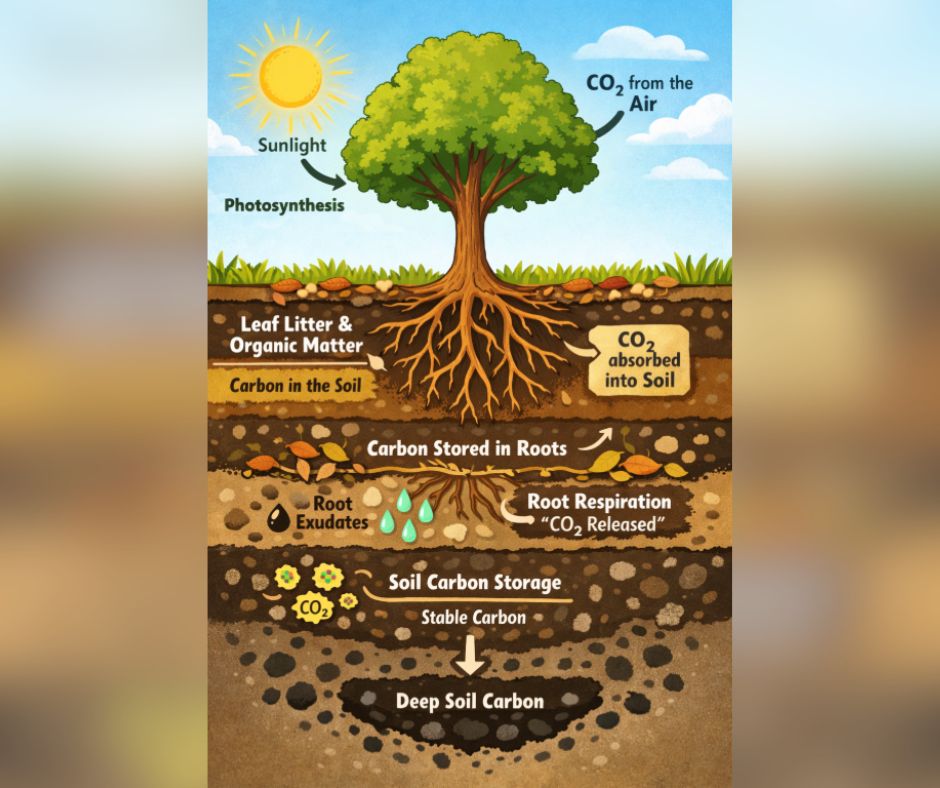
Most people walk into a forest and look up. They admire the cathedral ceilings of branches and leaves, the dappled sunlight peeking through, limbs that can look like they’re auditioning for a fantasy film. However, if you really want to understand how forests fight climate change, you have to do something far less glamorous: look down.
When it comes to long-term carbon storage, the real action is happening underground, where roots, microbes, and minerals are quietly running one of the most efficient climate operations on Earth.
Most carbon accounting stops at one meter deep, which is ridiculous, because forests don’t. Deep soils, one to more than nine feet deep, can store as much or more carbon as all above-ground biomass.
Roots: Overworked and Underpaid Carbon Couriers
Roots are the forest’s unsung labor force. They don’t get the glory of the trunk or the photogenic appeal of the canopy, but they’re doing the gritty work of shoving carbon into the soil day and night.
Trees send 30 – 50% of their hard‑earned photosynthate belowground, a move that would make any financial planner proud. Fine roots, those hair‑thin little strivers, grow, die, regrow, and die again, each time leaving behind a carbon breadcrumb trail.
It’s like a carbon version of Groundhog Day, except Bill Murray is a root and he’s actually helping the planet.
Root carbon pathways and fine root turnover are key processes that determine how much carbon plants return to the soil versus the atmosphere, and they play a central role in the global carbon cycle.
Microbes: Tiny, Frenetic Carbon Alchemists
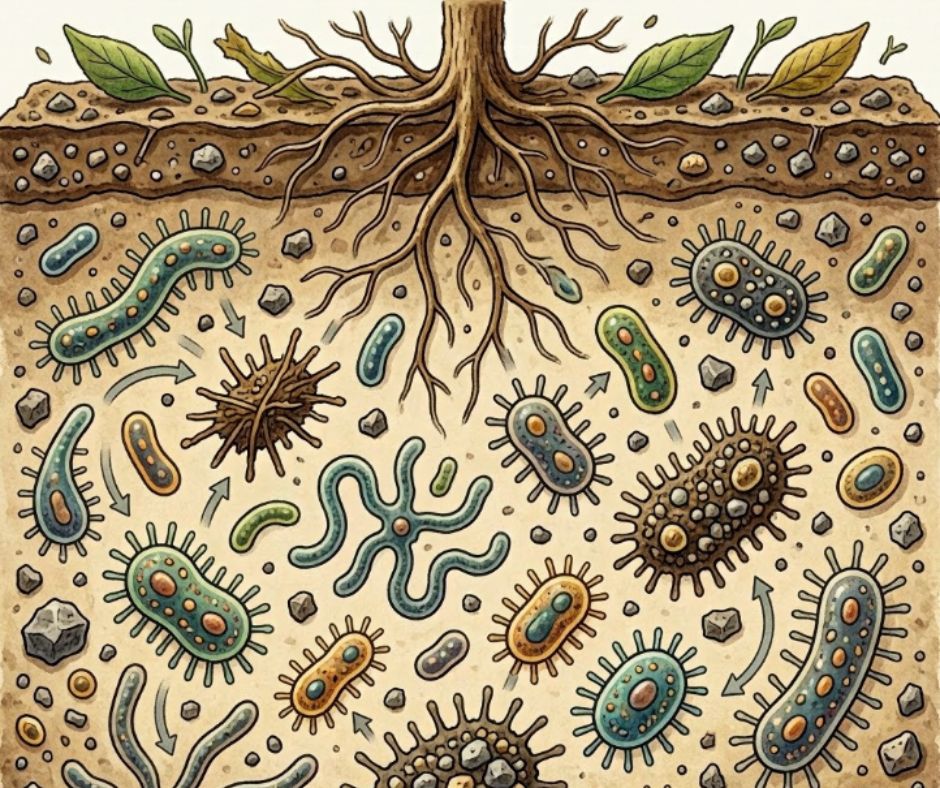
Now enter the microbes, the microscopic chemists who take root leftovers and turn them into microbial necromass, which sounds like a death metal band but is actually one of the most stable forms of carbon on Earth. Microbial necromass refers to the remains of dead bacteria and fungi, which can constitute a large fraction of stable soil organic matter. When microbes die, their cell walls and internal components often bind to soil minerals, becoming part of the long-term carbon pool. Through soil microbial carbon cycling, microorganisms transform, store, and release carbon (C) in organic and inorganic forms, playing a central role in the global carbon cycle and ecosystem function.
These microbes, like a death metal band, live fast and die young, but they also leave carbon that persists for centuries. Honestly, if microbes had a PR team, they’d be at the top of the charts in the climate movement.
Mineral‑Associated Carbon: The Fort Knox of the Forest
Deep in the soil, carbon meets minerals, which is to say clays, iron oxides, volcanic ash, and all forms of mineral‑associated organic matter (MAOM). This is the carbon equivalent of locking your valuables in a bank vault guarded by a dragon.
MAOM is stable for centuries to millennia. It’s a quiet and dependable carbon that isn’t easily rattled by wildfire, drought, or whatever else is thrown at it.
Why Underground Carbon Should Be a Policy Superstar
Underground carbon is massive, long‑lasting, fire‑resilient, surprisingly under‑measured, and underappreciated. Protecting the belowground carbon vault (the roots, microbes, minerals, and deep soils that quietly store more carbon) is essential for real climate change mitigation.
Closing Thought
Aboveground forests are like a cathedral, while underground forests resemble an ancient, quiet crypt filled with treasures. The next time you walk through a forest, admire the beauty of its towering trunks and the majesty of the canopy, but also take a moment to appreciate the treasure beneath your feet.
Further Resources:
The Hidden Life of Trees: What They Feel, How They Communicate―Discoveries from A Secret World, by Peter Wohlleben, Greystone Books, 2018
Fundamentals of Soil Ecology, by David C. Coleman, Mac A. Callaham, and D. A. Crossley Jr., Academic Press, 2017