February 27, 2025
Sagar Bhatt, Project Manager
California Department of Toxic Substances Control
DTSC Berkeley Office
700 Heinz Avenue
Berkeley, CA 94710
By email: Sagar.Bhatt@dtsc.ca.gov
Re: Draft Removal Action Workplan for the Harbor View Property Site in Redwood City, CA
Dear Sagar Bhatt,
The Sierra Club Loma Prieta Chapter’s Bay Alive Campaign welcomes this opportunity to comment on the proposed Remedial Action Workplan (RAW).1 We do so on behalf of tens of thousands of supporters who are concerned about the health of our communities, wildlife, living shorelines and Bay waters.
We have concerns that the RAW Alternative 4, recommended by the authors and preferred by DTSC, may not be protective against future human and Bay ecosystem exposure to asbestos-containing material (ACM) in the face of flooding or groundwater rise. Although the proposed plan will prevent near-term inhalation or dermal exposures by use of a clean soil layer and impermeable surfaces, and will require a land use covenant (LUC) to prevent future removal of the cap layer, there are uncertainties related to the potential for ACM to travel in flood water or groundwater. We also have concerns related to the proposal to move soil around the site without testing the excavated material for ACM content, increasing the risks of worker and offsite inhalation exposure from the earth-moving operations. We recommend the following changes to the plan.
Install permanent groundwater wells and other requirements for ACM monitoring
The presence of ACM at the site is attributed to a PABCO facility that produced asbestos-containing building materials at the eastern side of the site from 1948 to 1968. Raw asbestos fiber, concrete, and manufactured tiles were dumped into tidal channels. The Bay marshes were later covered with fill to bring the site up to its current grade. As shown in a cross-section of the site (Figure 1 below), the ACM extends down to the original Bay mud in places, with much of the material below the current groundwater table. A 1948 aerial photo of the site (Figure 2 below) shows remnant tidal channels on the west and east sides of the site. Historically, these channels would have extended to Redwood Creek to the north and to the Bay marshes across Seaport Boulevard to the east.
RAW Section 4.6.3 evaluates the potential for ACM fibers to migrate in groundwater and concludes that it is negligible based on the characteristics of the subsurface soil, which they state is a silty/clay matrix with a low porosity and organic content. However, this conclusion ignores the heterogeneous nature of the debris placed into the tidal channels. While some of the soil borings specify silty clay, others note concrete, miscellaneous debris, and layers of manufactured tiles. These materials may produce conduits for migration of asbestos fibers along the historical tidal channels to current bay marshes, increasing risk of airborne transport of ACM.
Site flooding is also of concern for ACM transport: the site is within the 100 year flood zone, and the RAW states that the projected 2050 groundwater elevation (assumed to equal sea level rise) will be 13 feet above NAVD88, essentially at the planned site elevation. There is no assurance that two feet of clean fill in the landscaped areas will be sufficient to avoid transport of ACM in floodwater.
We recommend installation of permanent groundwater wells on the northwest and east boundaries of the site in the location of historical tidal channels and periodic monitoring for ACM. Since the site does not currently border on Bay marshes and asbestos is likely present in offsite soils, this measure will not be conclusive as to migration; future DTSC negotiations with offsite property owners should include monitoring. There should also be requirements to monitor ACM in stormwater drains and overland runoff. Water samples should be analyzed using transmission electron microscopy (TEM).Test all relocated soil in Alternative 4 for ACM or Adopt Alternative 3 as preferred Alternative
The RAW proposes two alternatives that would protect future occupants of the site without requiring complete removal of all ACM:Alternative 3 proposes to cover all areas of the site where ACM has been detected (27 acres) with imported fill.
Alternative 4 proposes to relocate soil from high areas of the site to fill in low areas, irrespective of ACM content. Imported soil would be used to bring all areas of the site to grade and provide extra cover for landscaped areas.
It is not clear that there is enough soil available, for Alternative 4, in high areas of the site to account for the differences in imported fill volume and cost between these two alternatives. The site cross-sections and the Cut/Fill diagrams in Appendix F show few areas of the site that reach the planned final elevations, 13 feet above NAVD88 for the entire site and 14 feet above NAVD88 for buildings and roadways (RAW 4.6.1.). The amount of soil required to raise the entire site and adjacent roadways to this level appears to dwarf the amount of soil that would be relocated in Alternative 4.
Relocating soil that may contain ACM poses a higher risk of exposure to onsite workers and offsite receptors compared to leaving it in situ, as dust is generated both in excavation and dumping. Alternative 4 should be modified to require ACM testing of surface and subsurface soils targeted for relocation and offsite disposal of any soils containing ACM above allowable limits. Alternatively, adopting Alternative 3 would be more health protective for future site uses. Alternative 4 could leave ACM in place in shallow soils beneath buildings and roadways, potentially requiring additional assessment and remediation for future developments. Given the minor cost savings in reuse of potentially contaminated soil, we recommend adopting Alternative 3 or adding soil testing requirements and ACM acceptance limits to Alternative 4.
Other comments on the RAW
Clarify that the ACM distribution across the site shown in Figures 3 through 8 of the RAW is based on visual inspection of soil borings, not analytical results. Many of the samples obtained from strata, described as ACM in the soil borings, did not detect chrysotile or amphibole asbestos in the sample. This is likely due, in part, to the poor sensitivity of polarized light microscopy (PLM), which has a detection limit of 1%. In addition, PLM is known to produce both false positives and false negatives when contained in a matrix of bulk material2. Since nondetects were reported in some borings that described the sample content as “layers of manufactured tile”, these were likely false negatives. There is no indication in the RAW that confirmation of ACM by more accurate methods, such as TEM, were used in any of the site investigations.
The Redwood City RAW Community Update3 states “If visibly stained petroleum hydrocarbon contaminated soil is encountered during this work, it would be excavated and disposed of at a licensed facility.” This statement contradicts the RAW, which proposes “visual, olfactory, and photoionization detector (PID) measurement procedures” [emphasis added] to be used to decide on the need for further action. Although all known leaking underground storage tanks have undergone regulatory closure, the past intensive industrial use of the site means that undiscovered sources could still be present. The RAW should retain the proposed language requiring on-site monitoring for volatile organic compounds. Note that a PID measures total volatile compounds, with response factors varying among chemical classes. For acceptance at an offsite disposal facility, laboratory testing with more accurate methods may be required.
Alternatives costing more than $2,000,000 require a full Remedial Action Plan (RAP), rather than a RAW. If the Alternative 4 cost of $1.935 MM (20% contingency) is projected to exceed that threshold, with reasonable future inflation, with the need for additional testing for ACM and after addressing all comments, a RAP must be prepared.
Thank you for considering these comments.
Sincerely,
Jennifer Chang Hetterly
Bay Alive Campaign Coordinator
Sierra Club Loma Prieta Chapter
cc:
James Eggers, Chapter Director; Mike Ferreira, Chapter Chair; Gita Dev, Conservation Committee Chair; Susan DesJardin, Bay Alive Chair
See Figures 1 and 2 below from the RAW:
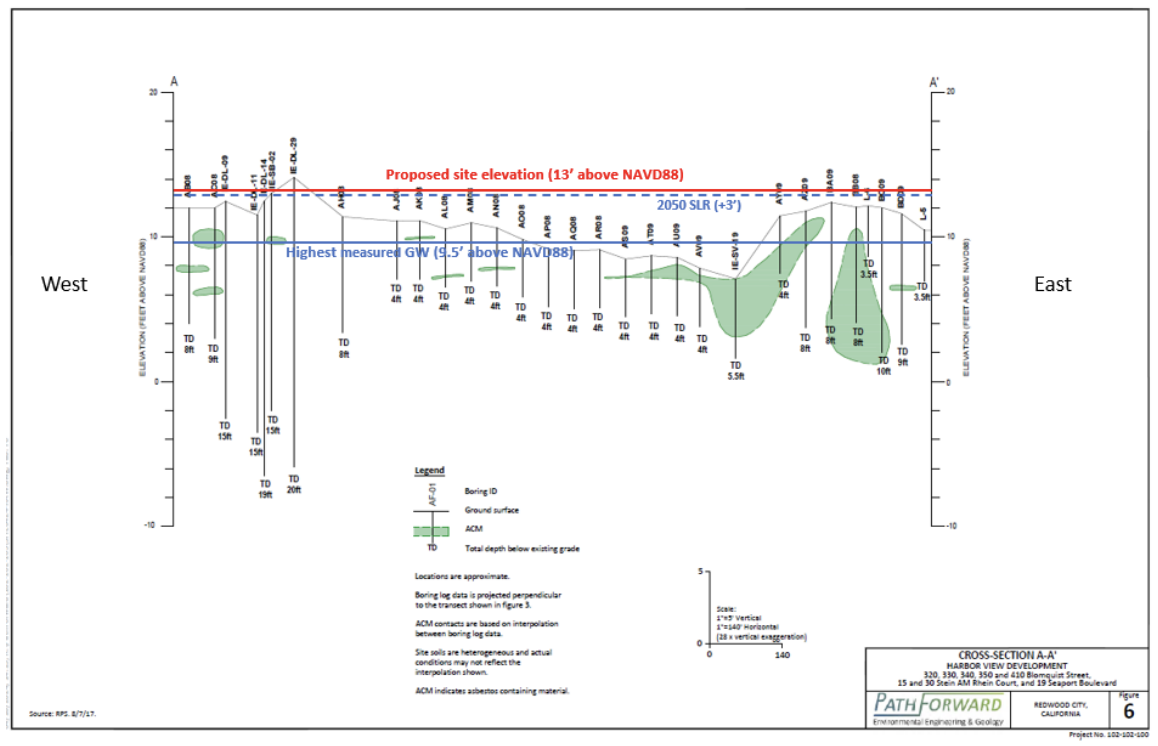
Figure 1: Cross-section of site, with added groundwater and proposed site elevations (modified from RAW Figure 6)
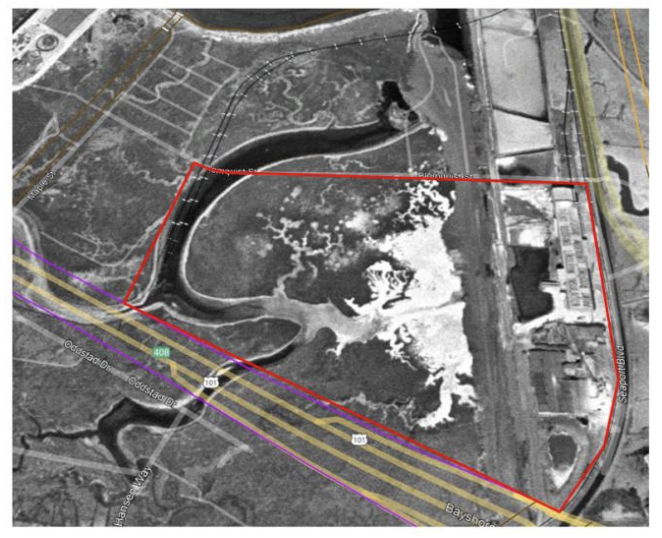
Figure 2: 1948 aerial photo, overlaid with current roads and site boundary (source: Google Earth)
1 Path Forward. FINAL REMOVAL ACTION WORKPLAN, 320, 330, 340, 350, and 410 Blomquist Street; 19 Seaport Boulevard; 15 and 30 Stein Am Rhein Court, Harbor View, Redwood City, California, December 5, 2024
2 U.S. Environmental Protection Agency. Test Method. Method for the Determination of Asbestos in Bulk Building Materials. EPA/600/R-93/116.
3 Community Update: Harbor View Property, January 2025. Proposed environmental cleanup plan for the Harbor View Property.