
Re: City Council April 7th agenda item 18: Sierra Club Loma Prieta Chapter and Santa Clara Valley Bird Alliance comments on the draft Dark Sky ordinance
Dear Mayor Lauing and Palo Alto City Councilmembers,
The Santa Clara Valley Bird Alliance and the Sierra Club Loma Prieta Chapter are organizations united by our shared commitment to the protection of the environment, nature, and open space.
Context
The introduction of LED lighting has induced vast improvements to energy consumption per lighting fixture (luminaire) and increased longevity of luminaires. These advances reduced the cost of lighting, resulting in more lighting overall. Furthermore, the spectrum of LED luminaires includes a high proportion of light in the blue (short wavelength) spectrum, which is harmful to human and environmental health.
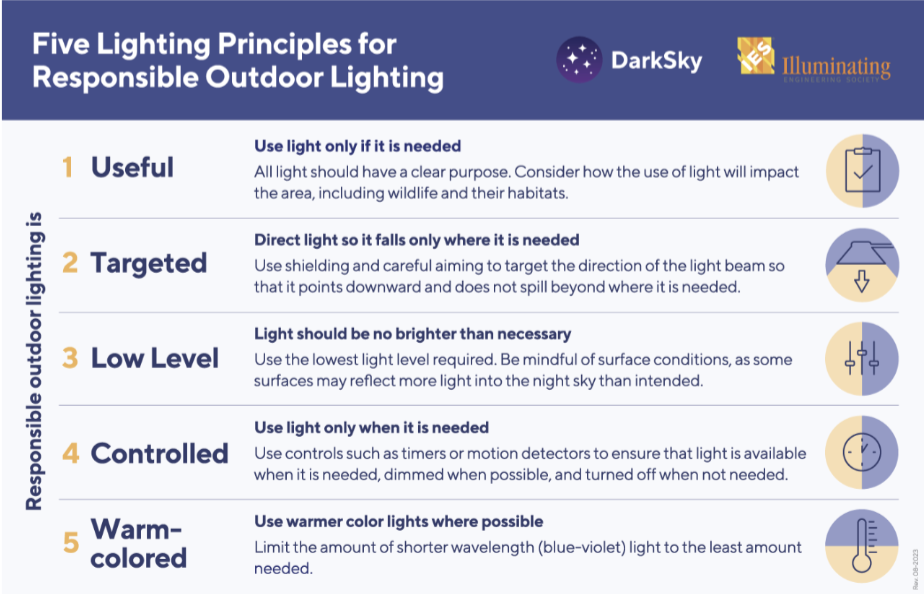
To prevent and reduce light pollution through the proper application of quality outdoor electric lighting, DarkSky International developed the Five Principles for Responsible Outdoor Lighting 1 :
We have supported Palo Alto in its efforts to create a Dark Sky ordinance by sharing research and model ordinance language with City staff, the Architectural Review Board and the Planning & Transportation Commission. The Planning and Transportation Commissioners (PTC), in their October 30th motion, made an effort to recommend strong ordinance language that reflects the Five Principles for Responsible Outdoor Lighting, but the April 7th proposed ordinance has not incorporated some of the most critical PTC recommendations.
Our recommendations for Dark Sky applicability, lighting curfews, and light trespass thresholds are based on adopted Dark Sky policies in California, including ordinances from Cupertino, Malibu, and Brisbane. The draft ordinance to be heard by Los Altos City Council on April 8th 2025 also includes language consistent with these recommendations. Our recommendations are reflected in the October 30th PTC motion.
Content of this letter
Our letter includes the following information, in order.
- A list of items in the October 30th PTC motion
- A summary of our recommended amendments to the April 7 draft ordinance
- A detailed background and analysis of each of our recommendations
- PTC Motion of October 30, 2024 (passed 6:0:1 with Commissioner Hechtman absent):
- Reinstate the provision that would expand applicability to projects that only include new or replacement of existing luminaires: Rejected by staff.
- Add a hardship exception provision that could consider technical feasibility, consistency with a historic structure, or financial burden: Rejected by staff.
- Change light trespass allowance from 0.5 to 0.1 foot candles (FC) throughout the ordinance: Rejected by staff.
- Reduce time limit on motion sensors from 10 minutes to five minutes: Accepted by staff.
- Add definition terminology requested by Sierra Club based on suggested best practices. Accepted by staff.
- Recommend to City Council that further outreach be done at the time of implementation, informing residents of the new regulations; and that regulations for interior commercial lighting be considered in the future.
- In addition, the PTC approval included a city-wide lights out requirements that included existing lighting (curfew). Applicability narrowed by staff.
- The following is a summary of the amendments we recommend to be made to the April 7th draft ordinance. Most of these recommendations mirror the PTC understandings and their motion of Oct 30, 2025.
- Applicability
- Follow the PTC motion of October 30th to reinstate:
“(c)(3) Installation of new outdoor lighting, replacement of existing outdoor lighting fixtures, or changing the lighting type or system”. - Consistent with the October 30th PTC motion, develop a hardship exception provision that could consider technical feasibility or financial burden.
- Follow the PTC motion of October 30th to reinstate:
- Curfew
- Reinstate the curfew language that was presented to the PTC on October 30th:
“(4)(A) Lighting Curfew. Unlike other provisions in this section, Lighting Curfew applies to all new and existing buildings and structures and luminaires, unless otherwise approved. All outdoor lighting shall be fully extinguished or be motion sensor operated by 10:00 p.m., two (2) hours after close of business, or when people are no longer present in exterior areas, whichever is later.” - Note: The underlined language “and luminaires” was added by us (and was not originally in the October 30th motion) to include all outdoor lighting that is not exempt from this ordinance or regulated by state code in curfew requirements.
- Reinstate the curfew language that was presented to the PTC on October 30th:
- Light Trespass
- Implement the October 30th PTC motion to
“change the light trespass from 0.5 to 0.1 foot candles at every reference throughout the ordinance”
- Implement the October 30th PTC motion to
- Protecting Streams and Baylands
- Ensure that no light trespass occurs into the Baylands Nature Preserve east of Highway 101.
- Retain the protections that the current municipal code provides to riparian ecosystems section 18.40.140 Stream Corridor Protection
“(3) Requirements Within streamside review area (g) Nighttime lighting shall be directed away from the riparian corridor of a stream.” - If possible, include
“(4) Guidelines Within Streamside Review Area (a) The distance between nighttime lighting and the riparian corridor of a stream should be maximized.”
- Seasonal Lighting
Apply a unique curfew to Seasonal lighting (midnight - 8AM) - Findings and Declarations and Purpose Language
Add the Five Principles for Responsible Outdoor Lighting to the Findings and Declarations and Purpose sections of the ordinance.
A detailed breakdown of each of our recommended improvements
Applicability
The April 7th draft restricts the applicability of the ordinance to new construction, substantial remodels, and new luminaires requiring a building permit. Without applying the ordinance to new and replacement luminaires, Palo Alto cannot effectively reduce light pollution. Over time, old lighting fixtures are likely to be replaced with new non-compliant lighting fixtures, and many new fixtures may be added that do not require a permit. This is likely to increase light pollution in the city.
In addition, this is a departure from other recently adopted Dark Sky Ordinances such as Cupertino’s, Malibu’s and Brisbane’s ordinances, which include new and replacement luminaires. This is also a departure from the initial draft of Palo Alto’s ordinance (October 28th PTC draft), and a dismissal of the October 30th PTC motion.
August 28th PTC draft ordinance, Applicability language
“(c) Applicability. For the purposes of this Section, except as otherwise provided in Subsection 18.40.250(3)(4)(A) below, the following projects shall comply with the outdoor lighting standards and guidelines set forth in this Section:
(1) All newly constructed structures and buildings
(2) Substantial Remodel, as defined in Section 16.14.070 of the Code, on existing structures or buildings
(3) Installation of new outdoor lighting, replacement of existing outdoor lighting fixtures, or changing the lighting type or system” (emphasis added)
In the October 30th draft ordinance presented to PTC, Section (c) Applicability (3) was removed. However, PTC motioned during the October 30th meeting to reinstate that language.
The October 30th PTC Motion asked staff to
Reinstate the original language of “Section (c) Applicability (3)” from the August 28th ordinance draft, which reads as follows: “(3) Installation of new outdoor lighting, replacement of existing outdoor lighting fixtures, or changing the lighting type or system, and
Consider a “hardship exception provision” that could consider technical feasibility, consistency with a historic structure, or financial burden.
In the April 7th draft, staff has not reinstated section (c)(3) as requested. Instead, the draft April 7th ordinance proposes the following language: “(3) New installation of outdoor luminaires requiring a building permit.”
Staff reasoning in rejecting the PTC motion (April 7th staff report)
This is done “in order to reduce the enforcement and limit financial costs associated with these smaller projects”, and
Staff considered an exception for projects facing significant financial impact from the new lighting requirements per PTC direction. However, staff determined that separating lighting costs from the entire construction cost or project valuation would be difficult for both applicants and staff responsible for verification. Furthermore, the new standards do not apply to the replacement of existing outdoor lighting or changes to the lighting type or system, which was one of scenarios that led to the concerns of financial burdens. An exception for historic resources has been added to ensure that the new standards do not impair historical integrity.
Our response
The Dark Sky ordinance, like many other regulations, does not require active enforcement. The ordinance simply provides a recourse to residents who are negatively impacted by light pollution. Furthermore, other cities that apply Dark Sky requirements to all new and replacement lighting, such as Cupertino and Brisbane, have not reported any issues with the enforcement of their standards.
Applying Dark Sky standards to only permitted luminaires (as staff suggests in the April 7th draft) could increase the complexity of enforcement rather than reducing it. Residents cannot know whether they have recourse to complain when a light is bothering them, since they cannot know whether that nuisance lighting source was permitted. If a resident complains about nuisance lighting under the April 7th draft, staff may need to check to see whether the building in question has received any permits recently, and then check those permits to determine which fixtures were installed under that permit, and whether those fixtures are the ones causing the nuisance lighting from the complaint. The April 7th draft not only is less effective at reducing light pollution, it is also more difficult for residents to understand and is potentially more complicated for the City to enforce.
Furthermore, if Dark Sky standards apply only to permitted lighting, then Palo Alto cannot hope to meaningfully reduce light pollution. Residents and businesses will continue to add new or replace existing fixtures with non- comforming luminaires. Unless the applicability extends to all lighting, the April 7th draft cannot stop existing property owners from installing flashing lights, strobe lights, or flood lights and other non-compliant luminaires that increase light pollution and light trespass into neighboring properties.
Applying Dark Sky standards to all new and replacement luminaires (as was done in the October 30th PTC motion) creates a universal standard that can more easily be understood by the public and by staff. For this reason, such recommended language is commonplace in adopted Dark Sky ordinances.
Per the October 30th PTC motion, the City can consider including a hardship exception for existing structures to provide recourse for property owners seeking to replace existing lighting. This would cover edge-cases such as certain very old multi-family buildings that may require extensive re-wiring when replacing old luminaires with new Dark Sky compliant luminaires.
Proposed Amendment
Consistent with the October 30th PTC motion, reinstate applicability language as motioned by the PTC on October 30th: “(3) Installation of new outdoor lighting, replacement of existing outdoor lighting fixtures, or changing the lighting type or system”
Consistent with the October 30th PTC motion, develop a hardship exception provision for existing buildings that could consider technical feasibility or financial burden.
Curfew
The April 7th draft lighting curfew language stems from the applicability of the ordinance and therefore applies the lighting curfew only to new and replacement luminaires that were installed under a building permit.
This approach creates an inconsistent landscape where some properties remain illuminated all night long, while a relatively smaller number of properties must comply with curfew requirements. This is contrary to the Dark Sky principle of using light only when it is needed, will not achieve reductions in light pollution, and will not protect human residents or migratory birds. Furthermore, it could create confusion among residents and businesses.
This inconsistent curfew landscape could present an enforcement challenge to the City, since any complaints about non-compliance will require staff to check permits and identify which specific lighting fixtures received permits and therefore must comply with the curfew. This also presents an unclear situation for residents, who can’t know whether a nuisance source of lighting must comply with the ordinance. Previous versions of Palo Alto’s ordinance (the October 30th PTC draft) contained a curfew that specifically applied to all new and existing buildings and structures. This approach is easier for residents to understand, likely easier to enforce, and more effective at reducing light pollution.
At the October 30th PTC meeting, in response to Commissioners' questions, staff assured the PTC that curfew requirements apply to all new and existing buildings and structures (see the language in bold below).
Oct 30th Draft Language presented to PTC, Section “(e) Lighting Standards (4) Lighting Control (A) Lighting Curfew. ”Unlike other provisions in this section, Lighting Curfew applies to all new and existing buildings and structures, unless otherwise approved. All outdoor lighting shall be fully extinguished or be motion sensor operated by 10:00 p.m., two (2) hours after close of business, or when people are no longer present in exterior areas, whichever is later.”
This language was removed AFTER the PTC meeting, by staff in their April 7th draft. The curfew requirements in the April 7th draft are now restricted to the new applicability clause of the ordinance, limiting curfew requirements to only apply to the following:
(1) All newly constructed structures and buildings, or
(2) Structures or buildings proposing a Substantial Remodel, as defined in Section 16.14.070, or
(3) New installation of outdoor luminaires requiring a building permit.
April 7th Draft Language presented to City Council:
Section (e) Lighting Standards (4) Lighting Control (A) Lighting Curfew.
“All outdoor lighting shall be fully extinguished or be motion sensor operated by 10:00 p.m., two hours after the close of business, or when people are no longer present in exterior areas, whichever is later.”
Staff reasoning and our responses
Staff reasoning: The cost of enforcement is “unsupported based on existing staff levels.”
Our response: Active policing is not required or recommended. There is no support for an assumption that staff will receive many complaints, and if they do, that just proves that this ordinance is truly necessary.
Staff reasoning: Requiring existing lighting fixtures to comply would set up an unrealistic expectation that all existing lighting would comply with the subject ordinance upon ordinance adoption.
Our response: Under the October 30th language, existing fixtures would need to comply with the lighting curfew, but not other provisions of the ordinance, because the curfew language has its own unique applicability clause that specifically applies to existing structures and buildings. Furthermore, the curfew language allows for lights to remain on until two hours after the close of business, or until people are no longer present, whichever is later. Businesses that are open late or receive late night foot traffic would therefore have their operations unaffected by the curfew. This sets a reasonable expectation for the public and makes the ordinance easy for them to understand.
In contrast, under the April 7th language, only permitted fixtures would need to comply with the curfew. This leads to situations where two identical fixtures, for two identical use cases, in two side-by-side locations, could have different curfew requirements, merely because one fixture was installed with a building permit and the other was not. This could make the ordinance incomprehensible to the public and prevent them from establishing any reasonable expectations regarding the lighting curfew.
Staff reasoning: Mandatory motion sensors would be a cost burden for property owners, a lighting curfew without them would likely result in widespread non- compliance, increased neighbor disputes, and diminished public support for Dark Sky initiatives.
Our Response: Motion sensors are not mandatory in the ordinance. There exist manual options as well as automatic timer devices that can be used instead of motion sensors. Motion sensors can cost $10-50.
Proposed Amendment
Reinstate the curfew language that was presented to the PTC on October 30th, in section (e)(4) as follows:
“(A) Lighting Curfew. Unlike other provisions in this section, Lighting Curfew applies to all new and existing buildings and structures and luminaires, unless otherwise approved. All outdoor lighting shall be fully extinguished or be motion sensor operated by 10:00 p.m., two (2) hours after close of business, or when people are no longer present in exterior areas, whichever is later.”Note: The underlined language “and luminaires” was added by us (and was not originally in the October 30th motion) to include all outdoor lighting that is not exempt from this ordinance or regulated by state code in curfew requirements.
Light Trespass
In the October 30th PTC meeting, PTC motioned to “change the light trespass from 0.5 to 0.1 foot candles at every reference throughout the ordinance.” However, Staff did not change the 0.5 foot candles (FC) requirement. This allows for light many times brighter than the full moon to trespass into adjacent properties.
Staff reasoning“The maximum light trespass to an adjacent property is currently 0.5 foot- candle in the City’s lighting code. Staff recommends no change to this standard.”
The PTC recommends 0.1 FC, which was adopted in nearby jurisdictions and reflects the Commission’s interest to minimize light spilling over to adjacent properties. While supporting this interest, staff is concerned that it sets up an unrealistic expectation of essentially no light spilling over to adjacent property and may result in increased complaints to the code enforcement program, taking staff from other priority cases.
Moreover, the California Building and Safety Code stipulates a minimum illumination of 1 foot-candle for exit paths to ensure safe building egress; this standard will prevail where there is a conflict. Balancing the ordinance’s objectives with critical safety considerations, the maximum light trespass level was ultimately maintained at 0.5 foot-candle.”
Our response
Cupertino uses a 0.1 FC standard, and Brisbane has a standard of zero trespass.
0.5 FC as an allowable light trespass number is as much as 25 times brighter than the light from a full moon (measured at .02 FC). The threshold for impacts to snowy plovers is 0.005 FC, so even 0.1 is impactful to the natural environment.
The City must comply with the state building code, but it can and should reduce light trespass where lighting is not mandated by state law. If it results in many complaints to code enforcement, then the ordinance is doing exactly what it is intended to do, i.e., provide better livability and environmental health in Palo Alto.
Proposed Amendment
Implement the October 30th PTC motion to “change the light trespass from 0.5 to 0.1 foot candles at every reference throughout the ordinance”.
Protecting streams and Baylands
Light at night devastates natural ecosystems. The existing ordinance recognizes this, and includes requirements and guidelines to reduce light impacts on streams. These protections are critical, yet they have been stripped from the language of the ordinance.
We are aware that a new steam protection ordinance is under development in Palo Alto, but until this new ordinance is adopted, the existing protections should remain in effect, and be expanded to protect other natural resources such as Baylands ecosystems.
Proposed Amendment
Ensure that no light trespass occurs into the Baylands Nature Preserve east of Highway 101.
Retain the protections that the current municipal code provides to riparian ecosystems section 18.40.140 Stream Corridor Protection
“(3) Requirements Within streamside review area
(g) Nighttime lighting shall be directed away from the riparian corridor of a stream.”
If possible, include the existing language:
“(4) Guidelines Within Streamside Review Area
(a) The distance between nighttime lighting and the riparian corridor of a stream should be maximized.”
Seasonal Lighting
The April 7th Draft Language exempts seasonal lighting during the period of October 15th through January 15th of each year from all of the requirements of the ordinance. October 15th occurs during bird migration season.
With new holiday lighting innovations that increase lighting overall, we believe that protections for migratory birds and the Dark Sky is warranted. We recommend establishing a unique curfew for seasonal lighting, rather than exempting it from curfew requirements entirely.
Proposed Amendment
Apply a unique curfew to Seasonal lighting (midnight - 8AM)
Add the Five Principles for Responsible Outdoor Lighting to the Findings and Declarations and Purpose sections of the ordinance.
These principles, from DarkSky International, are the basis for Dark Sky policy objectives, and should be included in the ordinance. As shown in the image on page 1 of this letter, these principles state that lighting should be useful, targeted, low level, controlled, and warm-colored.
Proposed Amendment
Add the Five Principles for Responsible Outdoor Lighting to the Findings and Declarations and Purpose sections of the ordinance.
Thank you for your time and consideration.
Sincerely,
Shani Kleinhaus
Environmental Advocate
Santa Clara Valley Bird Alliance
Dashiell Leeds
Conservation Coordinator
Sierra Club Loma Prieta Chapter
1 https://darksky.org/resources/guides-and-how-tos/lighting-principles/