Standardized Questions for Turf Study Focus Groups
On July 17, 2025, the City of Palo Alto conducted a Zoom session for a Turf Study focus group. This webpage includes the questions and the answers that the Sierra Club Loma Prieta chapter submitted before the Zoom session.
1. Introduction to Use and Experience
Question
Can you describe how you or your organization currently use athletic fields in Palo Alto, including El Camino Park if applicable? Please include, frequency, time of use, days used, and any unique uses (i.e. tournaments, special events, etc.)
Loma Prieta Answer
While I can’t name a Sierra Club Loma Prieta Chapter member in Palo Alto who plays league sports, there are several members with children or other relatives who play school and / or league sports in Palo Alto.
In addition to youth who complain about the heat of fields on hot days, and also about turf burn, parents and grandparents of young children say that plastic grass and synthetic rubber on playgrounds becomes too hot, and also that children don’t know to stay off surfaces that are hot.
2. Priorities and Values
Question
What are your top priorities or values when it comes to athletic field design and maintenance (for example, safety, environmental impact, playability, accessibility, cost, aesthetics)?
Loma Prieta Answer
In order, I’d say:
- Environmental impact (see information about microplastics below),
- PLAYERS’ HEALTH (see public health risks below) which includes “accessibility,” as well as risk of injury, heat stress, or other risks caused by repeated exposure to microplastics (see below),
- Cost (covered further down under “Financials”)
- Playability (see below)
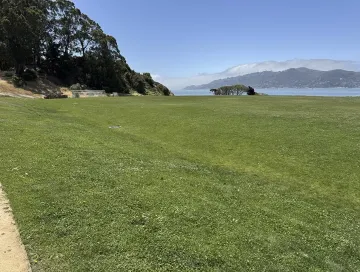
- Aesthetics - note that well taken care of real grass looks awesome (see picture of McKegney Green below)
Public Health Risks
Includes harms from microplastics as well as from embedded chemicals which, together, have been associated with higher risks for heart disease, inflammatory bowel disease, reproductive issues, respiratory disorders, cancer and more. When discussing public health, underserved populations are less likely to have robust healthcare, making recovery or treatment for the effects from microplastics and embedded chemicals less certain. John Hopkins Microplastics & Human Health, Harvard Medicine Microplastics & Human Health, Stanford Medicine Microplastics & Human Health, UN Microplastics & Environmental Justice, AAMC Microplastics & Human Health
Microplastics are distributed globally, so there is no getting away from them. We all have concerning amounts of microplastics in our bodies. PIRG Current Research on Microplastics in Humans
Environmental Risks
Microplastics, tiny particles resulting from plastic degradation or deliberately produced in sizes under 5mm, intensify multiple environmental crises. They contribute to biodiversity loss, ocean acidification, freshwater disruption, soil degradation, and altered atmospheric chemistry. This is a function of not only their fossil fuel origin but also their physical properties and of the complex mix of chemicals added to enhance product desirability. UN Fast Climate Change Facts, Geneva Plastics & Climate Change Page, CIEL Plastics in the Environment Page, UN Plastic Pollution Page, Guardian Plastic Pollution & Earth Systems Report, One Earth Journal Plastic Worsens Climate Change, Geneva Chemicals in Plastic
Playability / Hours of Use What’s Possible on a Sustainable Natural Grass Field
Below is quoted from a letter, from a parks superintendent in Arizona, which is hotter & drier than Palo Alto
On Fri, Jul 11, 2025 at 1:49 PM Sean Carlin wrote:
Being a Friday ... a quick reply but if you need more info send me a meeting invite for a discussion near the end of July ... right now we're swamped with park designs deadlines.
How many fields are part of the park?
4 now full size adult soccer/multi purpose. Going to 16 within 4 years park is in final design now.
What are they used for (what sport(s))? Flag football, soccer, a bit of lacrosse, and I'm not quite sure what else but there are probably a few other sports that simply rent the space to practice on the turf.
How old are the field(s)? 6 years old park first phase built 2019
What type of grass is used? Full bermuda ... can't quite remember the variety but will check. We're trying a few new types in new park construction to be a bit more wear and shade tolerant.
Was artificial turf ever a consideration - if yes, why are the field(s) grass? No. Too hot in Phoenix in our opinion on artificial turf during seasonal months of the year. Many high school football stadiums going artificial and some baseball, and Legacy Sports Complex in Mesa is all artificial ... mainly due to lack of water. My kid plays club baseball, I do not like the game on artificial turf, my opinion it slows the ball down greatly and changes the game and brings it in the infield. Grass is a better playing surface.
Do you track usage - how many hours and which sports per field?
Here's a bit of a rental screenshot.
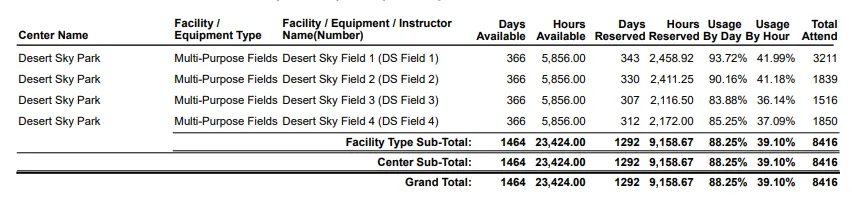
Do you track water usage? Are you using recycled or potable water? Reclaimed water use including a full pump system and lake in the park for the irrigation, and yes we track it. Landscaping entire park vegetation plus field watering. I get monthly reports and reclaimed use is quite high. Sand based fields drink and percolate water quickly.
Do you have tracking regarding maintenance: mowing, seeding, aerating, etc? Great question, we mow, aerate, fertilize, and occasionally are sprigging or resodding goal areas with more emphasis on repairing wear. Sand based fields with great drainage vs. being installed on native soil which is heavy clay content and does not drain well. Entire park was sodded when constructed.
Do you shut the field(s) at any point during the year - for what reasons and for how long? Yes ... sometimes up to 60 days hottest months of year during highest bermuda grass grow periods and least use due to climate. We do not overseed.
Are those using the field(s) happy? Our best park for large multiuse is grass play in my opinion.
Sean Carlin
Parks Superintendent
Gilbert Parks and Recreation
(Contact information available by request)
3. Environmental Considerations
Questions
What environmental concerns or benefits do you associate with synthetic turf? With natural grass?
Are there specific environmental impacts (for example, water use, heat, microplastics, biodiversity) that are particularly important to your group?
Loma Prieta Answers
Water Use
There are drought tolerant grasses developed specifically for sports fields in the Western U.S. for example Bandera Bermudagrass.
When the soil is properly tested & maintained, reclaimed water can be used. Sometimes minerals need to be added to the soil to counter salts or other minerals in reclaimed water.
Heat
Urban heat islands affect children, adults, birds, insects, etc. Besides being a public health concern, heat is an environmental concern. (See “Heat” elsewhere, for example for question #5 below.)
Microplastics
Microplastics, tiny particles resulting from plastic degradation or deliberately produced in sizes under 5mm, intensify multiple environmental crises. They contribute to biodiversity loss, ocean acidification, freshwater disruption, soil degradation, and altered atmospheric chemistry. This is a function of not only their fossil fuel origin but also their physical properties and of the complex mix of chemicals added to enhance product desirability. UN Fast Climate Change Facts, Geneva Plastics & Climate Change Page, CIEL Plastics in the Environment Page, UN Plastic Pollution Page, Guardian Plastic Pollution & Earth Systems Report, One Earth Journal Plastic Worsens Climate Change, Geneva Chemicals in Plastic
Chemicals, Includes PFAS and other U.N. Chemicals of Concern
The U.N. Geneva Environment Network, Toxic Chemicals in Plastic
https://www.genevaenvironmentnetwork.org/resources/updates/plastics-and-health/#scroll-nav__5
"To date, it has been estimated that more than 16,000 chemicals are used to make plastic, of which at least 4200 are chemicals of concern … A growing body of evidence points to the health risks posed are not only caused by plastic additives, as humans are also directly exposed to plastic materials in the form of microplastics and nano-plastics (Project TENDR, 2024). Exposure to plastics and chemicals can … act as endocrine-disrupting chemicals (EDCs), which are linked to infertility, obesity and diabetes, prostate and breast cancer, thyroid problems and increased risk of cardiovascular disease and stroke, among others. Other health conditions linked to additives include reproductive, growth, and cognitive impairment and neurodevelopment disorders. The technical report Chemicals in Plastics released by UNEP and the Basel, Rotterdam and Stockholm Conventions Secretariat in May 2023, highlights how women and children are particularly susceptible to these toxic chemicals."
Green House Gas
2019, Center for International Environmental Law, Plastic & Climate: The Hidden Costs of a Plastic Planet
https://www.ciel.org/project-update/plastic-climate-the-hidden-costs-of-a-plastic-planet/
"Nearly every piece of plastic begins as a fossil fuel, and greenhouse gases are emitted at each of each stage of the plastic lifecycle: 1) fossil fuel extraction and transport, 2) plastic refining and manufacture, 3) managing plastic waste, and 4) plastic’s ongoing impact once it reaches our oceans, waterways, and landscape … Plastic that is unmanaged ends up in the environment, where it continues to have climate impacts as it degrades … Significantly, this research showed that plastic on the coastlines, riverbanks, and landscapes releases greenhouse gases at an even higher rate."
Biodiversity
Real grass fields can support community play, pets, bird droppings (good bacteria take care of bird droppings if people do not pick them up).
4. Operational and Maintenance Factors
Questions
What has your experience with field conditions. (for example, closures, wear and tear, drainage)? Please include feedback for both natural grass and synthetic turf fields.
How important is year‐round availability or durability of fields to your use?
Loma Prieta Answers
- The following documents show comparisons between plastic turf and natural grass
Summary Ragel Ranch Sports Field, Notes on McKegney Green,
2. How to get many more cost-effective hours of play
- In many localities there are unused open grass fields. If a portion of that acreage was converted to open, unfenced sustainable grass sports fields, many more hours of organized sports play would be possible at a reasonable cost
- See letter from Arizona Parks Superintendent above — They will be able to talk about their IMPRESSIVE hours of play on their natural grass fields
Taken from answer to question #1
-
“Do you track usage - how many hours and which sports per field?
Here's a bit of a rental screenshot.
-
“Do you track usage - how many hours and which sports per field?
5. Health and Safety Concerns
Question
Do you have concerns about injuries, heat, or other health impacts associated with either surface type?
Loma Prieta Answer
Heat and Health: An Immediate Concern
Plastic turf absorbs and retains heat to dangerous levels. Using a calibrated infrared thermometer, I’ve documented on-the-ground temperatures well over 150°F on sunny days in Santa Clara and San Jose.
Photo Documentation: 2025 Santa Clara & San Jose Heat Measurements
This extreme heat creates dangerous playing conditions. Across the country, graduations and games are being delayed or moved indoors due to plastic turf-related heat risks (Heat Wave Sends 9 to Hospital, Excessive Heat Moves Date/Time of Union High School's Graduation Ceremony).
Leading institutions like the Icahn School of Medicine at Mount Sinai have issued statements advising against plastic turf use due to the associated health risks, especially for children:
Mount Sinai Position Statement
2024, The New Lede, As the World Heats Up So Does the Debate Around Artificial Turf
Injury & High School Age Players
Note: This medical/science report is behind a paywall. However I paid the fee and will include a copy to accompany this document.
2021 July/August, Current Orthopaedic Practice, 32(4):p 355-360. University Hospitals in Cleveland, OH and from Case Western University.
Injury incidence is higher on artificial turf compared with natural grass in high school athletes: a retrospective cohort study.
https://journals.lww.com/c-orthopaedicpractice/abstract/2021/07000/injury_incidence_is_higher_on_artificial_turf.6.aspx
”Conclusions: [High School] Athletes were 58% more likely to sustain an injury on artificial turf. Football, soccer, and rugby athletes were at a significantly greater injury risk on artificial turf.”
Microplastics & Public Health Risks
Includes harms from either microplastics or their embedded chemicals, recovery from or treatment for the effects are less certain. John Hopkins Microplastics & Human Health, Harvard Medicine Microplastics & Human Health, Stanford Medicine Microplastics & Human Health, UN Microplastics & Environmental Justice, AAMC Microplastics & Human Health
Microplastics are distributed globally, so there is no getting away from them. We all have concerning amounts of microplastics in our bodies. PIRG Current Research on Microplastics in Humans
6. Equity and Accessibility
Questions
Are there barriers to access or use of athletic fields that your group experiences?
How might field surface types, impact equitable use by different user groups (age, income, ability, sport type)?
Loma Prieta Answers
Equity and Public Health
Microplastics harm fauna, flora, and people. When discussing public health, underserved populations are less likely to have robust healthcare, making recovery or treatment for the effects from microplastics and embedded chemicals less certain. UN Microplastics & Environmental Justice, AAMC Microplastics & Human Health
Children and Youth
Leading institutions like the Icahn School of Medicine at Mount Sinai have issued statements advising against artificial turf use due to the associated health risks, especially for children:
Mount Sinai Position Statement
“Children are uniquely vulnerable to harmful exposures from artificial turf surfaces because of their unique physiology and behaviors, rapidly developing organ systems, and immature detoxification mechanisms.2 Children may be exposed to artificial turf chemicals through ingestion, inhalation, skin absorption, and open wounds or broken skin. Children and young athletes breathe faster than adults, putting them at greater risk for inhalation of chemicals that off-gas from turf fields. Small children put their hands and other objects in their mouths, increasing the risk of exposure via ingestion. In addition, youth have a higher surface area to body mass ratio, produce more body heat per unit mass, and sweat less than adults, all factors that increase susceptibility to heat injuries that have been observed on artificial turf fields. Vulnerability to turf chemicals persists through the teen years as the reproductive and nervous systems continue to develop beyond the first two decades of life. Lastly, children have more future years of life over which chronic diseases linked to the chemicals in turf develop …
Children are less able to regulate their body temperature than adults, making them particularly susceptible to conditions of extreme heat.“
7. Financial Considerations
Question
What role should upfront costs versus long‐term maintenance and replacement costs play in the City's decision‐making?
Would cost impact your organization’s ability to access or use these fields (for example, rental fees, frequency of use)?
Loma Prieta Answers
Cost
There are many kinds of natural grass fields — and also plastic turf fields — but generally speaking over a period of 12 or more years grass will be less expensive due to the fact that plastic turf must be replaced and that will cost $1million or more in today’s dollars. For example, check the costs for natural grass fields at Ragel Ranch in Sonoma County, Summary Ragel Ranch Sports Field
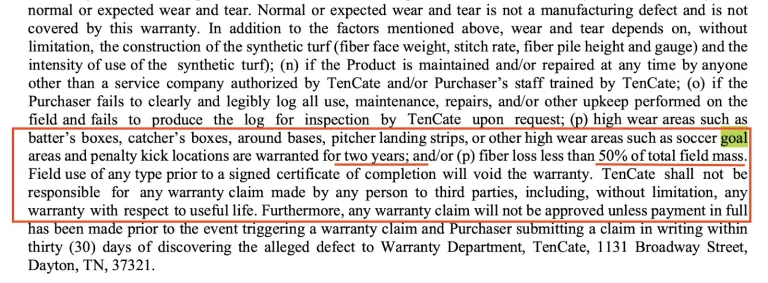
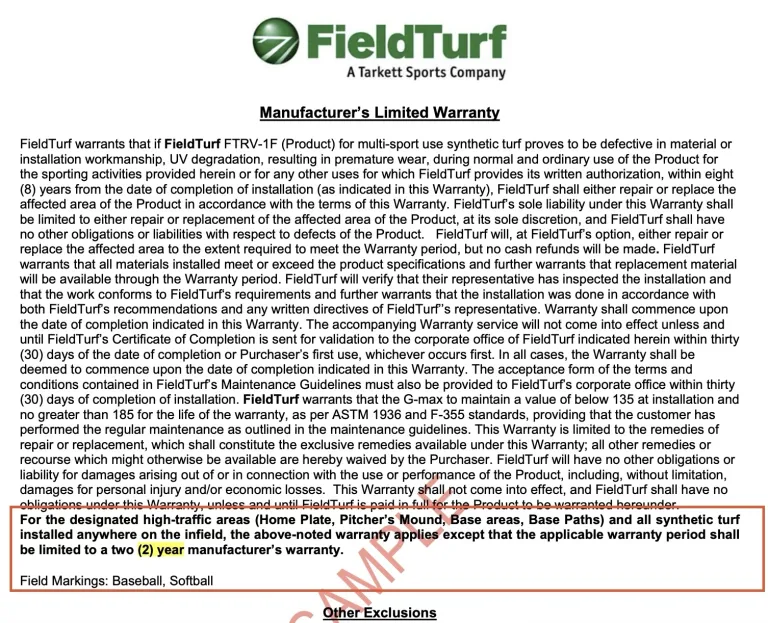
Warranties for Artificial Turf
Various warranties, warranty examples and FAQs. Below is one web page and several screen captures. The original PDFs are available upon request.
https://sporturf.com/wp-content/uploads/2014/05/8-Year-Manufacturers-Limited-Warranty-with-
Signatures-GrassTex.pdf
8 Year Warranty with an Exclusions that include
“I. Concentrated high wear areas identified as likely candidates for repair excluded from warranty provisions include, but not limited to, goal areas, penalty kicks, batters boxes, drill areas or any areas of concentrated use that could attribute to abnormal wear and tear.
The screenshot below comes from a TenCate Pivot 12 year warranty obtained from Tencate in January 2025. A 12-year warranty is the longest one. Most are for 8 years.
The screenshot below comes from an 8 year Field Turf warranty.
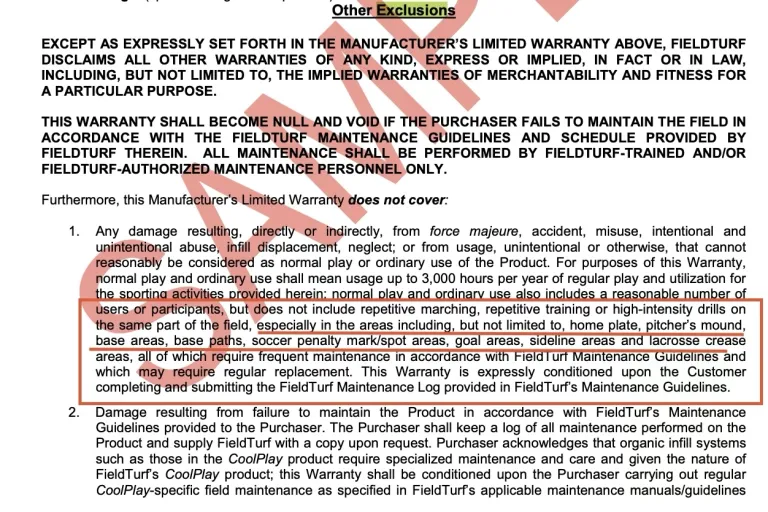
The screenshot below comes from an 8 year Field Turf warranty.

The screenshot below comes from an 8 year Field Turf warranty.
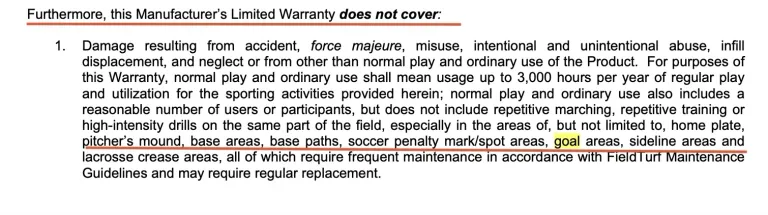
The screenshot below comes from an 8 year Field Turf warranty.
8. El Camino Park as a Case Study
Questions
Do you have any site‐specific feedback about El Camino Park that should be considered in this study?
Would you support using El Camino Park as a pilot location for field design improvements or new turf types? Why or why not?
Loma Prieta Answer
We support using El Camino Park as a pilot location for field design improvements of natural grass types, such as Bermudagrass, Fescue, Rye, etc.
9. Community Engagement and Decision‐Making
What would make you feel that your input is meaningfully considered in the City's decision‐making process?
10. Open Feedback
Is there anything else you would like to share that we have not asked about?