
May 12, 2026
County of Santa Clara Department of Planning and Development
Attention: Joanna Wilk, Principal Planner
County Government Center
70 W. Hedding Street, 7th Floor, East Wing, San Jose, CA 95110
Email: joanna.wilk@pln.sccgov.org
Re: Scoping comments in response to Notice of Preparation for Petal Fields Project File Number: PLN24-210-SB330
Dear Ms. Wilk,
This represents the comments of Green Foothills, Santa Clara Valley Bird Alliance, Keep Coyote Creek Beautiful, Sierra Club Loma Prieta Chapter, and Greenbelt Alliance in response to the Notice of Preparation for the Petal Fields project located at 330 Burnett Ave. (File Number: PLN24-210-SB330).
The project proposes to develop 838 residences, including 523 single family detached units, 145 single family attached units, and 170 multi-family rental units. The proposed project includes construction of a 3.5-mile-long water line extension and onsite wastewater facility.
The Petal Fields project is proposed on land zoned for agriculture and resource preservation that is surrounded on at least two sides by land being used for agriculture and resource preservation; therefore, the project is not entitled to the protections of the builder’s remedy.
The Housing Accountability Act, sometimes called SB 330, created the builder’s remedy, under which a local agency shall not disapprove certain qualifying housing projects except in certain limited circumstances, one of which is the following:
The housing development project or emergency shelter is proposed on land zoned for agriculture or resource preservation that is surrounded on at least two sides by land being used for agricultural or resource preservation purposes, or which does not have adequate water or wastewater facilities to serve the project.
Gov. Code §65589.5(d)(4).
The Petal Fields project is located on 15 parcels (APNs 726-37-007, 726-37-003, 726-37-004, 726-40-008, 726-40-003, 726-40-002, 726-40-001, 726-39-010, 726-39-009, 726-39-008, 726-39-002, 726-39-001, 726-40-007, 726-40-006, and 726-40-013). All of these parcels are zoned Exclusive Agriculture, and all of them are surrounded on at least two sides by other land that is being used for agriculture. The project site is currently the home of Kawahara Nurseries, an agricultural operation and wholesale nursery plant supplier. Each of the parcels that comprise the Petal Fields/Kawahara Nurseries site touches another parcel on at least two sides that is also part of the Petal Fields/Kawahara Nurseries site; therefore, each parcel fits the description of “land zoned for agriculture or resource preservation that is surrounded on at least two sides by land being used for agricultural or resource preservation purposes.”
In addition, the zoning for all of these parcels, and for the land surrounding each parcel on at least two sides, is designated -cv. That designation indicates that the land is within the Coyote Valley Climate Resilience Combining District. According to the Santa Clara County Zoning Ordinance, “[t]he purpose of the “-cv” Coyote Valley Climate Resilience combining district is to protect this agricultural greenbelt area as a means of increasing regional climate resilience. The predominantly agricultural lands of Coyote Valley are unique in their combination of natural characteristics, which are well-suited to providing ecological and public benefits, including flood attenuation as a result of sustaining wetland health, maintaining water supply as a result of protecting groundwater recharge potential, and carbon sequestration made available from natural and working lands.” (Santa Clara County Zoning Ordinance, § 3.95.010)
The Coyote Valley Climate Resilience Combining District is clearly intended for resource preservation purposes. Therefore, the parcels included in the Petal Fields project, plus the land that surrounds each parcel on at least two sides, are zoned, and being used both for agriculture and for resource preservation.
Lastly, the parcels with APNs 726-39-008, 726-39-002, and 726-39-001 are also in the -sr Scenic Roads Combining District, the purpose of which is to “protect the visual character of scenic roads in Santa Clara County.” (Santa Clara County Zoning Ordinance, § 3.30.010) The Scenic Roads Combining District is also intended for resource preservation purposes; therefore the parcels in this combining district have an extra layer of protection for resource preservation.
For these reasons, the Petal Fields project is not entitled to the protections of the builder’s remedy. The County should make findings accordingly and reject the project in its entirety.
The Petal Fields project is proposed on land that does not have adequate water facilities to serve the project; therefore, the project is not entitled to the protections of the builder’s remedy.
As noted above, Gov. Code §65589.5(d)(4) also provides that among the circumstances in which an agency may deny a builder’s remedy project is when the project is proposed on land “which does not have adequate water or wastewater facilities to serve the project.” The Petal Fields project also fails this test and thus is not entitled to the protections of the builder’s remedy.
The Petal Fields project has applied to Great Oaks Water Company for water service, and in January 2025 Great Oaks submitted an advice letter to the California Public Utilities Commission (CPUC) for an expansion of its service area to accommodate a water main line extending along Monterey Road through Coyote Valley, from San Jose to the Petal Fields site. The Notice of Preparation (NOP) states that this water line extension would be 3.5 miles long.
The CPUC rejected Great Oaks’ Advice Letter, which sought to utilize General Order 96-B. GO 96-B provides “a quick and simplified review of the types of utility requests that are expected neither to be controversial nor to raise important policy questions.” Since the construction of a new 3.5-mile-long water main line through Coyote Valley from San Jose to Morgan Hill would be both controversial and would raise important policy questions, the CPUC did not grant Great Oaks’ request, and instead recommended that Great Oaks file a formal application with the Commission so that the significant issues of fact and law that were raised by Great Oaks’ application can be addressed through a formal proceeding and evidentiary hearing in front of the Commission.
It is clear that the Petal Fields project does not have adequate, or indeed any, water facilities to serve the project. The application of Great Oaks to the CPUC may or may not eventually be approved, but as it stands, there is no water service to the site that is adequate to serve the project. Therefore, the Petal Fields project is not entitled to the protections of the builder’s remedy.
The Petal Fields project is proposed on land that does not have adequate wastewater facilities to serve the project; therefore, the project is not entitled to the protections of the builder’s remedy.
In addition to lacking adequate water facilities, the Petal Fields project also lacks adequate wastewater facilities to serve the project. The site plan and the NOP indicate that the project will include an onsite wastewater treatment plant. An onsite wastewater treatment system serving 838 residences raises legitimate concerns regarding long-term reliability, groundwater protection, maintenance accountability, and the consequences of system failure. The fact that the Petal Fields site plan includes no information on the details of this wastewater treatment system other than indicating the location of a future leach field suggests that this is not a serious plan on the part of the developer.
Furthermore, Great Oaks’ Advice Letter to the CPUC stated that “the developer has requested that Great Oaks provide water and wastewater service.” A footnote in the Advice Letter stated: “Great Oaks will submit a separate application requesting a Certificate of Public Convenience and Necessity to provide wastewater service to the development.” (Great Oaks Advice Letter 329-W, dated January 24, 2025.) However, there is no indication on Great Oaks’ website that this company provides wastewater services at all, or that it has the capability to do so. This further suggests that the Petal Fields developer has no serious plan for how to treat the project’s wastewater.
Even assuming that the Petal Fields project’s future plans for wastewater treatment are realistic, these shifting and vague plans serve to underline the fact that currently the project site has no wastewater treatment facilities. Therefore, by the terms of Gov. Code §65589.5(d)(4), the Petal Fields project is not entitled to the protections of the builder’s remedy. The County should make findings accordingly and reject the project in its entirety.
Potential Environmental Impacts of the Petal Fields Project
Notwithstanding the foregoing, we submit the following comments with regard to the scope of the environmental analysis for the Petal Fields project.
Agriculture
The majority of the Petal Fields project site consists of important farmland soils (prime farmland, unique farmland, farmland of statewide importance, or farmland of local importance). An EIR must analyze whether a project would “[c]onvert Prime Farmland, Unique Farmland, or Farmland of Statewide Importance . . . to nonagricultural use,” and mitigate the loss of these important soils if so.
In addition, the potential impacts of the proposed Great Oaks water line on the agriculture of Coyote Valley must be evaluated. This includes the impacts of construction of the water line (dust, noise, traffic, access) and the potential for impacts to nearby agricultural wells if Great Oaks increases pumping in Coyote Valley in order to supply the Petal Fields project.
Air Quality
The EIR must evaluate not only the air quality impacts from the residential project itself, but also from the Great Oaks water line construction and operation (as well as from infrastructure Great Oaks proposes to construct to provide wastewater service to the Petal Fields project, as stated in Great Oaks’ Advice Letter to the CPUC).
Biological Resources
The proposed Great Oaks water line will bisect Coyote Valley, which is a critical landscape linkage for wildlife movement. Monterey Road is a documented roadkill hotspot, indicating that animals frequently attempt to cross in this area in order to move between the Santa Cruz Mountains to the Diablo Range. The introduction of lengthy construction activities along a 3.5-mile stretch of this road is likely to cause additional barriers for wildlife movement due to construction barriers and fences, noise, and human activity. In addition, if any construction activities take place at night, the impacts on wildlife movement from bright floodlights as well as the noise and human activity taking place at night when it would normally be limited to daylight hours, must be evaluated.
Furthermore, if Great Oaks increases pumping in Coyote Valley in order to supply the Petal Fields project, the potential for this increased pumping to impact the ecosystems and wildlife dependent on Coyote Valley’s groundwater and surface water (including Ogier Ponds and Coyote Creek) must be evaluated.
Hazards
The site plan and the NOP indicate that the developer intends for the Petal Fields project to rely on an onsite wastewater treatment plant. For 838 residences to be serviced by an onsite septic system and leach field creates a significant risk of contamination to groundwater. The Petal Fields site is located in a liquefaction hazard zone, meaning that during a seismic event the soils become liquefied and unstable and may shift. Also, according to the Bay Area Greenprint, the project site is located in a hydrogeologically vulnerable area, defined as “[a]reas over aquifers where soil or rock conditions enable higher rates of recharge and therefore make the aquifer more vulnerable (or susceptible) to surface contaminants.” The EIR must analyze the potential for a significant hazard to the public or the environment due to potential release from the onsite wastewater treatment system, including whether the proposed system is adequate for the number of proposed residences.
Hydrology
The site plan and the NOP indicate that the developer intends for the Petal Fields project to receive water service from Great Oaks Water Company via a 3.5-mile-long water line through Coyote Valley. The Santa Clara Valley Water District (Valley Water) submitted a protest letter to the CPUC in response to the proposal for this water line. Valley Water’s protest letter is attached to these scoping comments; however, given the extreme pertinence of Valley Water’s comments to these scoping comments, we are citing the following sections from Valley Water’s letter for ease of reference:
Given the stated average annual demand of 280 acre-feet (AF) per year and maximum daily demand of 500,000 gallons per day (558 AF/year), it should be clarified whether Great Oaks plans to meet this demand from new or existing wells and where those wells are or will be located. Valley Water presumes the demand would be met by additional pumping in the Coyote Valley portion of the Santa Clara Subbasin (a high-priority basin under the Sustainable Groundwater Management Act (SGMA)). . . .
[T]he impacts associated with that groundwater pumping should be evaluated. The groundwater basin in the Coyote Valley is small, shallow, and dynamic and cannot sustain high volumes of pumping without adequate recharge.
As the local Groundwater Sustainability Agency under SGMA, Valley Water conducts managed recharge to ensure long-term groundwater supply for all beneficial users and prevent problems like declining groundwater levels and quality, dry wells, and impacts to groundwater-dependent ecosystems.
Great Oaks began pumping in the Coyote Valley in 2005, leading to a sharp and sustained increase in pumping per the graph below.
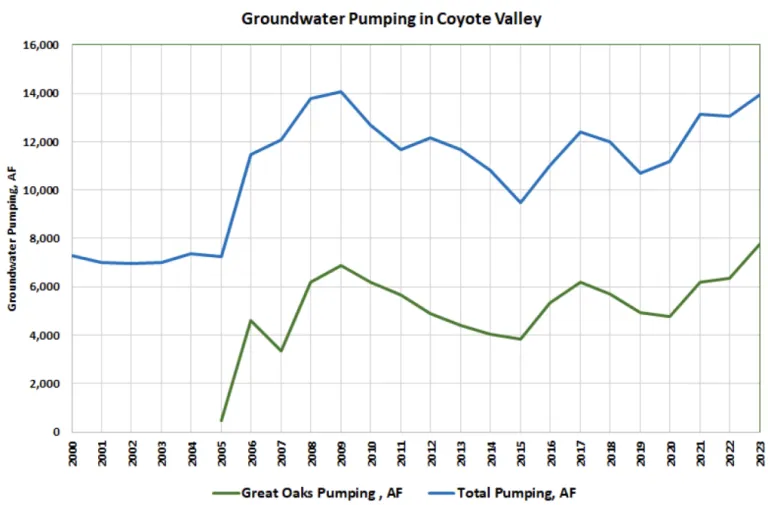
Valley Water is concerned the proposed service area expansion would further increase pumping in the small Coyote Valley. By constructing a long pipeline through unincorporated areas to the south near Morgan Hill, this expansion could result in additional expansion requests further south and outside of the Coyote Valley.
Valley Water is concerned that existing recharge and infrastructure would not be sufficient to support increasing Coyote Valley pumping. This could reduce water supply reliability for existing Coyote Valley residents and farmers, most of which depend on privately owned wells for their water supply, and it could reduce supply for groundwater-dependent ecosystems. . . .
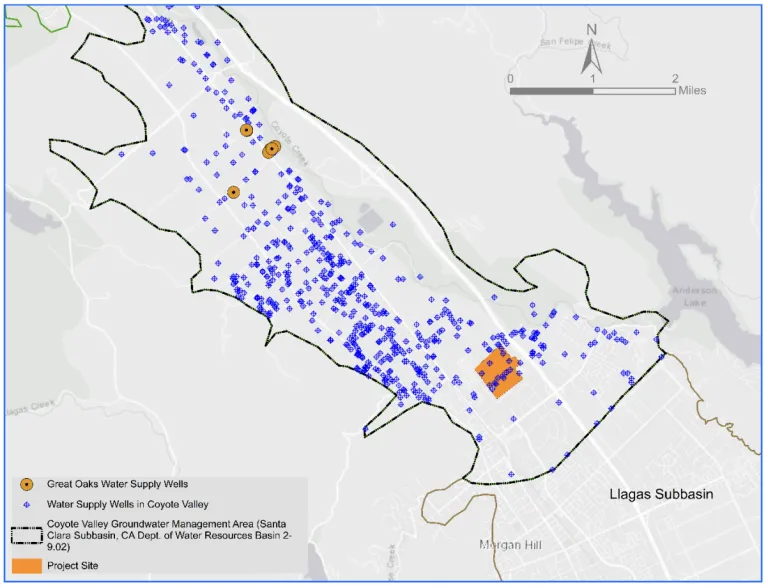
Given the size of the proposed development, additional information on the onsite wastewater treatment system (including long-term operation and maintenance) and expected groundwater impacts is needed, including loading of constituents like nitrate and PFAS and potential groundwater mounding. This is especially important given that nearby groundwater can be shallow and there are numerous water supply wells (see figure below) that are potentially at increased risk if the wastewater system results in substantial contaminant loading and/or changes in groundwater flow.
Attachment 1 of the advice letter also mentions the use of treated wastewater for landscape irrigation. Our understanding is that this would require a separate permit and review process from the San Francisco Bay Regional Water Quality Control Board. Please note that Valley Water has established a position that all recycled water used in the Coyote Valley for irrigation should be fully advanced treated to protect groundwater quality.
Given the development size, numerous drinking water wells nearby, and high vulnerability of local groundwater, Valley Water prefers the development be connected to sanitary sewer (rather than use an onsite wastewater treatment system) and that no recycled water be used for irrigation unless fully advanced treated.
The plans provided show several large retention basins up to nine feet deep. No site-specific groundwater data is provided but the last sheet of the plans references a groundwater depth of 20 feet based on “SCVURPP seasonal high groundwater maps.” However, several wells nearby show depth to groundwater of less than 15 feet in wet years. Site-specific information is needed to confirm adequate vertical separation per stormwater infiltration requirements.
(See Valley Water letter to CPUC dated February 12, 2025, attached to this letter.)
Valley Water’s letter raises a variety of important questions regarding the potential impacts of the Petal Fields project on the groundwater, drinking water supply, and general hydrology of the entire Coyote Valley area as well as the area surrounding the Project site. For example, an EIR must evaluate whether a project would substantially deplete groundwater supplies or interfere substantially with groundwater recharge such that there would be a net deficit in aquifer volume or a lowering of the groundwater table (e.g., the production rate of preexisting nearby wells would drop to a level which would not support existing land uses or planned uses for which permits have been granted). There is a significant possibility that Great Oaks’ pumping of water in Coyote Valley in order to supply the Petal Fields project will have one of these impacts. This issue, as well as other issues raised in Valley Water’s letter, must be addressed in the EIR.
Population and Housing
The proposed Great Oaks water line has the potential to induce substantial population growth in the region by extending a water line 3.5 miles between San Jose and Morgan Hill through an area that currently does not have water service. This impact must be evaluated.
Public Services and Recreation
The potential for a new development of 838 units to result in the need for new or expanded public services, and to increase the burden on local and regional recreational facilities such as parks and trails, must be evaluated.
Tribal Cultural Resources
The EIR must evaluate not only the potential impacts to tribal cultural resources from the residential project itself, but also from the Great Oaks water line construction and operation, as well as from whatever infrastructure Great Oaks proposes to construct to provide wastewater service to the Petal Fields project, as stated in Great Oaks’ Advice Letter to the CPUC.
Utilities and Service Systems
The Petal Fields project proposes to create a new wastewater treatment system and a significant new extension of the existing Great Oaks water supply system. Also, given that the developer proposes to treat sewage from 838 residences via an onsite wastewater treatment system, the EIR must evaluate the potential impacts if this treatment system should fail, causing the Petal Fields project to request extension of sewer lines from the City of Morgan Hill. The adequacy and impacts of the stormwater drainage system proposed in the site plan should also be evaluated in light of the fact that a significant amount of what is currently pervious surface will become impervious surface under this project.
Growth-Inducing Impacts
As noted in Valley Water’s letter to the CPUC, the proposed expansion of the Great Oaks water line through Coyote Valley to the Petal Fields project site could result in additional expansion requests further south and elsewhere, as well as requests for tie-ins to the water line from parcels located in Coyote Valley. The growth-inducing impacts of the proposed Great Oaks water line must be evaluated.
Furthermore, Great Oaks’ Advice Letter to the CPUC also stated that Great Oaks intends to provide wastewater service to the Petal Fields project. If true, this is a further growth-inducing aspect of the Petal Fields project that must be evaluated.
Thank you for the opportunity to submit these comments.
Sincerely,
Alice Kaufman
Policy and Advocacy Director
Green Foothills
Shani Kleinhaus
Environmental Advocate
Santa Clara Valley Bird Alliance
Deb Kramer
Executive Director
Keep Coyote Creek Beautiful
Katja Irvin
Guadalupe Group Conservation Chair
Sierra Club Loma Prieta Chapter
Victorina Arvelo
Senior Resilience Manager
Greenbelt Alliance