By Tom Schuster, Director, Sierra Club Pennsylvania Chapter
From 2001: A Space Odyssey, to The Terminator, to The Matrix, popular culture has long had a fixation on the perils of Artificial Intelligence. While these stories warned us of what AI might DO if we lose control, we are starting to learn about the serious impacts of the physical infrastructure required to create and run AI.
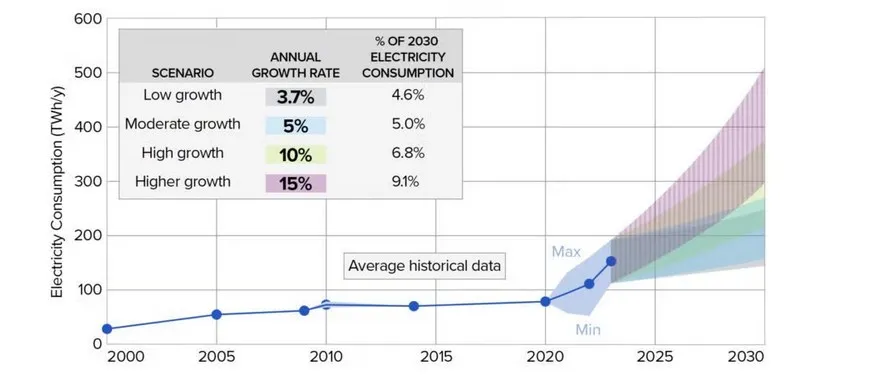
AI requires computing power on a scale we have not previously seen. A small AI data center may consume as much electricity as 100,000 households, while a large data center can require the equivalent of a million or more homes. We’re adding the equivalent electricity demand of a medium to large city through a single grid connection in as little time as 18 - 30 months. The eye-popping chart below from the Electric Power Research Institute highlights the recent exponential growth in data center energy consumption as AI use took off, and projects that by 2030, data centers could consume up to 9% of all electricity in the United States.
This power demand surge has the potential to reverse most of the progress we’ve made tackling climate change. It is already causing some utilities to delay the planned retirement of aging coal-fired power plants. When the 2 gigawatt Homer City coal plant retired, it was the largest fossil power plant in Pennsylvania. A mere 2 weeks after its demolition in March, it was announced that the site would be redeveloped into a massive data center campus to be powered by a new seven unit 4.4 gigawatt gas-fired power plant. This would be the largest gas plant in the country by a wide margin, and we estimate its CO2 emissions to be comparable to all the cars in Pennsylvania.
There are a host of other environmental concerns, ranging from water consumption and deforestation, to noise and air pollution from banks of diesel backup generators. There is also a greatly heightened risk of grid destabilization and blackouts.
But the problem on most people’s minds these days is how fast their electric rates are going up - and it turns out that AI data centers are behind that too.
The issue is simple supply and demand. Data centers have soaked up all the excess generating capacity on the regional grid (run by PJM). New power projects typically take much longer to build than data centers, so capacity prices go up. According to an analysis by NRDC, the last PJM capacity auction increased average electric bills by $20-$30 per month, and if these trends continue, they could be $70 per month higher by 2033. PJM’s independent market monitor found that data center load growth is the primary reason for these increases.
Those numbers are bad enough, but they only account for generating capacity. But it turns out we are also paying for data centers to connect to the transmission grid. An analysis by the Union of Concerned Scientists found that data centers caused $4.3 billion in transmission upgrades across seven states in 2024, and that cost was spread across all electric customers in the utility territory in which the upgrades took place. A look at the study’s appendix shows that of the $492 million in costs in Pennsylvania, about 93% of that was in PPL territory. If residential customers pay for roughly a third of that and there are about a million residential customers in PPL territory, that averages out to an extra $150 per customer.
So what can we do about this? Tackling this problem won’t be quick or easy, but we have a few opportunities to make a dent in the short run.
First, it just so happens that PPL, the utility at the epicenter of the data center boom in PA, has just requested a rate increase from the Public Utility Commission (PUC). Their filing proposes to raise residential rates, but actually lower rates for the customer class that includes data centers. This will be contested, and they won’t get everything they ask for. A key part of this process will be a series of public hearings, and we’re asking you to make your voice heard. Sign up here to indicate your interest in testifying, and we’ll let you know as soon as the dates and locations of the hearings are announced. Even if you can’t make a hearing, you can lend support by talking to your elected officials about your concerns, and educating your neighbors by writing to your local paper.
If you’re not a PPL customer, the PUC is about to propose a new large load tariff, which is a standard set of rules and prices that data centers will pay. We’ve filed comments in the first phase of this process, and we need your help to make sure the final product is as strong as possible to prevent unjust subsidies for data center development.
Finally, our Dirty Energy Conservation Team has taken on Data Centers as a priority issue, and we invite anyone interested in fighting back to join this team to learn, share, strategize, and act at both the state and local levels.
This issue sure seems scary and daunting, but as the graph above indicates, there is a lot of uncertainty about how big this buildout will be, and lots of levers we can pull to affect that trajectory. There are also some examples of data centers powered entirely (or nearly so) by renewable energy and batteries. AI is definitely happening, but the impacts it has on our neighborhoods, our climate, and our wallets are still to be determined. Let’s make sure we have a say in how it turns out. Let’s all take the red pill.
This blog was included as part of the November 2025 Sylvanian newsletter. Please click here to check out more articles from this edition!