Jump to: Data Center Basics | Why Pennsylvania? | Possible PA Regulations | Local Governments | Public Testimony | More Resources | Contact/Join Us
Introduction
The burst in data center proposals across the country, and including Pennsylvania, has resulted in an increase in demand for energy and water which in turn has affected consumer prices for electricity and concerns about water availability and quality.
Many developers are rushing to get projects started before state and local regulations can be developed that could ensure transparency and protect regional rate payers and communities that could be impacted by ground water pollution, noise pollution, air pollution and an increase in greenhouse gas emissions.
This page is a collection of resources compiled by the Sierra Club Pennsylvania Chapter Conservation Teams. Find more data center info, including PA legislation we are supporting, on the PA Chapter Spotlight On Issues Data Center page. |
Data Center Basics
Data centers are large windowless warehouses that store large computers and servers, and therefore, information. It is within these buildings that AI and the cloud "live." As demand for these services increases, these facilities are rapidly growing in number and size and using more and more of our power and water. A subset of data centers are cryptocurrency mines, which use computers and servers to obtain decentralized digital currency.
Fast Facts:
- 💡 They need a lot of POWER 💡
- Customers in 7 PJM states paid $4.4B for grid infrastructure to support data centers. There were xx data center proposals in play as of Nov, 2025.
- The US Government has loaned Microsoft $1B to help restart part of Three Mile Island nuclear power plant.
- 💦 They consume millions of gallons of WATER 💦
- A large data center can use up to 5 million gallons of water per day, equivalent of towns of 10,000 to 50,000 people.
- 🍃 They poison our AIR 🍃
- On-site "emergency" diesel generators contaminate air with particulate matter. Generators that could be run for demand response periods.
- An expected increase in carbon dioxide (CO2) emissions by 36 percent or 1,014 million short tons, due to data centers.
- 👷 They create minimal jobs 👷
- The average data center employs around 30 people. The average McDonald’s employs 50 people.
The national Sierra Club has released the 2026 Data Center Policy Guidance for local lawmakers, regulators, and advocates to promote policies that protect everyday electricity customers and our environment.
For further insight into what the environmental and human impact of the growth of using Artificial Intelligence is, check out the resources at Bowdoin College's Hastings Initiative for AI and Humanity.
Why Pennsylvania?
There are a number of reasons that data center proposals are booming in Pennsylvania - although all states are seeing some new proposals. PA is close to the population centers of New York, Philadelphia, Baltimore and Washington. Pennsylvania has relatively cheap electricity (but we are catching up fast). There is the potential to get "private power generation" by rescuing newly or soon to be shuttered coal or nuclear power plants. And power from coal waste sites is currently subsidized by Pennsylvania. Water is also in good supply compared to western US areas.
Perhaps the biggest attraction to data center developers is that there is very little in the way of state and local government regulation for these kinds of facilities. It seems like there is a race to get proposals submitted before regulations can be passed by governments that are still learning about the dangers of large data centers.
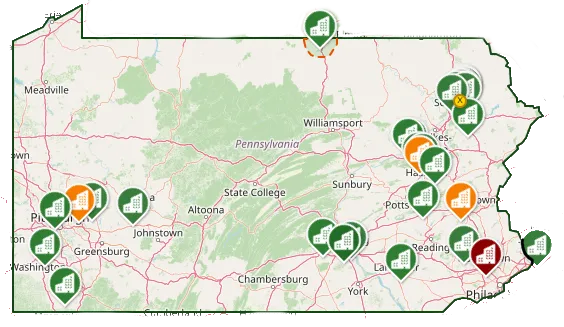
Possible PA Regulations
Other states have passed or are considering bills that will have considerations for:
Large Load Tariff
- forces the businesses that are causing an increase in electricity demand to pay for the added grid infrastructure that will be needed. (Kansas, Ohio, Pennsylvania PUC). Read Sierra Club's analysis of the Large Load Tariff movement.
Aligning with State Energy Policy and Goals
- significant new power generation will impact the pie chart of how a states power is generated for many years to come. If a state has a clean energy goal, these new projects could advance or delay the achievement of greenhouse gas emissions targets.
Transparency and Load Forecasting
- states can require that utilities report on the forecasted and the actual electricity consumption, and peak usage, of large load customers. Reporting creates public clarity, holds the utility accountable for risk mitigation, and provides transparency on how demand changes with market conditions.
Water Usage Regulations
- in addition to energy use disclosure, state regulations can require disclosure of water sources, volume used across time periods, impact studies to public systems, surface water or aquifers and impact on area wells and agriculture prior to any approval for the siting of a data center.
Restricting Tax Incentives
- states may consider repealing unbounded, lucrative tax incentives for data centers, or set new requirements on the tax incentives to ensure sustainable outcomes.
Moratorium
We support a statewide pause on new construction (moratorium) WHILE ALSO developing statewide regulations to protect ratepayers, environmental impacts, etc because a moratorium bill may not pass WHILE ALSO encouraging local governments to protect themselves with zoning ordinances because state legislation may not get approved.
For more details and references to states that have passed data center policies, check out the national Sierra Club's 2026 Data Center Policy Guidance for local lawmakers, regulators, and advocates.
The Pennsylvania Legislature has many data center related bills and co-sponsor memos already in play. Go to palegis.us/quick-search and enter "data center" as the search term.

To see Sierra Club Pennsylvania's position (Support/Oppose/Watch) on any bill, go to our Legislative Tracker and type in the bill number or key term.
Local Governments
Statewide regulations may or may not become law. Here are some resources and examples for municipal governments to consider:
PennFuture, York County, Cumberland County - model municipal ordinances cover a range of topics: building size, landscape buffers, fencing, noise and vibration, water and sewer, power supplies (grid connected or on-site generation), emergency management, aesthetics, parking.
Zoning Control - [example in Blakely , PA]
Public Hearings - make sure all stakeholders have a voice
Development Restrictions - Atlanta ordinance restricting development, Dekalb County 100-day moratorium, Loudoun County, VA eliminates by-right development
Sierra Club PA Chapter Local Governments Best Practices Fact Sheet for Data Centers
Southeastern PA Group (SPG) Data Center Resources for Local Governments
Public Testimony
You may have an opportunity to comment or testify at a state, county, township, city, borough or utility public hearing about a planned data center project. Your voice is powerful. Here are some resources to help you and your neighbors give truthful and relevant statements about the potential environmental and human impacts of new data center developments.
Find an upcoming public hearing in your county at https://www.publicnoticepa.com/ - just fill in "data center" for keywords and select you County.

More Resources
Our volunteers are continually developing or discovering more examples and useful resources about the impact of the data center construction boom in Pennsylvania. Check back for the latest info.
Data Centers Increase Electromagnetic Fields Exposure from Environmental Health Sciences
Community Forum on Data Centers at the Mt Lebanon Library (May, 2026) YouTube recording
Articles
Many Pa. residents don’t want data centers in their communities. State leaders are welcoming them, Spotlight PA
Limerick Board of Supervisors vote to send a letter opposing a land swap for proposed data center, 6ABC
Data centers are here, and more are coming. Our zoning is not ready. Smart Growth America
Amazon Delivers ... Frustration. Sierra Club PA Chapter Sylvnanian Article