By Ellen Foreman, Member, Moshannon Group
“Forever Chemicals” Present Risks to Fish, Wildlife, Plants and People
Just as the snow began to melt, Pennsylvania’s Moshannon Group invited residents to meet at a Spring Creek Watershed area, an important environmental zone that acts as a natural filter for drinking water, buffers against flooding, and sustains a valued Class A wild trout fishery. The Group’s Water Chair, David Roberts, has been tracking PFAS (Per and Poly Fluoroalkyl Substances) contamination in the surface waters of both the Spring Creek and the Bald Eagle Creek watersheds since 2022.
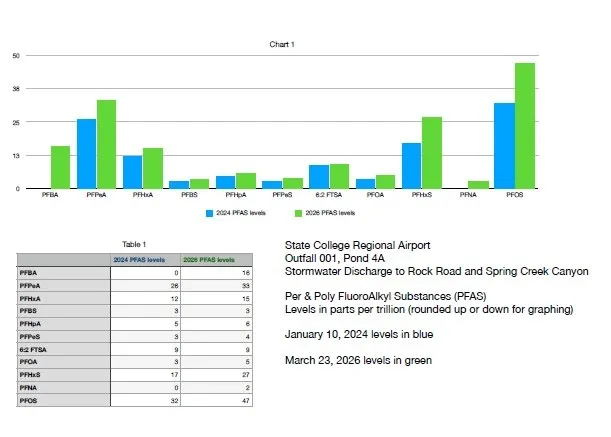
Roberts and volunteers from the Centre County Senior Environmental Corp had planned to collect samples from the first big snow melt as it flowed through an outfall from the State College Airport into Spring Creek. He predicted that again, high levels of the “forever chemicals”, up to nine different kinds, would be found in the samples. Sadly, lab results revealed that in addition to the nine chemicals previously found, two additional chemicals showed up in the March 23 results.
Airport is Largest Source
“The matter of where the chemicals are coming from is not in doubt, there is also no doubt as to who is responsible for the cleanup. The frustration is that nothing is happening and this situation continues to threaten both aquatic life as well as human health,” Roberts said.
Penn State University (PSU) until recently owned the State College Airport. The use of firefighting foam on training exercises which leached into the soil has been identified as the primary source of the contamination. In late 2024, Penn State entered a Consent Order and Agreement with the Pennsylvania Department of Environmental Protection (DEP) under which the university agreed to remediate the contamination. PSU filed a suit against multiple manufacturers and producers of PFAS and the American Federation of Firefighters in June 2024.
While PSU has submitted a Remedial Investigation Workplan November 2025 workplan, it does not address stormwater discharge from the Airport. Though the Moshannon Group supplied the water sample data to the DEP it noted that there is no Pennsylvania standard for PFAS in stormwater.
In addition to the direct effects on the stream, residential and business wells near the airport in Benner Township were found to contain PFAS levels exceeding state and federal drinking water standards.
Local Residents Suffer
A resident from the nearby Walnut Grove community, Rick Weyer, attended the outing and described the effects of the contamination. “We stopped drinking and cooking with our water until we were provided with a filtration system by Penn State which is extremely cumbersome. However, we have not been able to eat food from our gardens as our soil is contaminated with PFAS.” He added that medical authorities tested residents’ blood for PFAS and in his case the levels were in the 99th percentile. The Center for Disease Control reports that nearly all Americans have some level of PFAS levels in their blood (in 2018 that average was 4.3 micrograms per liter).
While the health implications of ingesting food and water contaminated by PFAS continue to be the subject of multiple studies, a study cited by the CDC indicates that elevated levels of PFAS are associated with several health issues including altered immune and thyroid function, liver disease, lipid and insulin dysregulation, kidney disease, adverse reproductive and developmental outcomes, and cancer.
Other Sources Identified
“In addition to the airport runoff, other sources of PFAS include treated wastewater that flows into the watershed,” Roberts said. “Wastewater authorities have the ability to separate and remove PFAS today though it is a more costly process.” Roberts said he is hopeful that these processes will begin to be implemented presently.
“The biggest issue though as we’ve seen from the sampling continues to be waste water from the use of Aqueous Film-Forming Foam (AFFF) for firefighting and safety training at the airport,” Roberts said.
The irony is that this substance was literally mandated by the FAA before the health effects of PFAS were known. The forever chemicals were used to quickly extinguish highly flammable jet fuel fires but are no longer in use at the State College Airport.
Roberts says that he hopes to broaden the Sierra Club’s testing locations and frequency and to continue to advocate for action as new owners take over airport operations. He has applied for a Sierra Club conservation grant to expand the testing. He added, “it takes data and community involvement to make things happen and that’s why we plan to stay on top of this.”
This blog was included as part of the July 2026 Sylvanian newsletter. Please click here to check out more articles from this edition!