Yesterday marked the unofficial end to a very eventful summer. I sat down to write a brief recap which quickly turned into a full length blog. From pipeline ruptures to public service commission hearings, multiple lawsuits and so much more, the recap bears testimony to what we can accomplish when we work together.
Thank you to all the incredible people who helped shape a progress-filled summer, from our in-office volunteers to birddogging team members to our conservation team members who lead our efforts to make Wisconsin clean and sustainable.
Dark Skies, Bright Future
Our teams' summer fundraising campaign was a big success. We breezed through our goal of $20,000 and put on a great program featuring a series of videos including:
- An Overview of the Dark Sky Initiative
- Wolves at Night
- A look at Newport State Park, the State’s Dark Sky State Park
- A tour of High Cliff State Park
- Wetlands and Wildlife at Night
- Dark Sky successes
Learn more about the campaign and watch the segments here.
Line 5
While the legal challenges to Enbridge’s permits to build the reroute are ongoing, Enbridge has been allowed to move forward with construction. The Bad River Band and environmental groups challenged the permits Enbridge received to build the reroute. Earlier this summer, in the legal filing asking for a pause on construction, the environmental groups explained:
The Reroute would cause significant adverse impacts to wetlands and waterways. Petitioners-Interested Persons’ members live, work, own property, and recreate in the immediate area of the Reroute, and in areas within the same watershed as the Reroute. Doc. 57, 5-9. As established below, construction would impair the functioning of these wetlands and waterways and public rights therein. Those impairments would have impacts reverberating throughout the watershed, thereby harming the interests of Petitioners-Interested Persons’ members in preserving and enjoying these highly functional waters. Further, many of these impairments would be permanent, because Enbridge’s proposed monitoring for impacts and plans to restore affected areas after construction are fatally flawed.
The Judge in the case issued a temporary stay on construction for four river crossings. A few weeks ago, he lifted that stay. Over the last few months, Enbridge’s behavior has raised concerns about the threats Line 5 opponents have warned of for years. Community members are documenting what’s going on at the Watch Line 5 website, where you can find all of the information they’re compiling, complete with locations, images, videos, and notes. Here are some of the updates from this summer of destruction:
In mid-August, we released a summary, Destruction and Intimidation: Enbridge’s Line 5 construction impacts so far, on Enbridge’s frac-outs and local impacts throughout a summer of construction. The report detailed the intimidation by Enbridge workers, frac-outs, and other permit violations, and more. Read it here.
Line 5 in court

On August 20, attorneys for the Sierra Club, the Bad River Band, Enbridge, and the Department of Natural Resources presented oral arguments in front of Judge John P. Anderson in the case regarding Enbridge’s Line 5 reroute proposal. The hearing kicked off with John Petoskey, Earthjustice attorney for the Bad River Band, reminding the court that:
“This case is about the public trust waters and about a tribe trying to protect its homelands.”
In the hearing, attorneys for the Sierra Club and a number of other environmental groups and the Bad River Band made a strong case for overturning Enbridge’s reroute permits because DNR violated Wisconsin's protective wetland and water laws and failed to fulfill its public trust duty under the state constitution. Enbridge’s main counterargument cited the extent of DNR’s review and number of pages in the record as reasons why these concerns were unnecessary.
Less than a week following the hearing, Enbridge was responsible for the largest gas-liquids spill in Wisconsin’s history. On August 25, a semi-truck rolled into an excavation site that's part of the Line 5 reroute project and ruptured the existing Line 5 pipeline. Line 5 and other fossil fuel infrastructure pose risks like this every day they operate. The plume of gas that was released led to local homes being evacuated and concerns remain about the health and other impacts of this breach. According to the Wisconsin Department of Natural Resources, the pipeline was struck around 10am, and Enbridge reported the accident to the federal Environmental Protection Agency at 11:02 am and to the DNR at 11:15 am.
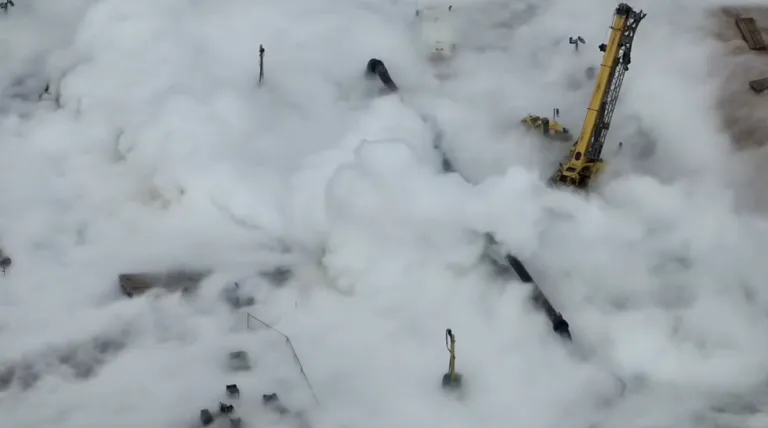
Given this rupture and Enbridge’s other instances of permit violations, DNR Secretary Hyun sent Enbridge a letter stating:
“...the agency is deeply concerned about this spill and immensely frustrated by other recent noncompliance events...The department requests that you halt work on the pipeline re-routing project until this event on the existing pipeline is sufficiently resolved and Enbridge has demonstrated that measures are in place to prevent future spill events related to all pipeline work.”
Enbridge responded by shutting down construction for two days while it conducted a “safety check.” Then it restarted construction before the DNR was even allowed onto the site of the massive rupture. DNR still hadn’t been there. So much for “sufficiently resolved.” The day Enbridge resumed construction, they had another frac-out near the Potato River.
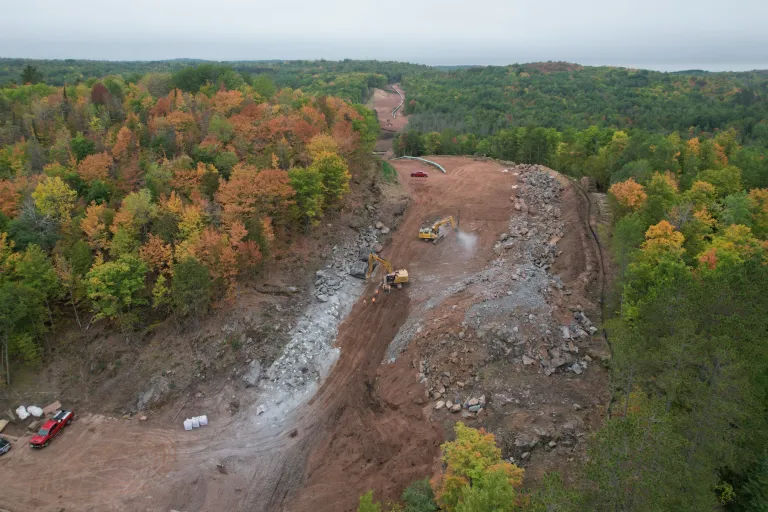
We responded by calling on Governor Evers and Secretary Hyun to revoke Enbridge’s permits. Enbridge has a history of a lack of transparency and drilling failures regarding their pipeline operations and the Department of Natural Resources has raised their concerns in a long list of questions sent to Enbridge, demanding answers for this incident and prior noncompliance. Enbridge’s permit states,
“The Department may modify or revoke this permit for good cause, including if the Project is not completed according to the terms of the permit”
Enbridge has violated the “terms of the permit” multiple times. Join us in calling on Governor Evers and Secretary Hyun to revoke Enbridge's permits.

Protecting our Lands, Waters, and Wildlife
Protecting our National Forest
Our undeveloped national forests are the heart of our public land. But now one of the most important -- and most underappreciated -- conservation policies is on the verge of being cut by the Trump Administration. If the Roadless Area Conservation Rule is repealed, 45 million acres of pristine national forests across the country would be opened up for the first time in over 20 years to road building and the logging, mining, and extractive industries that come with that.
The policy was created by the Forest Service because it was ecologically critical, fiscally responsible, and overwhelmingly popular. Now the administration is repealing it citing fire concerns and timber value - but neither of those justifications stands up to scrutiny.
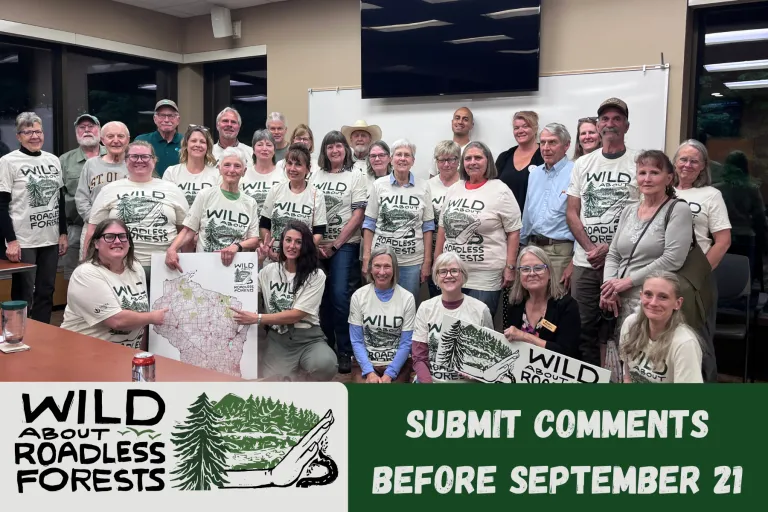
In early June, about 100 Wisconsinites in the Rhinelander area turned out at a town hall meeting where dozens voiced their objections to the U.S. Forest Service’s proposed repeal of its longstanding “Roadless Rule” that ensures parts of our national forests remain untouched by new road construction and logging. We were honored to be joined by Roadless Rule author Mike Dombeck, who spoke about the rule, ahead of testimony by dozens of people who support the Roadless Rule. As Mike said, "There are currently more miles of roads in our national forests than there are miles between Earth and the moon!"
Yet, in August, the Trump Administration moved to pave through the the .02% of Wisconsin that is left without roads. This announcement kicked off a comment period that will close on September 21.
- Submit comments here
- Attend the Roadless Rule Action Night. Join us for a screening of "Why We Need the Roadless Rule" along with some discussion and time to write comments for the Roadless Rule. RSVP here.
Lunch and Learnings
The Water Team hosted a Lunch and Learn with the Wilderness Alliance about the impact of wake boats and the need to protect against them. You can watch the recording here. The Water Team is also hosting Lunch and Learns throughout the Fall. On September 9, join us for A Water Ethic: Building on Leopold's Legacy. Keep an eye out for future Lunch and Learn dates on the Water Team’s action page.
Observations in Nature
In partnership with the Four Lakes Group, we started a monthly series called "Observations in Nature" at the University of Wisconsin Arboretum earlier this year. The recurring event, which is currently scheduled through November, has had a great turnout each time so far with a mix of returning and first-time attendees. The location of the Arboretum in proximity to the Beltline Highway gives us an opportunity to inform and update attendees on a major expansion being proposed. The October Observation in Nature is scheduled for October 7.
Limiting Wolf-Farmer Conflicts
The Department of Natural Resources (DNR) has announced new rulemaking about reimbursement for animal (livestock, pets, and hunting dogs) deaths from wolves. The Wildlife Team supports a tiered approach that prioritizes farmers and pays them in full right away, while deprioritizing out-of-state repeat hounders and eliminating their funding.
Hound‑training claims arise when bear hunters voluntarily release unleashed, often GPS-collared hunting dogs in pursuit of bears—often in posted “wolf caution” areas—fully aware of the risks and danger involved. In contrast to unavoidable agricultural conflicts, these incidents are the result of a chosen recreational activity practiced by a very small minority of Wisconsin residents and a substantial number of non‑residents.
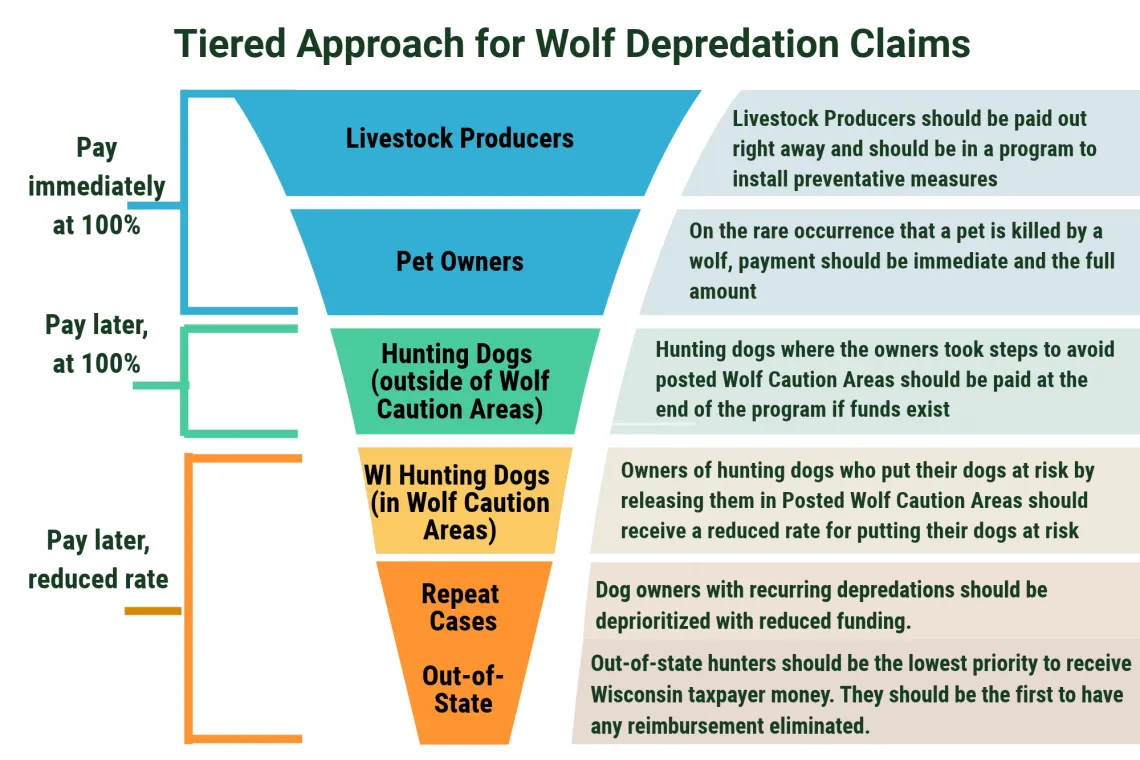
Wisconsin taxpayers should not subsidize repeated losses for individuals who do not live here, do not purchase a license to train dogs here, and do not contribute revenue to the DNR. The highest‑paid claimant is from Minnesota and received $17,624.20 for eight dogs. Among the top ten claimants, three are from Minnesota, Colorado, and Texas, totaling $36,654.44. (All financial data and reimbursement totals are pulled from a WDNR open records request from September 2025.) These claims should be the lowest priority, if not denied entirely, when funds are insufficient.
Earlier this summer, at a Wolf Advisory Meeting, the DNR confirmed that predator-proof fencing has been working 100% of the time at the farms where it has been installed. That is one reason depredations are significantly down this year in Wisconsin. State and federal officials should prioritize helping the remaining farms install this fencing and other depredation-prevention methods.
There will be a public comment period and hearing when DNR releases the draft rule. Follow sc.org/wiwildlife for updates and more information.
Clean Air and Data Center Protections
No data center gas plants
This summer, the Public Service Commission (PSC, the agency that regulates electric and water utilities), held public input opportunities about two proposed methane gas plants, which are sometimes called "natural gas plants" by industry, trying to make gas sound safer and cleaner than it is.
The proposed gas plants are both for data centers in Wisconsin. They are being proposed and built by an independent power producer called Invenergy, and We Energies, the largest electric and gas utility in the state, have already filed to purchase the plants in order to power data centers in its territory.
In both cases, most public comments opposed the construction of these facilities. Commenters ranged from local residents, health professionals, environmental advocates, children, and elected officials.

While we wait for the Public Service Commission to rule on these gas plants, two new, massive, gas plants have been proposed near Calumet. Stay tuned for information about how you can get involved.
New Report: Thirsty Power

This summer, we released a new report, Thirsty Power: Coal and gas will leave us high and dry, which analyzes Wisconsin’s current power generation, the water needed for that power, and the potential impacts on Wisconsin’s water as Big Tech tries to build more data centers across the state. These data centers require enormous amounts of power– and in some cases are prompting entirely new gas plants that will compound water and energy use at peak times.
Five new gas plants, known or assumed to be proposed for data centers, would use 142 million gallons of water a year on average – the equivalent of the annual drinking water for 778,082 people– and the majority of which would be needed during summer months when energy and water use has been strained by drought and heat. The proposed Red Oak Ridge gas plant in Kenosha would consume an estimated maximum of 266,400 gallons of water from the Great Lakes per day – the equivalent of daily consumption of nearly 3,248 average Americans. The proposed Foundry Ridge plant would use an estimated maximum of 55,152 gallons of groundwater from local wells per day.
New Lawsuit calls for Environmental Review on data centers
The Midwest Environmental Advocates filed a lawsuit on behalf of the Sierra Club challenging a Wisconsin Department of Natural Resources (DNR) decision to issue permits for a massive data center campus in Port Washington without fully evaluating the project’s environmental consequences. Learn more about this lawsuit here.
Lawsuit aims to protect the air of Southeastern Wisconsin residents
Clean Wisconsin and Sierra Club filed motions to intervene and for summary disposition in a case at the U.S. Court of Appeals for the Seventh Circuit to defend a pollution cleanup rule designed to protect families from dangerous ozone, also known as smog. This rule is especially critical for people in southeastern Wisconsin, who repeatedly breathe air with unsafe levels of ozone. Learn more here.
What’s next for the rest of the year
Electing Climate Champions
As part of our commitment to helping elect strong independent environmental leaders who will work hard for Wisconsin’s environment, we have identified a number of districts where Sierra Club members and volunteers can make a BIG difference. Our members will be sending postcards, knocking on doors, and making phone calls to ensure climate champions win this November. Sign up to get involved here.
Save the Date: Wolf Awareness Week set for October 18-24
Please plan to join us for this exciting week focusing on wolf ecology, dispelling persistent myths, and promoting coexistence with these keystone species. Our theme this year will be “Wolf families” using a different lens each day to examine Wisconsin wolf families - how wolf families survive together and the challenges our Wisconsin wolf families still face today. Sign up for the week here.
Save the Date: Chapter Awards on November 17
Each year our chapter recognizes some of our many wonderful volunteers and community leaders for their dedication, passion and leadership. We could not do our work alone, and celebrating our award winners is one of the best parts of our year. This virtual ceremony will allow us all to come together and celebrate these environmental leaders from across the state. Look out for information on regional, in-person watch parties!