By Felix Revello, Sierra Club Kansas Feedlot Fighter
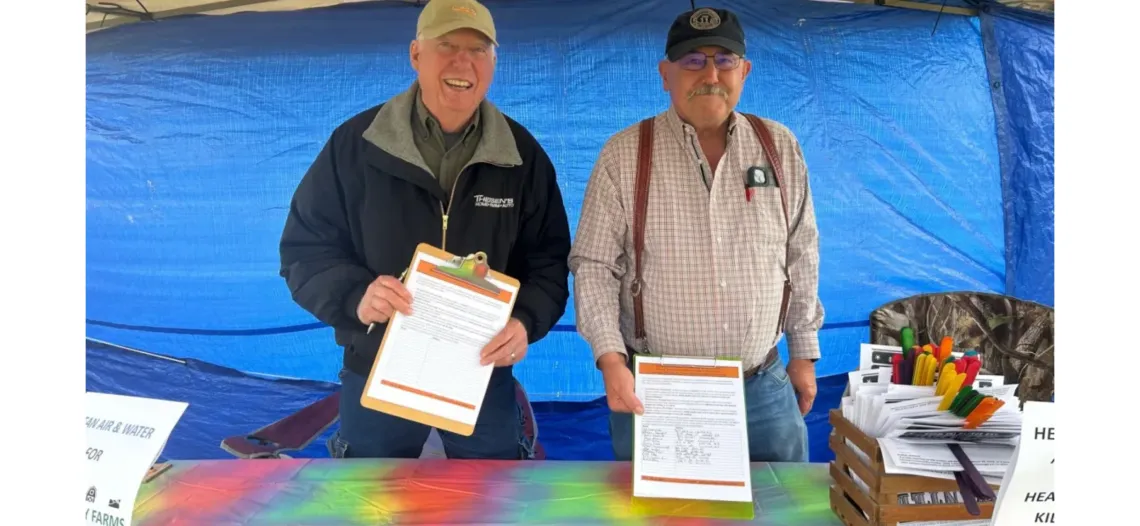
Left to right, Felix Revello and Merrill Cauble
You may remember the ongoing Pawnee County Feedlot Fight we began in 2025. I and my local trail pard Merrill Cauble continue our community organizing, partnering with other organizations, and promoting citizen science and citizen empowerment. Kansas Chapter Sierra Club CAFO specialist Craig Volland is our go-to expert on KDHE permitting processes. Socially Responsible Agriculture Project (SRAP) keeps us on target by strategizing with us, maintaining our Facebook page and helping us develop designs for flyers and mailings.
This was and remains a fight to motivate our Governor, KDHE Secretary, Pawnee County Commissioners and bureaucrats to protect citizens instead of protecting the corrupt CAFO industry - an industry that profits while destroying rural air, water, human health and rural main streets.
The two-year quest for rural environmental justice
Late in 2025 KDHE announced their review of renewal wastewater pollution control permits for the two old existing mega-feedlots south of Larned with combined capacity of 56,000 cattle capacity. We got back in the saddle and carried the fight into 2026. Honestly, we hadn’t got out of the saddle. We responded, again. More community organizing encouraging Pawnee County residents to sign petitions and write letters to Governor Kelly and KDHE. Those efforts were fruitful. We got KDHE to hold a public hearing in Larned, again. Public hearings are strikingly unusual for wastewater permit renewals. Lots of folks showed up for the hearing on February 19th to express their opposition. Informing citizens is effective.
A major success from all that wrangling is that KDHE’S Bureau of Environmental Remediation followed up on their 2025 “Preliminary Assessment” of groundwater pollution from these feedlots “Site Investigation” (SI) completed in April 2026.
The SI concludes that the feedlots “appear to be a source of substantial groundwater contamination above background. Therefore, the Site Assessment Program recommends deferral to the appropriate program under CERCLA as amended by SARA consistent with the NCP 40 CRF § 300."
Even without understanding all that, you would think that means the permits shouldn't be renewed, right?
Wrong. KDHE reissued full 5-year permits on May 4th of this year. The permits were renewed after and despite the SI concluding that the feedlots are sources of pollution. Our partners and citizens had suggested 1-year permits renewable only if progress toward lower pollution levels was shown annually.
Another partner, Strategies for Ethical and Environmental Development (SEED), helped us file a Petition for Reconsideration with KDHE. We are still waiting for a response from KDHE Secretary Stanek. There is no required time period for the Secretary to reply.
We should also mention that the Kansas Rural Center (KRC) sent a letter to KDHE supporting our position. KRC is a potential continuing partner with us on environmentally friendly agriculture issues in the future. Their members believe in sustainable agriculture and supporting rural communities, family farms and healthy ways of growing crops and livestock.
Media have been very helpful in supporting our messaging… Larned’s “Tiller and Toiler”, Great Bend Tribune, Kansas Reflector, High Plains Public Radio, Sentient. And see the coverage of our fight on the Brockovich Report.
Where does this leave us now? We keep the topic fresh and alive with the public through news releases about our latest water samples. We will follow up on the CERCLA potential in the near future. CERCLA stands for, Comprehensive Environmental Response, Compensation, and Liability Act of 1980. The current federal administration may not be the best place to pursue a CERCLA process at this time but it is being considered. Timing is important. Do we wait out the Trump administration or go full out? That is a question we are considering.
We also will focus more public attention to air pollution because it is the issue that galvanizes resistance against the feedlots since it affects the most people. Larned, our largest town in Pawnee County, with its over 3,000 residents, is north of the feedlots. Most days many residents are downwind of the pollution.
We're using a PurpleAir particulate monitor to record and report hazardous (PM2.5) air particulates from the feedlots. We figure on waiting until spring to inform the public about our results because air particulates generally decline in the winter but rise in spring and summer. We plan to couple air monitoring with the Smell My City program and a local weather station. But, right now you can find our sensor in Larned by Googling “Real-Time Interactive Map by PurpleAir”.
All of the above means that we are continuing the fight. Remember, you aren’t defeated as long as you’re fighting. This is one fight we intend to win.