
July 1, 2025
To members of San Jose City staff working on the Climate Smart San Jose update,
The Sierra Club Loma Prieta Chapter and Silicon Valley Youth Climate Action’s San Jose Youth Climate Action Team are local environmental organizations committed to conservation and climate action and are broadly supportive of the Climate Smart San Jose and Carbon Neutrality by 2030 goals. We are writing this letter to provide comments and questions on the draft Climate Smart San Jose Plan Update.
In the 2018 Climate Smart San Jose Plan, many individual measures and actions are listed. Many of these measures and actions are not carried into the 2025 update. The 2025 update does not give as much detail with the individual actions intended to achieve its milestones. Please elaborate on specific measures that San Jose needs to implement in order to reach its ambitious goals, including timelines and resources needed to complete these measures, where applicable.
Please increase the milestones for Natural and Working Lands (NWL) Preservation and Expansion. As seen in the table below, the NWL milestone decreases (from 94,995 acres to 94,200 acres) from 2027 to 2030. This decrease would result in the loss of 795 acres of NWL in San Jose. For the community health and biodiversity benefits that these lands provide, this NWL milestone should be increasing year after year, and should not incorporate any planned decreases.
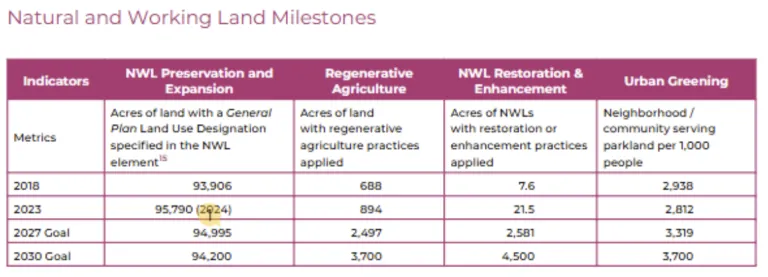
In the NWL Milestones pictured above, how are the terms “Regenerative Agriculture”, “Restoration and Enhancement”, and “Urban Greening” defined? As written, the Plan does not extensively define or elaborate on these terms. These practices should include native plants that support local wildlife and biodiversity.
To reduce paved areas and expand green space we encourage the City to support the conversion of vacant lots into public serving green spaces, including community food forests, native gardens, and areas that provide native tree canopy cover. A relatively small investment into a community organization can help transform these spaces. The City could explore possibilities to compel the landowners of these vacant lots to allow green community projects on their land.
Are the Plan’s Smart Water Use Milestones (pictured below) compatible with San Jose’s plans to incentivize the construction of more data centers? Is the potential increased demand for water from data centers factored into these projections? Why do the milestones for total volume of water use rise while the per capita residential water use is simultaneously declining, and is this rise in water use associated with data centers or population growth? If so, how much of these increases can be attributed to these causes?

Could San Jose explore, or has it explored, a program to promote drought tolerant lawns and gardens with native plants? This could take the form of education, rebates, or collaborations with agencies such as Valley Water and/or with community based organizations.
In Low-Carbon Growth Milestones for Household Energy Use (pictured below) household natural gas use is intended to drop from 115 million therms to 49 therms between 2023 and 2027, and from 49 million therms to 0 therms between 2027 and 2030. How does the City intend on achieving these rapid drops in household energy use, given its lack of progress on this metric to date?
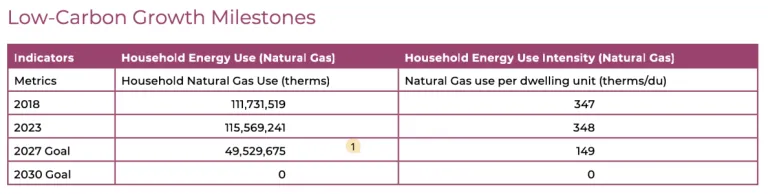
The in document page 9 of the update, titled “Introduction” should include a frank assessment as to what degree San Jose is on track to achieve its Carbon Neutrality and Climate Smart goals. At the current rate of progress since 2018, San Jose appears to not be on track to meet its goals. A call to dramatically accelerate the City’s efforts would be critically important, to give a clear message to both the public and City elected officials about the scale of what is needed to be done in the next 5 years in order to achieve carbon neutrality.
In anticipation of the implementation of Bay Area Air Quality Management District Appliance rules 9-4 and 9-6, phasing out the sale of gas furnaces and water heaters1, San Jose should prepare its residents for a local economy in which gas appliances are no longer available for purchase. To ensure equitable and timely access to electric appliances for San Jose residents who want or need to replace their gas appliances, the Climate Smart Plan Update should scale up the size and availability of rebates. Significant work needs to be done to make climate solutions more affordable to residents.
The Climate Smart San Jose Plan should explore the possibility of expanding the approach of the Zero Emissions Neighborhood Pilot (ZEN) to electrify entire areas, enabling the City to then disconnect the gas piping from entire blocks or neighborhoods in a more focused effort.
With the City’s current cuts to Climate Smart non-personnel funding for the 25-26 fiscal year, what specific Climate Smart programs or initiatives will be impacted? Could funding from the Energy Department fill this void and be used for partnerships with community based organizations (for which non-personnel funding has previously been available)?
Why do the milestone goals for commercial space located within 1⁄2 mile of a high-quality transit stop (pictured below) decline between 2023 and 2030?
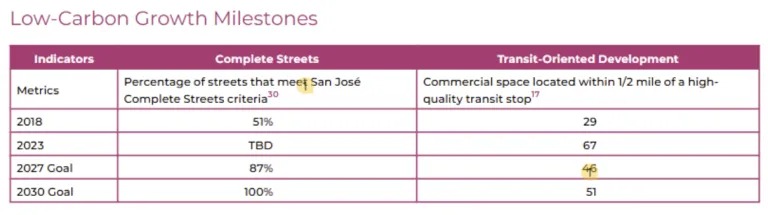
How does San Jose plan to increase awareness of and ridership for public transportation? If not being considered already, in areas with adequate transit, actively disincentivize driving by reducing parking (especially free parking), creating more slow streets, and reducing the number of and/or the width of lanes.
Thank you for your time and consideration. We look forward to supporting the adoption and implementation of a robust Climate Smart Plan Update that accelerates emissions reductions while protecting and expanding open space.
Sincerely,
Dashiell Leeds
Conservation Coordinator
Sierra Club Loma Prieta Chapter
Mani Bekele
Policy Officer, San José Action Team Co-lead
Silicon Valley Youth Climate Action
1 https://www.baaqmd.gov/rules-and-compliance/rule-development/building-appliances