
January 6, 2025
Julia Ayres,
Principal Planner
City of Brisbane
JAyres@brisbaneca.org
Re: Guadalupe Quarry Redevelopment Project, Draft Environmental Impact Report, SCH No. 2022060358
Dear Ms. Ayres,
The Sierra Club Loma Prieta Chapter and Green Foothills submit the following comments regarding the Guadalupe Quarry Redevelopment Project (Project.) Our organizations work to protect open space, wildlife habitat, and other ecological and natural resources in the Bay Area. We collectively represent thousands of members in and around Brisbane who care deeply about open space and nature.
The proposed Project plans to close and reclaim the currently idle1 Guadalupe Quarry to construct and operate an approximately 1,319,000 square-foot, 100-ft tall warehouse facility and ancillary site modifications. These modifications include new access routes, and the construction of a new underground electrical line from the Pacific Gas and Electric Company (PG&E) Martin Substation to the Project site. The Project includes a General Plan amendment of land use designation, subdividing the quarry property and making parcel boundary adjustments along access routes, and annexing approximately 104 acres into the City of Brisbane. The Project also plans to protect 36 acres of the property under a conservation easement and donate 46 acres to San Mateo County Parks as Conserved Habitat. Additionally, the Project includes an amendment to the San Bruno Mountain Habitat Conservation Plan, and a Reclamation Plan Amendment for the Guadalupe Quarry.
- Project Alternatives
We strongly disagree with the selection of Alternative 1, ‘Reduced-Density Warehouse‘ as the Environmentally Superior Alternative. This alternative proposes a slightly smaller warehouse, but it does not eliminate any of the significant, unavoidable impacts and does not reduce the number of additionally required amendments to various existing plans. We believe that the No Project Alternative – No Build Scenario is the Environmentally Superior Alternative, followed by Alternative 2, Industrial Park.
Production levels at the quarry fell to a level that meets the SMARA definition of “idle2”, prompting the County to prepare and approve an Interim Management Plan (IMP) In September 2020. Since then, activities on site are limited to the IMP requirements for erosion control, revegetation, public safety, maintenance, and monitoring requirements that must be complied with until production levels exceed the “idle” definition, or until the quarry closes and implements its reclamation plans. The baseline Existing Conditions, set at the time the Notice of Preparation was published on June 16, 2022, are therefore not an active quarry but instead, an idle quarry.
The current conditions at the quarry, and as described in DEIR Section ES.7.3 No Project Alternative – No Build Scenario are, “In 2022, small quantities of sand and gravel were produced at the quarry. Inspection records from March 30, 2023, indicate that very little activity occurs on site, other than maintenance of drainage facilities and processing equipment. Therefore, the baseline and the current activities generate no noise, light or dust, and have little adverse impact on the environment, and no impacts to Biological Resources. There are also no new significant, unavoidable impacts on any natural resource.
The DEIR in section ES.7.3 states, “The No Project Alternative – No Build scenario assumes continuation of quarry activities at a level consistent with existing operations within the previously disturbed areas of the quarry”. As described in the DEIR, the existing level of activity has almost no adverse impacts to the environment. In implementing an approved IMP, this alternative in fact ameliorates the conditions on the quarry site, and has no impacts beyond the already disturbed areas. There is no reason to assume that the quarry will ever resume full-capacity mining operations, and it is likely that the quarry will be abandoned if this project is not approved. Therefore, we maintain that the ‘No Project Alternative – No Build Scenario’ is the Environmentally Superior Alternative.
The next Environmentally Superior Alternative, second to the ‘No Project Alternative – No Build Scenario’ alternative, should be Alternative 2, Industrial Park. This alternative includes development of an industrial park on approximately 68 acres of the disturbed quarry floor, in accordance with the quarry reclamation plan approved by the County in 1995. However, it does not expand the area to be disturbed, while Alternative 1 would result in over 20 acres of new disturbance on top of the 81.5 acres already affected by the existing quarry. The smaller footprint of development significantly reduces the impacts of the Project.
- Amendment and conflict with the San Bruno Mountain Habitat Conservation Plan
The DEIR states that the Project will require US Fish and Wildlife approval of an amendment to the San Bruno Mountain Area HCP and an Incidental Take Permit (ITP) to allow “take” of endangered butterfly species that would be impacted by the Project. The HCP and ITP amendment will include updated operating programs for Administrative Parcels impacted by the Project, to be provided to the Plan Operator and USFWS for review and approval. This is not a minor amendment, and yet there is no mention of opportunities for the public to engage in this process.
Amendments to HCPs typically include public review and opportunities to comment, and potentially conducting additional environmental analysis depending on the amendment's scope. The DEIR provides almost no information on the scope of the proposed amendment to the HCP. We believe that the discussion of the amendment to the San Bruno Mountain Area HCP and the implementation of Incidental Take Permit (ITP) should be subject to public review. In addition, these changes should be described comprehensively in the Final EIR to provide transparency. Further, the Final EIR should provide a full description, including maps, of the proposed amendment to the HCP and ITP.
If a public review is not anticipated, it should be, as part of the mandated process. If future public review of the amendments is anticipated, it means that this CEQA review of project impacts is inappropriately segmented and thus, incomplete.
In the absence of a comprehensive description of the scope of an anticipated amendment to the HCP and ITP, the EIR cannot find that there are no conflicts with the existing San Bruno Mountain HCP. This HCP emphasizes the protection of contiguous habitat to support the survival and the recovery of listed species, and it is reasonable to expect that the development of the proposed project would conflict with and impair the effectiveness of this existing HCP.
Furthermore, the Project would develop approximately 0.23 acres of land for secondary access that is within the San Bruno Mountain Area HCP area and is presently designated as conserved lands. The DEIR suggests that this is not a conflict with the HCP because:
- An equal amount of land would be dedicated to the County for conservation, and
- The Brisbane General Plan anticipated redevelopment of the Project site, and the secondary access would be developed for fire safety.
We maintain that a conflict with the HCP exists, and remains significant, because:
- The DEIR has not shown that for the covered species, the ecological value of the land that will be dedicated is equivalent to the ecological value of the land that would be lost.
- Fire safety is important, but should not justify unnecessary degradation of the HCP. The HCP is a federally adopted document, and so local requirements of anticipated redevelopment must not override it.
- Project Description
Under CEQA, the inclusion in the EIR of a clear and comprehensive description of the proposed project is critical to meaningful public review. County of Inyo v. City of Los Angeles (1977) 71 Cal.App.3d 185, 193. “An accurate, stable and finite project description is the sine qua non of an informative and legally sufficient EIR.” Santiago County Water District v. County of Orange (1981) 118 Cal.App.3d 818, 830.
Here, the Project Description fails to provide complete information about two major aspects of the Project: the proposed amendments to the San Bruno Mountain Habitat Conservation Plan (HCP), and the proposed amendment to the Guadalupe Quarry Reclamation Plan. Typically, amendments to HCPs or to quarry reclamation plans require their own separate EIR processes, which are performed when the proposed amendments have been fully drafted and are available for the public to review. Here, it appears that neither the HCP amendment nor the Reclamation Plan amendment have yet to be drafted. Thus, the claim that the DEIR can adequately evaluate the impacts of amendments that do not exist strains credulity. Without including full and complete details of exactly what these proposed amendments will entail, the Project Description cannot be called “accurate, stable and finite.”
- Significant Impacts to Biological Resources
4.1. Impacts to riparian woodland community/ Central Coast Riparian Scrub
A Biological Resources Analysis Supplemental Technical Memo (Appendix F) shows that the proposed Project could impact up to 1.08 acres of riparian woodland community classified as Central Coast Riparian Scrub. The Draft EIR indicates these impacts would result from road access activities. Two alignment options are being considered: Alignment A, which would cause significant impacts (1.08 acres along 804 linear feet) by running parallel to the drainage, and Alignment B, which would involve a clearspan bridge crossing the drainage at a perpendicular angle, reducing the extent of the impacts.
The Central Coast Riparian Scrub is a highly vulnerable habitat with a restricted range, containing small and declining populations, and subject to increasing threats of extirpation in California. Any encroachment into this habitat would harm the watershed’s ecological integrity, disrupt sensitive species, and contribute to pollution. With only 2–7% of California’s riparian habitat remaining intact, protecting these areas is crucial. Additionally, narrower riparian buffers are significantly less effective in mitigating development impacts compared to wider ones.
To adequately mitigate impacts on the riparian woodland community, the Project should be designed to completely avoid encroachment, even temporarily, into the riparian woodland community/Central Coast Riparian Scrub. Such avoidance measures are necessary to preserve this critically important and highly sensitive habitat.
4.2 Nitrogen Deposition
In 2015, Creekside Science produced a report assessing the San Bruno Mountain Habitat Conservation Plan3. Chapter 8 of the report reviews impacts to San Bruno Mountain vegetation cover due to nitrogen deposition from vehicle emissions and industrial activities. Increased rates of nitrogen deposition fertilize soil on the mountain and lead to a higher biomass of invasive plants detrimental to the quality of the mountain's habitats. For example, elevated nitrogen deposition facilitates the growth of invasive plants that degrade grasslands essential to the endangered Mission Blue and Callippe Silverspot butterflies.
The report mentions that "the low elevation leeward slopes from Devil’s Arroyo around to Brisbane Acres have lower N-deposition" than those on the South Slope and Northeast Ridge. This "lower deposition zone" includes the Guadalupe Quarry and surrounding areas like Owl and Buckeye Canyons.
The DEIR provides no analysis of the potentially significant impact of nitrogen deposition from the vehicular traffic associated with the proposed land uses and zoning. The current baseline conditions of the "lower deposition zone" may be altered. The final EIR should address and provide mitigation for this impact. Alternatively it can deem it a significant and unavoidable impact to the local plant and butterflies community, and find it a significant conflict with the adopted San Bruno Mountain HCP which was created to protect and recover these biological resources.
4.3 Artificial light at night (ALAN) remains a significant, unavoidable impact
We recognize and appreciate the City of Brisbane's well-drafted Lighting Ordinance, but this regulation comes short in addressing the proposed Project because of the location of the proposed Project at the heart of San Bruno Mountain, surrounded by wildlife and endangered species habitat. At this location, ALAN should be recognized as a significant, unavoidable impact.
4.3.1 Impacts of ALAN on butterflies
While adult butterflies are primarily diurnal, many species rely on low-light conditions during specific life stages, such as when feeding, finding roosting sites or mating at dusk. Artificial light at night (ALAN) has the potential to significantly impact butterfly behavior, physiology, and ecology. Research4 has established impacts that include:
- Attraction to light sources: Artificial lights can attract butterflies, causing them to congregate around illuminated areas. This attraction means that butterflies cannot leave the lit area, creating a population sink where butterflies die and stop contributing to the populations. Furthermore, in the lit area, butterflies are more vulnerable to predators.
- Disrupted circadian rhythms: Butterflies rely on natural day-night cycles to regulate their activity, and exposure to artificial light at night can disrupt their internal clock, causing them to be active when they should be resting. Not only adult butterflies are impacted: ALAN can significantly affect the behavior of caterpillars, disrupting their feeding patterns, development, and overall life cycle, as shown for Monarch butterflies5. It can also increase predation of butterfly larvae (caterpillars)6.
- Migration disruption: For migratory butterflies like monarchs, light pollution can confuse their navigational cues, leading them off course during their long migrations.
- Reduced roosting effectiveness: When butterflies roost near artificial light, their resting periods can be disturbed, impacting their energy reserves.
- Host Plant Impacts: Pollinator disruption affects plant reproduction, altering plant communities and ecosystems dependent on insect pollination.
4.3.2 Impacts of construction lighting
The DEIR states, “Construction lighting is generally exempt from the Brisbane Municipal Code Chapter 15.88 (Dark Sky Ordinance) provided such lighting is temporary, necessary, and is discontinued immediately upon completion of the construction work. The ordinance also requires that construction lighting comply with the Dark Sky Ordinance to the greatest extent practical”.
Construction is anticipated to take over a year, which is longer than a generation cycle for some of the endangered species of San Bruno Mountain. For example, the endangered San Bruno Elfin butterfly typically live for about a week as adults, spending most of their short life cycle in larval stages and pupae, emerging mainly in the early spring months to mate and lay eggs on their host plant. Biologically, the lengthy construction period means that potentially significant impacts will be imposed and disrupt the reproduction and survivorship of this species and others.
The EIR should analyze a mitigation measure under which the timing and duration of construction is modified to restrict construction to daylight hours, and prohibit construction-lighting at night to avoid the negative impacts of construction-related ALAN.
4.3.3 Impacts of artificial light at night (ALAN) from vehicles
Artificial light at night stemming from vehicles, can cause significant environmental impacts. The DEIR does not analyze the impacts of artificial light at night stemming from vehicle traffic, which includes “employee passenger vehicles, outside services (e.g., fuels, maintenance, deliveries), freight trucks and trailers, and delivery vehicles.” The unshielded, horizontally angled, high-Kelvin and high-lumen output of vehicle headlights can significantly impact wildlife and habitats that are routinely exposed to them. “The Project would establish paved roads around the perimeter of the warehouse between the Project site and the steep, vegetated slopes of San Bruno Mountain.” “The perimeter of the Project site functions as a wildlife corridor providing connectivity to San Bruno Mountain and Associated Habitats.” The impacts of vehicle lighting will be exacerbated by the anticipated warehouse operating hours of 5am to 10pm.
The impacts of light at night from vehicle traffic should be analyzed. Furthermore, the EIR should provide mitigation that closes roads and operations at night to limit light pollution.
4.3.4 Impacts of artificial light at night (ALAN) from buildings, including parking structures
The proposed project contains “surface parking areas around the perimeter of the on-site development footprint, for a total of 1,554 spaces.” The EIR states that “the perimeter of the Project site functions as a wildlife corridor providing connectivity to San Bruno Mountain and Associated Habitats.”
“Brisbane Municipal Code Chapter 15.88 requires all outdoor light fixtures to be fully shielded, prohibits light trespass, and prohibits the sitting of lighting around the perimeter of a site with the exception of security lighting.”
Given this exemption for security lighting, Brisbane’s Dark Sky Ordinance standards will not adequately mitigate the type of lighting proposed at the perimeter. Due to the proximity of perimeter lighting with wildlife habitat, additional mitigation is necessary to reduce impacts, such as - Require the use of motion sensors to ensure that lighting is only used when activity is present,
- Establish an upper limit of 2400 Kelvin to reduce the impacts of blue light,
- Establish a policy for lights to be turned off while it is dark.
Because of the location of the Project site in proximity to valuable habitat including a wildlife corridor, even with additional mitigation there will be significant unavoidable impacts.
4.4 Risk of Bird Collisions with windows
Bird collisions with man-made structures are considered one of the primary causes of bird population declines in North America7. The DEIR proposes “all windows of the warehouse facility would be equipped with anti-reflective glass.” But at this location, reduced reflectance does not reduce the impact to a less than significant level - especially at night. The Project must incorporate additional bird-safe design measures to mitigate potential impacts on avian species because the site’s proximity to sensitive habitats increases the risk of birds colliding with building façades.
The EIR should require the following:
- Façade Treatment: Install screens or frit patterns with markers spaced no more than 2 inches horizontally and/or 2 inches vertically. Fritting should be on the outside surface of the glass. Avoid see-through situations where a bird can see a flight path through glass elements in the buildings.
- Lighting: Minimize light pollution by installing blinds or window covers that block indoor lighting from being visible from the outdoors at night.
- Monitoring: Include post-construction monitoring to evaluate and adapt bird-safe measures as needed.
4.5 Fencing
Fencing can have negative environmental impacts on wildlife and natural habitats. These impacts include wildlife movement impedance and disruption of migration patterns, habitat fragmentation and entrapment risks. The materials used for fencing such as plastic, can also contribute to pollution if not disposed of properly.
The Project includes the construction of two fences. One temporary fence will surround two water storage ponds. These ponds will be lined with non-degrading plastic and encircled by a six-foot chain-link fence to ensure safety during construction. A six-foot-high perimeter fence will also be installed along the debris ditch to secure the site. Water ponds on construction sites can attract a wide variety of wildlife, including birds, mammals, amphibians, and reptiles. The proposed fence around the ponds can become a potential hazard as animals could be trapped, injured or unable to escape when they attempt to access the water. The rockfall protection barrier (mesh, as described in Figures 2.7-1. And 2.7.-2) can also create a barrier to wildlife movement, and has the potential of entrapment of flying birds and bats.
Given the potential environmental impacts for these barriers, the project should incorporate additional mitigation measures. The EIR should require the following:
- Fence Placement: the placement of fences should avoid directing wildlife towards roads and other wildlife-hazardous areas, or create safe wildlife passage at such locations.
- Monitoring of Fencing Impact: Implement ongoing monitoring of the fences and mesh structures to assess their impact on wildlife movement. This could include regular surveys of the site to ensure no animals are trapped or obstructed, and that wildlife are able to move safely through the area.
- Wildlife-friendly fencing: Design and construct fences that allow wildlife to pass through. Avoid small gaps or mesh sizes and using larger gaps at the base
- Ensure the plastic will be removed promptly after construction and sent for recycling to avoid long-term pollution.
4.6 Vehicle related wildlife mortality
The Guadalupe Quarry Redevelopment Project site and its surrounding areas, including San Bruno Mountain, are home to a diverse array of sensitive and protected species. These include the federally endangered Mission Blue (Icaricia icarioides missionensis), San Bruno Elfin (Callophrys mossii bayensis), and Callippe Silverspot (Speyeria callippe callippe) butterflies. Additionally, many species of resident and migratory birds, as well as small mammals, inhabit the area. Larger mammals observed in the area include Mountain Lions (Puma concolor)8, Red Foxes, Coyotes, Black-tailed Deer, American Badgers, Bobcats, Eastern Fox Squirrels, and Western Gray Squirrels. Of these mammalian species, the Mountain lion is a Candidate for listing under the California Endangered Species Act and at this time, is afforded the same protections as a state-listed endangered or threatened species. American Badger is a Species of Special Concern in the state of California.
The proposed Project would include improvements to Quarry Road, which provides access to the project site, and construction of a new secondary access road connecting South Hill Drive to the project site. The Project would also increase traffic from the currently negligible levels to substantial traffic during the day and potentially, at night. This increases the potential for wildlife - especially nocturnal wildlife - to collide with vehicles, or to be run over by vehicles. The DEIR, however, does not sufficiently address the risks posed by increased traffic, new road construction, and associated impacts to wildlife, including the potential for fatal road collisions. Mortality due to traffic can also apply to the endangered butterflies of San Bruno Mountain.
4.7 Mountain Lions
The DEIR does not provide analysis of the movement of Mountain Lions in the area, and the potential impacts on increased traffic and lighting on Mountain Lions. Since road collisions are a major mortality factor for Mountain Lions, the potential for a project-related increase in fatal road collisions should be evaluated. Figure 19 shows fatal Mountain Lion collisions in the Bay Area, including collisions near San Bruno Mountain.
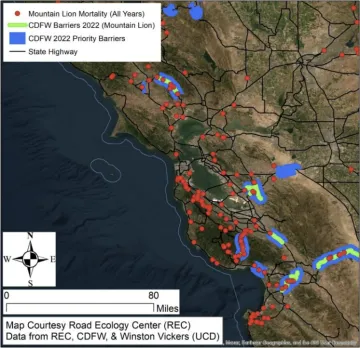
Figure 1: Fatal Mountain Lion collisions in the Bay Area
- Proposed Mitigation Measures
The following section contains a summary of mitigation issues and suggestions raised in this letter. To mitigate potential impacts to Mountain Lions, butterflies, and other wildlife, the following measures should be included in the Final EIR:
- Conduct Wildlife Studies:
- Implement camera trapping, animal tracking, and roadkill studies to accurately assess wildlife movement in and around the project area.
- Install Directional Fencing and Wildlife Crossings:
- Build directional fencing along existing and new roads to guide small and large mammals toward safe underpasses, culverts, or dedicated wildlife crossings.
- Ensure crossings are designed to accommodate Mountain Lions and other large species.
- Limit Nighttime Activity:
- Close all project facilities and all access roads at night (7PM to 6AM) to allow nocturnal species, including Mountain Lions, safe passage without the risk of vehicle collisions. Night closures will also reduce noise and light pollution, minimizing disruption to nocturnal wildlife behavior and reduce the risk of bird collisions.
- Road closure and limitation on warehouse operations at night should be a required mitigation measure, rather than an element of the project. This is because elements of the project are easier to modify, and it is reasonable to expect that should a future tenant ask for longer hours, longer shifts or even 24/7 operations, their wishes will be accommodated without revisiting the EIR.
- Avoid or Minimize Light Pollution:
- The EIR should analyze a mitigation measure under which the timing and duration of construction is modified to restrict construction to daylight hours, and prohibit construction-lighting at night to avoid the negative impacts of construction-related ALAN. Limit construction to day-light hours and prohibit construction-lighting.
- Use guards (employees) and motion sensors instead of using permanent lighting features for security purposes.
- Minimize light pollution by installing blinds or window covers that block indoor lighting from being visible from the outdoors at night. This mitigation measure will also help reduce the risk of bird collisions.
- Establish an upper limit of 2400 Kelvin to reduce the impacts of blue light
- Reduce Bird Strikes:
- Façade Treatment: Install screens or frit patterns with markers spaced no more than 2 inches horizontally and/or 2 inches vertically. Fritting should be on the outside surface of the glass. Avoid see-through situations where a bird can see a flight path through glass elements in the buildings.
- Mitigate Impacts of Fencing:
- Fence Placement: the placement of fences should avoid directing wildlife towards roads and other wildlife-hazardous areas, or create safe wildlife-passage at such locations.
- Monitoring of Fencing Impact: Implement ongoing monitoring of the fences and mesh structures to assess their impact on wildlife movement. This could include regular surveys of the site to ensure no animals are trapped or obstructed, and that wildlife are able to move safely through the area.
- Wildlife-friendly fencing: Design and construct fences that allow wildlife to pass through. Avoid small gaps or mesh sizes and using larger gaps at the base
- Ensure the plastic will be removed promptly after construction and sent for recycling to avoid long-term pollution.
- Monitor and Adapt:
- Establish a long-term monitoring program to document wildlife movement, roadkill incidents, and the effectiveness of mitigation measures.
- Analyze the impacts of artificial light at night from vehicles.
- Include post-construction monitoring to evaluate and adapt bird-safe measures as needed.
Thank you for your consideration,
Gita Dev
Conservation Committee Chair
Sierra Club Loma Prieta Chapter
Alice Kaufman
Policy and Advocacy Director
Green Foothills
1 https://www.conservation.ca.gov/smgb/Regulations/Documents/SMARA-statutes-regs-7-2018.pdf
§ 2727.1. “Idle” means that an operator of a surface mining operation has curtailed production at the surface mining operation, with the intent to resume the surface mining operation at a future date, for a period of one year or more by more than 90 percent of its maximum annual mineral production within any of the last five years during which an interim management plan has not been approved. (Amended by Stats. 2011, Ch. 491, Sec. 1. Effective January 1, 2012.)
2 https://www.conservation.ca.gov/smgb/Regulations/Documents/SMARA-statutes-regs-7-2018.pdf
§ 2727.1. “Idle” means that an operator of a surface mining operation has curtailed production at the surface mining operation, with the intent to resume the surface mining operation at a future date, for a period of one year or more by more than 90 percent of its maximum annual mineral production within any of the last five years during which an interim management plan has not been approved. (Amended by Stats. 2011, Ch. 491, Sec. 1. Effective January 1, 2012.)
3 Weiss, S.B., Naumovich L. and C. Niederer. 2015. Assessment of the past 30 years of habitat management and covered species monitoring associated with the San Bruno Mountain habitat conservation plan. Prepared for the San Mateo County Parks Department.
https://www.smcgov.org/parks/san-bruno-mountain-habitat-management-approach-projects-documents
4 Seymoure Brett M. 2018. Enlightening Butterfly Conservation Efforts: The Importance of Natural Lighting for Butterfly Behavioral Ecology and Conservation. Insects. doi: 10.3390/insects9010022. https://pmc.ncbi.nlm.nih.gov/articles/PMC5872287 and Falcón Jack et al. 2020 Exposure to Artificial Light at Night and the Consequences for Flora, Fauna, and Ecosystems. Front Neurosci. doi: 10.3389/fnins.2020.602796 https://pmc.ncbi.nlm.nih.gov/articles/PMC7701298/
5 Haynes Kyle J et al. 2023. Artificial light at night increases the nighttime feeding of monarch butterfly caterpillars without affecting host plant quality. https://doi.org/10.1016/j.baae.2023.07.007.
6 Deitsch John F and Kaiser Sara A. 2023. Artificial light at night increases top-down pressure on caterpillars: experimental evidence from a light-naive forest. Proc Biol Sci. 2023 Mar 8;290(1994):20230153. doi: 10.1098/rspb.2023.0153 https://pmc.ncbi.nlm.nih.gov/articles/PMC9993043/
7 https://www.fws.gov/library/collections/threats-birds
8 https://www.smcgov.org/parks/be-aware, Mountain Lions hunt alone at night, but can be present anytime... Though sightings are rare, mountain lions may be encountered at any of the following parks: Devil's Slide Trail, San Pedro Valley, San Bruno Mountain, Junipero Serra, Quarry/Wicklow, Crystal Springs Regional Trail, Edgewood, Huddart, Wunderlich, Memorial, Pescadero Creek, and Sam McDonald.
9 Source: https://roadecology.ucdavis.edu/photo-galleries/mountain-lion-maps#&gid=1&pid=2