September 2, 2025
Palo Alto Community Services Department and Palo Alto Parks and Recreation Commission
250 Hamilton Ave
Palo Alto, CA 94031
Email to: kristen.o'kane@paloalto.gov, ParkRec.commission@paloalto.gov,
CC: Sarah.Robustelli@paloalto.gov
Subject: Request to Redo the “Comparative Analysis of Synthetic and Natural Turf Athletic Fields” study with Transparent and Accurate Analysis
Dear Palo Alto City Community Services Director Kristen O’Kane and Parks and Recreation Commission Chair Nellis Freeman,
The Sierra Club Loma Prieta expresses its concern about the Draft Comparative Analysis of Synthetic and Natural Turf Athletic Fields commissioned by the City. While the report may be copious and well-written, in a grammatical sense, it falls short as a serious analytical study needed for the staff and council to make an informed decision. It presents information selectively, relies on questionable and outdated data, particularly in relation to natural grass care, and often lacks transparency in sourcing. A meaningful and conclusive decision on this matter cannot be made until the report is properly revised and corrected.
Lack of Source Transparency
The report frequently provides numerical estimates without adequate citations or calculations. For instance, the claimed annual maintenance cost for natural grass ($42,000 to $65,000, noted on pages 98 and 153), a critical piece of information, is not linked to any specific sources or breakdowns and is therefore questionable. The references for Chapter 7 are a list of broad websites, making it impossible to trace the origins of specific figures [1]. For Chapter 10, references are merged with Chapter 9, which only adds to the general confusion.
Several URLs in the reference list (pages 164 – 171) are either broken (page 165, https://www.epa.gov/smm/greenscapes, and page 170, https://www.unep.org/resources/pollution-solution) or incorrectly formatted (page 168, http://www.synturf.org/images/Cost_Artifi). Even some that appear valid do not link to relevant content (page 170, after translating to English, there is no microplastic reference, https://www.miljodirektoratet.no. This indicates either carelessness in submitting a report which is not expected to be used and for which Palo Alto residents have paid good money, or a lack of diligence in verifying sources to confirm whether statements in the report are actually supported by evidence.
Misinterpretation of Field Usage Hours
A major problem with the report lies in the misleading field usage hours for the Mayfield site and, separately, the miscalculated usage hours for the El Camino Park synthetic turf field. The report states that the Stanford/Palo Alto Mayfield site (two fields in Mayfield Park totaling 5.9 acres) accommodate "3,000+ hours annually" (page 139) and, separately, synthetic fields in El Camino Park can accommodate “up to 3,000 hours” per year (page 158). But these figures are misleading: the 3,000 hours at the Mayfield site refers to two fields, meaning each field supports about 1,500 hours.
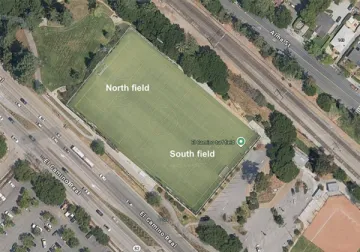
With El Camino Park, the report treats the North, South, and Large Fields as entirely separate, summing hours as if they’re independent when in fact they overlap. For example, if one group reserves the North Field and another reserves the South Field during the same 4-hour block, that block should count as 4 total hours, not 8, since both groups share the same overall space.
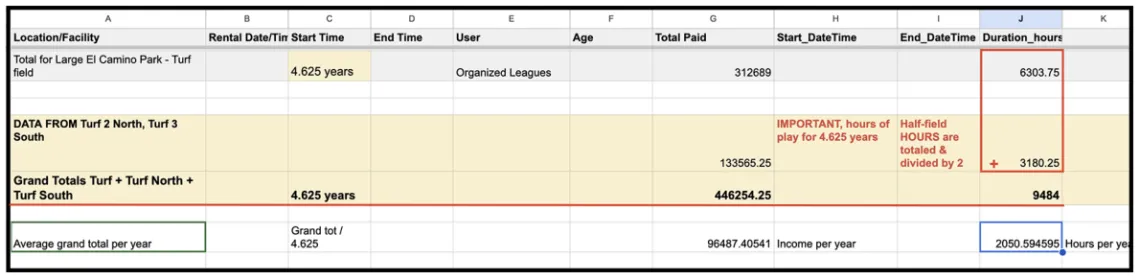
Using data obtained via Public Records Request for 2021 through mid-August 2025 (4.625 years) for El Camino Park, and calculating properly:
Average annual synthetic field usage =
(Large Field hours + ((North + South hours) ÷ 2)) ÷ 4.625)
= ~2,051 hours/year
This is significantly less than the report’s implied 3,000 hours and highlights the need for careful review and accurate methodology.
Synthetic Turf vs. Grass Usage During Rainy Seasons
On page 28, the report claims that “rainy seasons often delay league use of natural grass fields.” However, data from El Camino Park shows that synthetic turf field usage also dips during the rainiest months (December–February), suggesting that leagues often apparently choose not to play in heavy rain regardless of field surface.
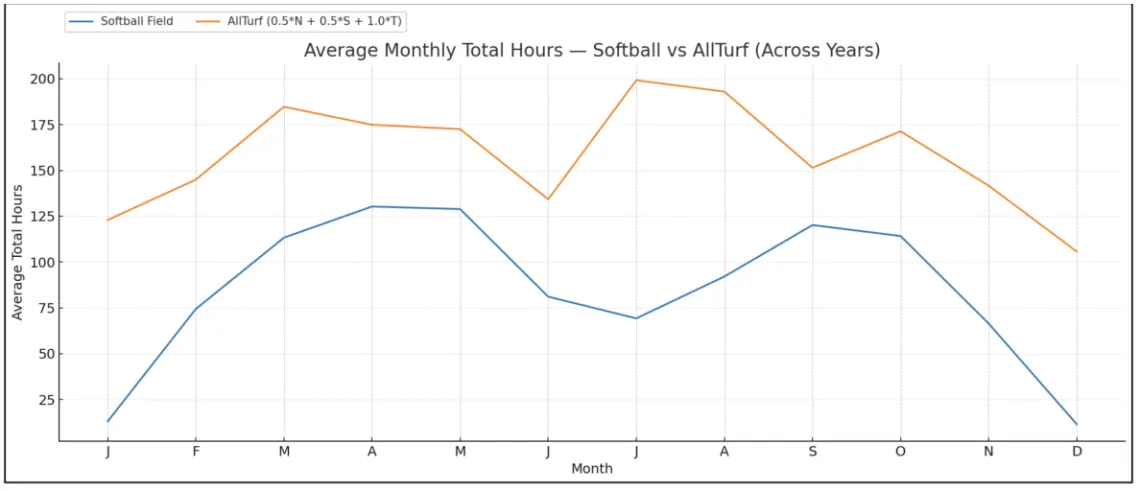
A comparative chart of typical annual synthetic turf field and adjacent natural grass softball field usage between 2021 and 2025 shows that both fields experience similar seasonal usage trends. This undermines the argument that players demand year-round play on synthetic turf.
Underreported Grass Field Capacity
The report claims (pages 53, 63, 79, and especially the chart on page 81) that natural grass fields can only support 600 – 1,200 hours of play per year. However, real-world examples show otherwise.
In Gilbert, Arizona, having a harsher climate than Palo Alto, four sand-based fields at Desert Sky Park each host more than 2,000 hours of annual use, with some exceeding 2,400 hours. [2] These fields are irrigated with reclaimed water and managed with a hybrid organic/traditional approach. Gilbert officials, including Parks Superintendent Sean Carlin, are open to sharing their management practices. Unfortunately, Palo Alto’s consultant appears not to have contacted them, which is another missed opportunity.
Other cities in the U.S. and Australia have successfully implemented organic-only natural grass care programs, yet the report does not include or evaluate these models, despite their relevance to sustainability and long-term cost savings. [3][4][5]
Cost Comparison: Synthetic Turf vs. Grass
It is vitally important to also examine the cost, using actual field revenue and maintenance cost estimates given in the report.El Camino Synthetic Turf Field Revenue (2021–2025, 4.625 years):
● Total revenue = ~$446,254
● Average annual revenue = ~$96,487
Over 10 years, projected revenue is $964,870.Maintenance costs: Synthetic turf requires a new carpet layer around year 10, estimated at $842,000 (page 29). This leaves only $122,870 in net gain.
If we instead assume the highest natural grass maintenance cost from the report—$65,000/year—the 10-year cost would be $650,000, leaving a net gain of $314,870.
Therefore, grass wins on maintenance costs over time.
Even if leagues paid a discounted rate of 70% to use a grass field (i.e., $67,541/year), the 10-year revenue would be $675,410, still yielding a net surplus of $25,410, even at the report’s highest estimated maintenance cost.
Therefore, the information in the report clearly shows that grass is less expensive. Please also note that using more sustainable, organic methods that grass fields allow may reduce maintenance costs even further. [3][4][5][6]
Conclusion
There is much in this report that calls for re-evaluation. From flawed calculations and broken references to unsupported assumptions and missed opportunities to consult real-world examples, the draft does not meet the standard of analysis required for a multi-million-dollar policy decision.
While the prose is polished, good writing cannot compensate for poor analysis. We owe it to the public to base decisions on accurate, well-sourced, and clearly explained data.
We respectfully urge the City to reject this draft and commission a new, truly comparative and transparent study.
Sincerely,
Susan Hinton
Chair, Plastic Pollution Prevention Team
Sierra Club Loma Prieta Chapter
Sue Chow
Co-Chair, Peninsula Regional Group
Sierra Club Loma Prieta Chapter
Gita Dev
Chair, Conservation Committee
Sierra Club Loma Prieta Chapter
References:
[1] All references for Chapter 7 on page 164 - specific web pages or quotes are not provided in the Draft Comparative Analysis of Synthetic and Natural Turf Athletic Fields:
https://www.sportsfieldmanagement.org/
https://www.fifa.com/
https://www.nflpa.com/
https://www.astm.org/
https://www.epa.gov/
https://www.cast-science.org/
[2] https://www.sierraclub.org/loma-prieta/palo-alto-turf-study
[3] https://www.gba.org/organically-managed-grass-athletic-fields/
[4] https://youtu.be/4gDs9Z4kQME?feature=shared
[6] https://www.turi.org/natural-grass-playing-field-case-study-springfield-ma/