In the Santa Cruz Mountains and Peninsula foothills, oaks have shaped the landscape for millennia, providing habitat for songbirds, food for wildlife, and stability to hillsides. However, these iconic trees now face unprecedented threats.
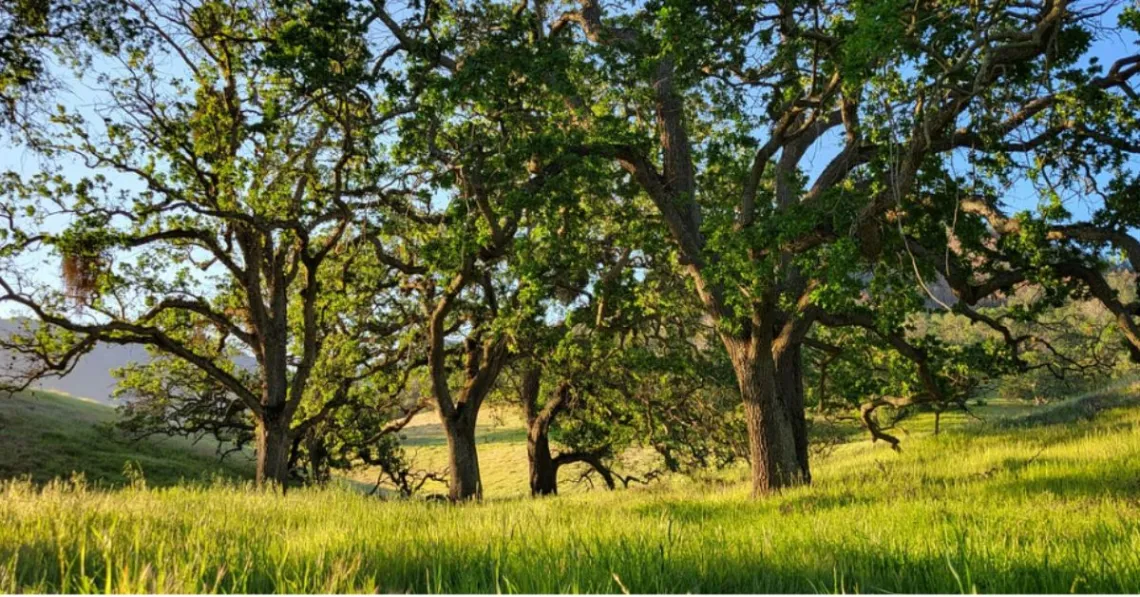
This past year, we've highlighted two significant biological threats: Sudden Oak Death, an invasive pathogen that has devastated millions of trees statewide, and the Mediterranean Oak Borer, a newly arrived beetle targeting valley and blue oaks. These dangers are real and worsening, but they are only part of a broader ecological issue.
Research indicates that oaks are also being negatively impacted by poorly designed thinning and logging projects promoted as wildfire prevention. Mechanical disturbances can increase the prevalence of invasive grasses and suppress oak regeneration, while heavy machinery compacts soil, damaging root systems and decreasing seedling survival. Even the University of California has warned that overly aggressive timber harvesting and grading can degrade oak woodlands and exacerbate erosion. Poorly planned understory removal can eliminate wildlife cover and remove fire-resilient native shrubs such as toyon and coffeeberry, while excessive removal of dead wood can eliminate critical habitat for cavity nesters, insects, and beneficial fungi. The overall effect can be a reduction of biodiversity.
Additionally, canopy reduction can increase fire intensity due to drier understory vegetation. The use of heavy machinery also risks spreading pathogens like Phytophthora ramorum, which causes Sudden Oak Death and thrives in disturbed areas and along access roads. Freshly cut wood can attract beetles, including the Mediterranean Oak Borer, according to the California Forest Pest Council.

A case in point is the Junipero Serra Park Fuel Reduction Project. Intended as a commonsense fuel-reduction measure along the park's residential edge, the project was presented as a FEMA-funded hazard-mitigation treatment focused on removing dead trees and thinning vegetation. Its actual implementation diverged from these assurances, sparking criticism from concerned citizens in nearby residential areas. Crews cut down the youngest trees—the saplings and small hardwoods forming the next generation of the forest canopy. Their removal opened gaps along the park’s boundary, allowing more sunlight and wind to dry out the understory, thereby potentially increasing fire risk rather than reducing it.
Residents quickly noticed changes: exposed soil where shaded duff had once been, a brighter landscape where the canopy had filtered light, and the noise of heavy machinery disrupting the usual tranquility. County documents associated with the project made no mention of monitoring for Sudden Oak Death or other pathogens, nor did they address potential erosion risks on the park's slopes from mechanical disturbances.
What was intended as a safety measure may have inadvertently rendered the park more vulnerable to fire. Oaks naturally serve as fire breaks due to their moisture content and slow ignition rates. When thinning projects target too many of these trees for removal, the result can be a hotter, drier forest floor. Increased sunlight can desiccate leaf litter and encourage invasive grasses, which are more flammable than intact oak woodland.
While well-intentioned, the project reflected a concerning pattern: thinning driven by diameter limits rather than ecological considerations, and the assumption that removing vegetation inherently reduces fire risk. Time will tell the project's overall impact, good or bad.
Even attempts at "restoration" can have negative consequences. Some agencies aim to reestablish conifer dominance, such as redwoods or Douglas fir, at the cost of removing oaks that have naturally thrived for decades. Oaks are not invaders; they are native, climate-resilient, and essential to the ecological future of the region. Replacing them with dense conifer stands increases shade, suppresses oak regeneration, and shifts forest dynamics away from the diverse, fire-adapted mosaic that has always characterized our coastal Santa Cruz Mountains. The Golden Gate Biosphere’s Vulnerability Assessment indicates that oak woodlands are already under threat from climate change, which is causing hotter summers, prolonged droughts, fragmentation, and mismanagement. These are all rendering oaks weaker and more susceptible to pests and diseases.

If we are to ensure that these vital trees thrive in the face of current and future challenges, more attention must be given to the ecological role of oaks in fostering biodiversity and maintaining healthy ecosystems. Protecting them will require a shift in approach, from reactive thinning projects to carefully thought-out strategies that prioritize ecological integrity and resilience and demonstrate the respect oak woodlands deserve.
More on what science tells us about the potential harms of thinning oak woodlands:
Mortality, scarring, and growth in an oak woodland following prescribed fire and commercial thinning in the Ozark Highlands, Kinkead, et al., 2017 - Thinning can increase mortality, scarring, and damage to oak woodlands (peer-reviewed)
Effects of management thinning on CO2 exchange by a plantation oak woodland in south-eastern England, Wilkerson, et al., 2016 - Thinning reduces CO₂ uptake, alters carbon balance (peer-reviewed)
Thinning – a Tool for Restoration of California’s Southern Sierra Nevada Blue Oak Woodlands, Standiford, et al.,2015 - Thinning dramatically alters canopy structure and can increase drought stress (not peer-reviewed)
Influences of conifer encroachment and removal on oak woodland ecophysiology and biodiversity—a case study from northern California, U.S.A. - Goff - 2025 - Restoration Ecology - Wiley Online Library, discusses indirect harms to oak woodlands(peer-reviewed)
Other resources:
University of California, Berkeley Oak Grove Controversy - Wikipedia